Supreme Court Sets Aside Banda Magistrate’s 70-Page Summoning Order Against Woman
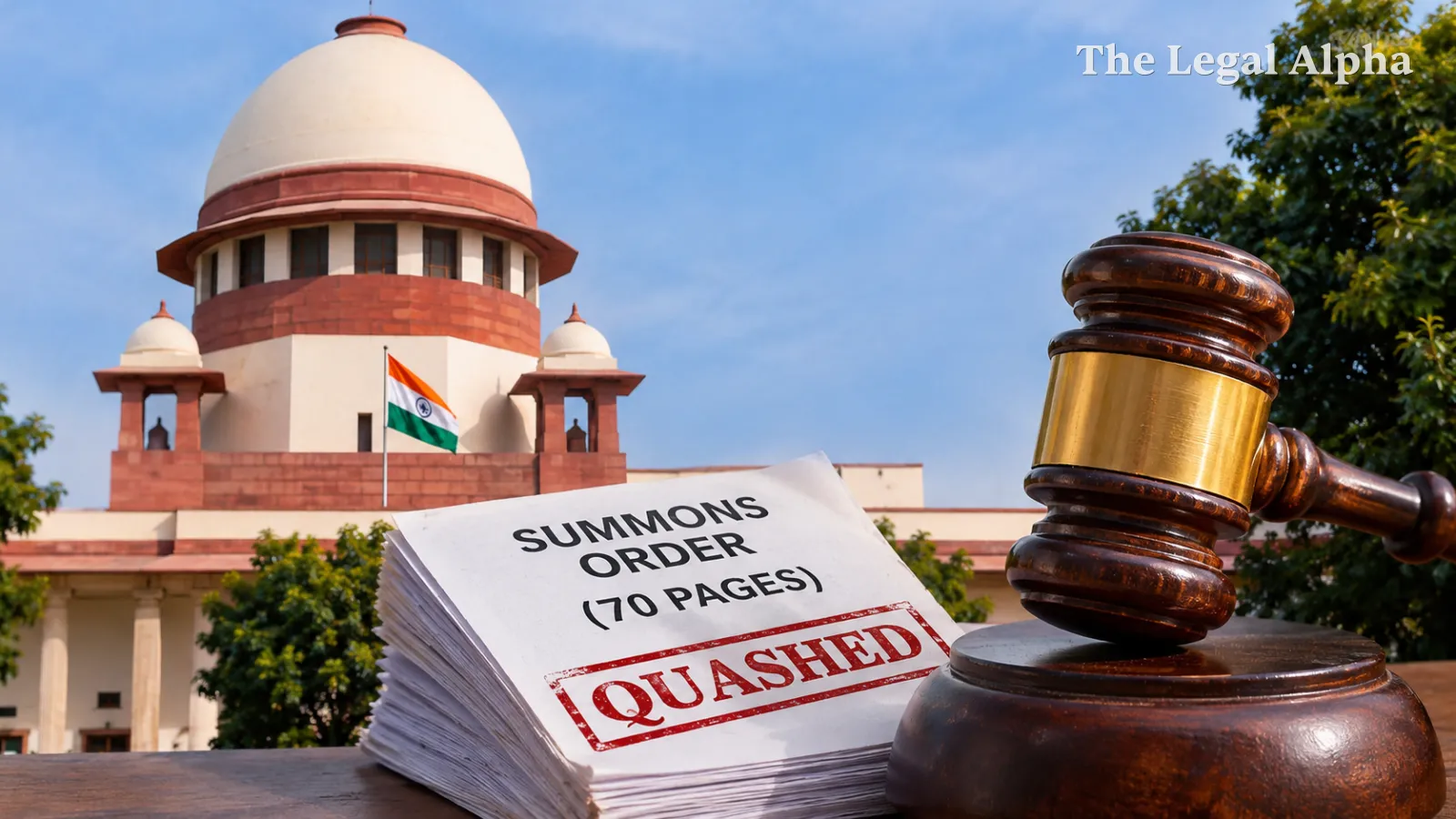
The Supreme Court of India has quashed criminal proceedings against a woman who was summoned to face trial in a murder case despite being exonerated during the police investigation. The Court set aside the order passed by the Chief Judicial Magistrate (CJM), Banda, Uttar Pradesh, holding that the Magistrate had failed to follow the mandatory procedure governing protest petitions under the Code of Criminal Procedure, 1973.
In Deepti Singh v. State of U.P. & Anr., a Bench comprising Justice Prashant Kumar Mishra and Justice Shree Chandrashekhar criticised the Magistrate for passing an elaborate 70-page order without first determining whether the protest petition fulfilled the legal requirements of a complaint.
The judgment was delivered on November 25, 2026.
What Happened in the Banda Murder Case?
The dispute originated from an altercation on June 18, 2022, involving a disagreement over the diversion of drainage water in Banda, Uttar Pradesh. The incident resulted in the death of Abhishek Singh, following which an FIR was registered on June 19, 2022, against Gaurav Singh, his wife Deepti Singh and an unidentified person.
The complainant, Pratima Singh, alleged that Deepti Singh had instigated her husband during the altercation and that the accused had assaulted her brother.
The investigation was subsequently transferred to the Crime Branch, Mahoba. Following the investigation, the police filed a chargesheet against Gaurav Singh for offences under Sections 323, 504 and 506 of the Indian Penal Code, while Deepti Singh was not sent up for trial due to the absence of sufficient evidence establishing her involvement.
Dissatisfied with the investigation and the exclusion of Deepti Singh from the chargesheet, the informant filed a protest petition on December 14, 2023.
On March 25, 2025, the Chief Judicial Magistrate, Banda, passed a 70-page order taking cognizance of several offences and summoning Deepti Singh, her husband, two doctors and multiple police officers.
The Magistrate also referred to various judicial precedents and examined the investigation records, medical opinions and witness statements.
Deepti Singh challenged the order before the Allahabad High Court, but her application seeking quashing of the proceedings was dismissed on February 18, 2026. She subsequently approached the Supreme Court.
Area of Law
Area of Law: Criminal Law
Sub-topic: Criminal Procedure – Cognizance, Protest Petitions and Issuance of Summons
Core Legal Issue
The principal question before the Supreme Court was whether a Magistrate could summon a person who had been exonerated during a police investigation by acting on a protest petition without following the procedure prescribed for complaint cases under Chapter XV of the Code of Criminal Procedure, 1973.
The Court also examined whether merely identifying alleged shortcomings in a police investigation could provide sufficient legal grounds to treat a protest petition as a complaint and initiate criminal proceedings against additional persons.
What Did the Supreme Court Decide?
The Supreme Court allowed Deepti Singh's appeal and set aside both the Allahabad High Court's February 18, 2026 order and the Banda CJM's March 25, 2025 cognizance order insofar as they concerned her.
The Bench held that the Magistrate had committed a serious legal error by issuing summons without determining whether the protest petition satisfied the requirements of a complaint under Section 2(d) of the CrPC.
The Court explained that a protest petition can be treated as a complaint, but it must contain specific allegations against the proposed accused and a list of witnesses. Merely summarising objections to the police investigation does not automatically make a protest petition a complaint.
The Bench further observed that once a Magistrate decides to treat a protest petition as a complaint, the procedure under Chapter XV of the CrPC must be followed before issuing process.
Criticising the length of the order, the Supreme Court observed that writing a 70-page cognizance order was a sheer waste of judicial time. It clarified that an order taking cognizance does not need to be an elaborate or extensively reasoned document.
The Court also held that the Allahabad High Court had failed to examine the procedural irregularities committed by the Magistrate and should have exercised its inherent jurisdiction to correct the illegality.
Consequently, the Supreme Court quashed the entire criminal proceedings against Deepti Singh in Case No. 844/12/2023. The ruling did not determine the criminal liability of the other persons summoned in the proceedings.
Key Legal Points
-
Protest petitions must satisfy complaint requirements: A protest petition must contain specific allegations against the proposed accused and a list of witnesses to qualify as a complaint under Section 2(d) CrPC.
-
Mandatory complaint procedure: When a Magistrate treats a protest petition as a complaint, the procedure under Chapter XV must be followed before issuing summons.
-
Defective investigation does not automatically justify prosecution: Alleged shortcomings in a police investigation cannot independently justify taking cognizance of a complaint that lacks sufficient material.
-
Cognizance orders need not be lengthy: The Supreme Court clarified that taking cognizance involves judicial application of mind and does not require an elaborate order.
-
High Courts must correct procedural illegality: The inherent powers of High Courts must be exercised where subordinate courts act illegally or without jurisdiction.
Relevant Legal Provisions
Section 2(d), Code of Criminal Procedure, 1973: Defines a complaint as an allegation made orally or in writing to a Magistrate, with a view to taking action under the Code, that some person has committed an offence. It excludes a police report.
Section 190(1)(b), CrPC: Empowers a Magistrate to take cognizance of an offence upon receiving a police report containing facts constituting such offence.
Section 200, CrPC: Provides for examination of the complainant and witnesses, if any, on oath when a Magistrate takes cognizance of an offence on a complaint, subject to the statutory exceptions.
Section 202, CrPC: Allows postponement of the issue of process and an inquiry or investigation to determine whether sufficient grounds exist to proceed against the accused. Such an inquiry is mandatory in cases where the accused resides beyond the Magistrate's territorial jurisdiction.
Section 203, CrPC: Empowers the Magistrate to dismiss a complaint where there is insufficient ground for proceeding.
Section 204, CrPC: Governs the issue of summons or warrants against an accused when sufficient grounds exist for proceeding.
Section 528, Bharatiya Nagarik Suraksha Sanhita, 2023: Preserves the inherent powers of the High Court to give effect to orders under the Sanhita, prevent abuse of the process of any court and secure the ends of justice. It corresponds to Section 482 of the CrPC.
Arguments of the Parties
Appellant – Deepti Singh
The appellant argued that the Magistrate had adopted an incorrect procedure while dealing with the protest petition. Her counsel submitted that the Magistrate could not issue summons against her merely by relying on objections to the police investigation without following the procedure prescribed under Chapter XV of the CrPC.
It was further argued that the Magistrate could not use the protest petition as a means to bypass the statutory requirements governing complaint proceedings.
Respondents – State of Uttar Pradesh and Informant
The State and the respondent-informant defended the Magistrate's authority to take cognizance on a police report or a protest petition and relied upon judicial precedents in support of their submissions.
The respondents also contended that the appellant could pursue a discharge application before the trial court and raise her objections at that stage.
The Supreme Court rejected the suggestion that the appellant should be relegated to the remedy of discharge, finding that the Magistrate had acted beyond jurisdiction by issuing summons without following the prescribed procedure.
Why Does This Judgment Matter?
The ruling reinforces the importance of procedural safeguards before an individual is summoned to face criminal prosecution.
A person excluded from a police chargesheet is not automatically immune from further proceedings. A Magistrate retains the authority to independently examine the police report and may also entertain a protest petition. However, the exercise of that authority must remain within the framework prescribed by criminal procedure.
The judgment makes an important distinction between a protest petition that merely challenges the quality of an investigation and one that contains the essential elements of a legally valid complaint.
It also serves as a reminder that judicial orders must focus on the legal requirements relevant to the stage of proceedings. Lengthy reasoning and extensive references to precedents cannot substitute for compliance with mandatory statutory safeguards.
For criminal law practitioners, the decision provides important guidance on challenging summoning orders where a Magistrate has treated objections to a police investigation as a complaint without following the prescribed procedure.
Legal Takeaway
A protest petition cannot automatically become a complaint merely because it questions the fairness of a police investigation. If a Magistrate chooses to treat it as a complaint, the statutory safeguards under Chapter XV of the CrPC must be followed before issuing summons. The Supreme Court has reaffirmed that procedural legality, rather than the length of a judicial order, determines the validity of the exercise of judicial power.
Sources
Primary Source:
Supreme Court of India, Deepti Singh v. State of U.P. & Anr., 2026 INSC 1264, judgment dated November 25, 2026.
Additional Sources:
-
Bar & Bench – Report on the Supreme Court's decision.
-
ThePrint – PTI report on the quashing of the Banda CJM's cognizance order.
-
LiveLaw – Report on the legal requirements governing protest petitions.