Supreme Court Asks Centre to Consider Humanitarian Visit for US-Based Professor Whose OCI Status Was Cancelled
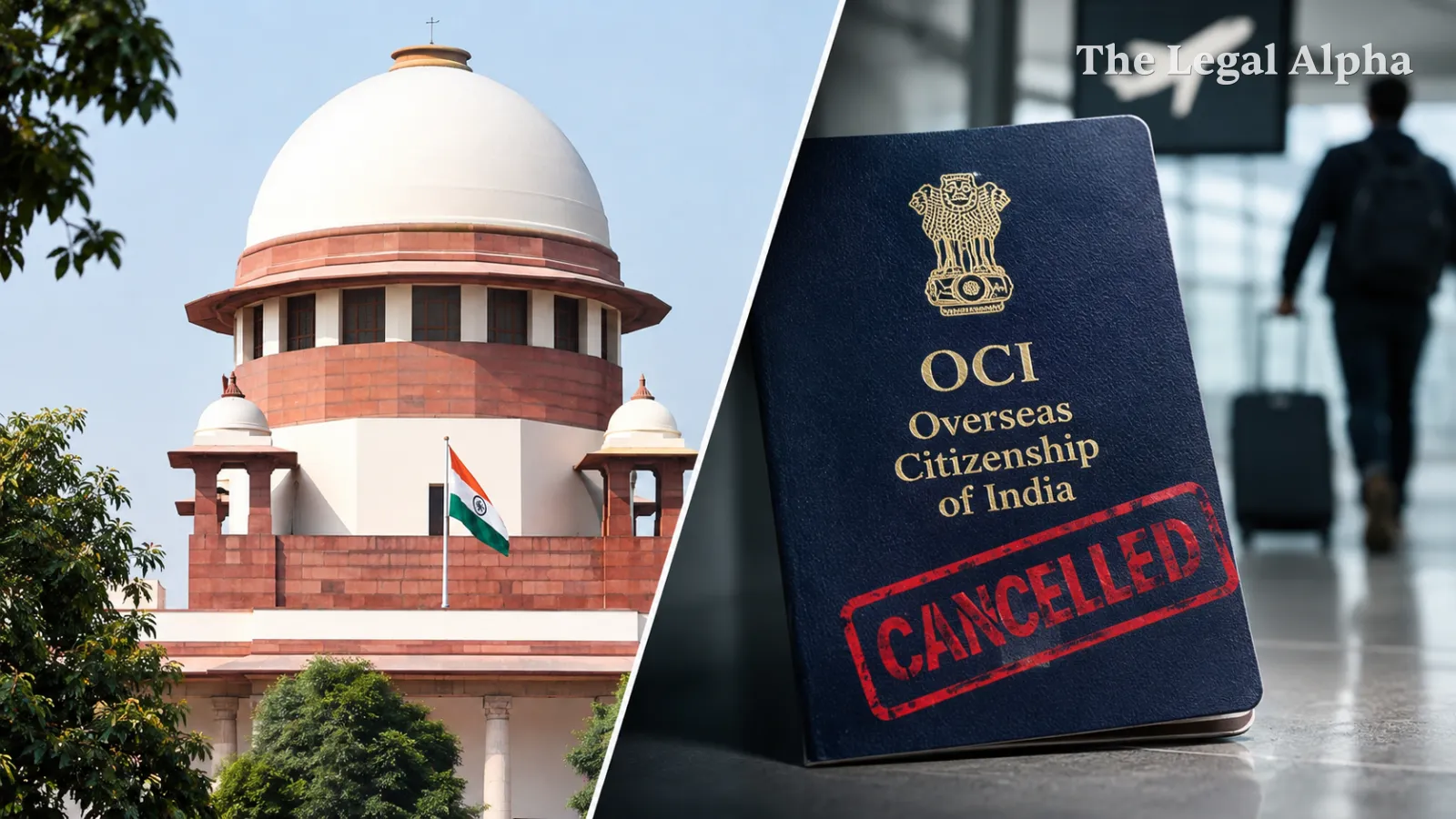
The Supreme Court has asked the Central Government to consider allowing US-based professor Khalid Jahangir Qazi to visit India under strict conditions so that he can meet his sisters. The Court indicated that security concerns could potentially be addressed through restrictions on his movement and mandatory reporting requirements.
The development concerns the balance between national security considerations and humanitarian circumstances, particularly where an elderly person seeks permission to visit family members in India.
Area of Law
Immigration Law and Constitutional Law
Sub-topic
Overseas Citizenship of India (OCI) – Cancellation, Blacklisting and Right to Family Visits
Core Legal Issue
The central issue is whether a foreign-based individual whose OCI registration has been cancelled and who has been blacklisted can be permitted to enter India temporarily under conditions, particularly when the underlying cancellation and blacklisting orders have been challenged successfully before the Delhi High Court.
The case also raises questions about whether security concerns can be addressed through proportionate restrictions instead of an outright denial of entry.
What Did the Supreme Court Observe?
A Bench comprising Justices Joymalya Bagchi and V. Mohana considered the request for temporary permission to enter India.
The Court highlighted the petitioner's advanced age, reportedly above 80 years, and suggested that he could be permitted to visit only the town where his sisters reside.
It also referred to the fact that a single judge of the Delhi High Court had already set aside the orders cancelling his OCI registration and blacklisting him. The Supreme Court questioned the justification for continuing to prevent his entry when the High Court judgment had not been stayed.
However, the Supreme Court did not grant immediate permission to travel. The Centre was asked to obtain instructions on whether entry could be allowed subject to appropriate restrictions. The matter was adjourned for a week.
Arguments of the Parties
Petitioner's Position
Qazi sought permission to enter India to meet his family members. His case relies, among other things, on the fact that the Delhi High Court's single-judge decision setting aside the OCI cancellation and blacklisting orders had not been stayed.
Central Government's Position
Additional Solicitor General S.V. Raju opposed the request, alleging that Qazi had been involved in separatist activities and had links with Pakistan's Inter-Services Intelligence (ISI).
The Centre also argued that the family wedding for which permission had initially been sought had already taken place and expressed concerns that his visit could be used for activities prejudicial to national interests.
These are allegations and submissions made by the government, not findings established by the Supreme Court in the present hearing.
Relevant Legal Provisions
-
Section 7D, Citizenship Act, 1955: Provides grounds on which the Central Government may cancel OCI registration.
-
Citizenship Rules, 2009: Govern matters relating to OCI registration and its cancellation.
-
Section 3, Foreigners Act, 1946: Empowers the Central Government to regulate or restrict the entry, presence and departure of foreigners.
-
Article 226, Constitution of India: Provides the High Courts with writ jurisdiction to examine the legality of governmental action.
The Delhi High Court's November 2024 judgment, reported as 2024:DHC:8754, set aside the relevant cancellation and blacklisting orders and directed the government to follow a fresh notice and decision-making process.
Key Legal Points
-
The Supreme Court has explored whether temporary entry can be permitted subject to reasonable security conditions.
-
The petitioner's advanced age and wish to meet family members formed an important part of the Court's consideration.
-
The Court questioned the continued restriction on entry in light of the Delhi High Court's earlier judgment.
-
The government's national security concerns remain part of the dispute.
-
The proposed temporary arrangement would not determine the merits of the pending litigation.
Why Does It Matter?
The development highlights the difficult balance between national security and individual circumstances in immigration-related disputes.
The case is particularly significant for OCI cardholders because OCI registration does not confer Indian citizenship or an unconditional right of entry into India. At the same time, government restrictions remain subject to applicable statutory requirements and judicial scrutiny.
The Court's suggestion also raises an important practical question: whether carefully designed restrictions, including limits on geographical movement and mandatory reporting, can address security concerns without imposing a complete prohibition on a family visit.
The matter may also have implications for future disputes involving cancellation of OCI registration, blacklisting and temporary entry into India.
Legal Takeaway
The Supreme Court has not granted Qazi permission to enter India yet. It has asked the Centre to consider a restricted visit on humanitarian grounds while keeping the underlying legal dispute open.
Sources
Primary Sources:
Additional Sources: