Madhya Pradesh High Court: Divorce Decree And Acquittal In Section 498A Case Do Not Automatically Bar Wife From Claiming Maintenance
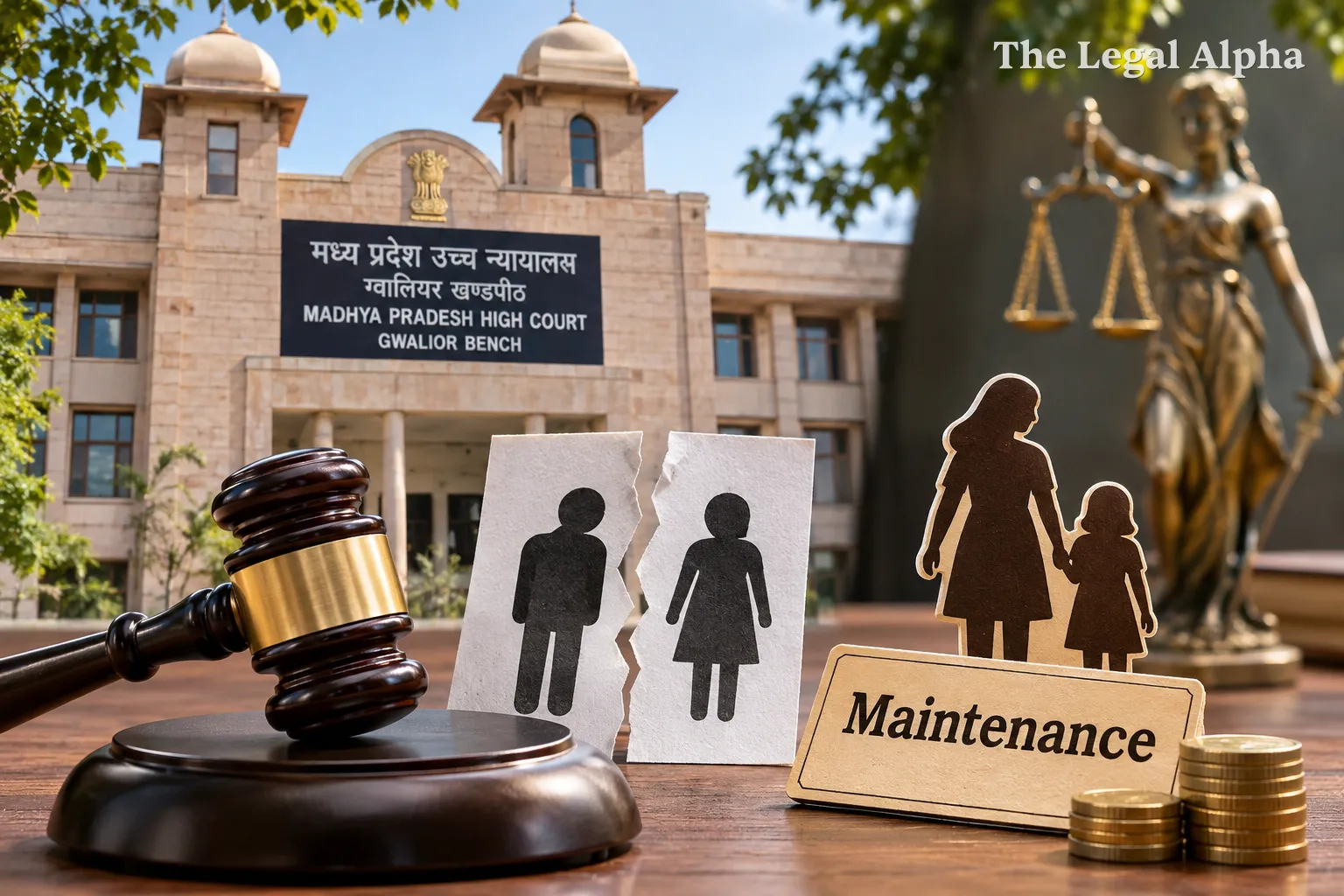
The Madhya Pradesh High Court has reaffirmed that a husband's acquittal in a criminal case under Section 498A of the IPC and a divorce decree granted in his favour do not automatically extinguish his statutory obligation to pay maintenance to his former wife.
In Dr. Sandeep Nahta v. Smt. Deepa @ Jaya Nahta, Justice Pushpendra Yadav held that criminal proceedings and maintenance proceedings operate under different legal standards. The Court observed that an acquittal in a criminal case does not, by itself, establish that the wife has been living separately without sufficient reason.
The Court also clarified that a divorced woman who is unable to maintain herself can continue to claim maintenance under Section 125 of the Code of Criminal Procedure, subject to the applicable legal conditions.
The decision was delivered on October 26, 2026, by the Gwalior Bench of the Madhya Pradesh High Court in Criminal Revision No. 38 of 2024 and the connected revision filed by the wife and daughter.
Area of Law
Area of Law: Family Law
Sub-topic: Maintenance Rights of Divorced Women, Section 125 CrPC and Matrimonial Disputes.
What Happened in the Case?
The dispute arose from a maintenance order passed by the Family Court, Gwalior, on December 4, 2023. The Family Court directed Dr. Sandeep Nahta to pay monthly maintenance of ₹6,000 to his wife, Deepa, and ₹5,000 to their minor daughter, taking the total monthly amount to ₹11,000.
The wife had approached the Family Court claiming that she had no independent source of income and was dependent on her father. She also submitted that her husband, who was employed as a Medical Officer and was running a private clinic, had sufficient financial resources to maintain them.
The husband opposed the claim, arguing that his wife was a qualified dentist earning between ₹40,000 and ₹50,000 per month. He further relied on his acquittal in the Section 498A IPC case and the divorce decree granted in his favour on the ground of cruelty.
The divorce decree had also been affirmed by a Division Bench of the High Court, which awarded permanent alimony of ₹15 lakh in favour of the wife and daughter.
Both sides challenged the Family Court's maintenance order before the High Court.
Core Legal Issue
The principal question before the High Court was whether a husband's acquittal in a Section 498A IPC prosecution and a divorce decree granted on the ground of cruelty could, by themselves, disentitle the divorced wife from receiving maintenance under Section 125 CrPC.
The Court also considered whether the wife's professional qualifications, the permanent alimony awarded in the divorce proceedings and the husband's subsequent salary revision justified interference with the existing maintenance arrangement.
What Did the Madhya Pradesh High Court Decide?
The High Court rejected the husband's challenge and upheld the Family Court's maintenance order of ₹11,000 per month.
The Court made several important observations:
Acquittal under Section 498A does not automatically defeat maintenance
The Court explained that a criminal prosecution under Section 498A IPC and proceedings for maintenance under Section 125 CrPC serve different purposes and involve different standards of proof.
An acquittal in a criminal case, which requires proof beyond reasonable doubt, does not automatically establish that the wife had no sufficient reason to live separately.
The Court relied on the principles discussed in Prashant Shrivastava v. Smt. Sushma Shrivastava, as well as earlier decisions concerning the effect of acquittal in matrimonial cruelty cases.
Divorce decree does not end the right to maintenance
The Court rejected the husband's argument that the divorce decree granted in his favour automatically disentitled his former wife from claiming maintenance.
It referred to Section 125(1) CrPC, which expressly includes a divorced woman who has not remarried within the statutory explanation.
The Court observed that a divorced woman who cannot maintain herself does not automatically lose her right to financial support merely because the marriage has legally ended.
Professional qualifications alone are insufficient
The husband contended that his wife was a qualified dentist and was earning a substantial monthly income.
However, the Family Court had found that she was unable to maintain herself. The High Court found no ground to interfere with that finding in the absence of sufficient material establishing the claimed independent income.
Permanent alimony does not automatically conclude the maintenance dispute
The husband also relied on the permanent alimony of ₹15 lakh awarded by the Division Bench.
The wife, however, had challenged that decision before the Supreme Court, where her Special Leave Petition was pending.
The High Court did not accept the permanent alimony award as an automatic ground for terminating the existing maintenance arrangement.
Husband's Salary Revision And Wife's Request For Enhanced Maintenance
During the pendency of the revision proceedings, the wife brought another development to the Court's attention.
She submitted that her husband's salary had increased following the implementation of the Seventh Pay Commission, with effect from January 1, 2017, and that he had also received substantial arrears.
According to her submission, his monthly income had increased from approximately ₹56,000 to more than ₹1 lakh.
The High Court observed that the subsequent salary revision and receipt of arrears could constitute a substantial change in circumstances if properly established.
However, the Court clarified that these subsequent developments could not be examined for the first time in its limited revisional jurisdiction.
Instead, the wife was permitted to approach the Family Court under Section 127 CrPC, corresponding to Section 146 of the Bharatiya Nagarik Suraksha Sanhita, 2023, seeking alteration or enhancement of maintenance.
The wife and daughter were directed to place relevant documents, including salary revision notifications, proof of arrears and the daughter's educational expenses, before the Family Court.
The husband was also permitted to submit his financial documents and objections.
Key Legal Points
- Acquittal is not an automatic bar: An acquittal under Section 498A IPC does not, by itself, establish that a wife has no sufficient reason to live separately or disqualify her from claiming maintenance.
- Divorced women retain statutory protection: A divorced woman who has not remarried and is unable to maintain herself can claim maintenance under Section 125 CrPC, subject to the statutory requirements.
- Different standards of proof apply: Criminal proceedings and summary maintenance proceedings have different purposes and evidentiary standards. An acquittal in one does not automatically determine the outcome of the other.
- Professional qualifications are not proof of income: A wife's educational or professional qualifications alone do not establish that she earns sufficient income to maintain herself.
- Maintenance can be enhanced: A substantial change in the financial circumstances of either party can justify alteration of maintenance under Section 127 CrPC, subject to proof.
Relevant Legal Provisions And Precedents
Section 125, Code of Criminal Procedure, 1973: Provides for maintenance to wives, children and parents who fulfil the statutory requirements. The explanation includes a divorced woman who has not remarried.
Section 127, CrPC: Provides the mechanism for alteration of maintenance upon proof of a change in the circumstances of the person receiving or paying maintenance.
Section 144, Bharatiya Nagarik Suraksha Sanhita, 2023: Corresponding provision governing maintenance of wives, children and parents under the new criminal procedure framework.
Section 146, BNSS: Provides for alteration of maintenance allowances in the event of a change in circumstances.
Section 498A, Indian Penal Code: Deals with cruelty by a husband or his relatives towards a married woman.
Captain Ramesh Chander Kaushal v. Mrs. Veena Kaushal (1978): The Supreme Court recognised the social justice objective underlying maintenance provisions and the right of a wife to maintenance.
Prashant Shrivastava v. Smt. Sushma Shrivastava: Relied upon by the High Court while considering the effect of acquittal in a Section 498A IPC prosecution on a wife's maintenance claim.
Arguments Presented By The Parties
Husband's Arguments
The husband argued that his wife had left the matrimonial home voluntarily and was earning independently as a qualified dentist.
He further submitted that the acquittal in the Section 498A IPC case and the divorce decree granted on the ground of cruelty demonstrated that she was not entitled to maintenance.
He also relied on the permanent alimony of ₹15 lakh awarded by the Division Bench and contended that the existing maintenance order should not continue.
Wife And Daughter's Arguments
The wife and daughter argued that the monthly maintenance of ₹11,000 was inadequate considering the husband's financial capacity and their needs.
They submitted that there was no reliable evidence establishing that the wife was earning independently.
They also pointed out that the daughter's educational expenses had increased and that the husband's salary had subsequently risen following the Seventh Pay Commission revision.
The wife further argued that her challenge to the permanent alimony award was pending before the Supreme Court.
Why Does This Judgment Matter?
The judgment is significant because it distinguishes between the consequences of criminal proceedings, divorce proceedings and independent maintenance claims.
A husband's acquittal in a matrimonial cruelty case does not automatically establish that the wife was unjustified in living separately. Similarly, obtaining a divorce decree does not necessarily bring an end to the statutory responsibility to maintain a former wife who fulfils the conditions under Section 125 CrPC.
The decision also highlights that courts must examine the actual financial circumstances of the parties rather than relying solely on educational qualifications or professional status.
Importantly, the ruling provides clarity on the appropriate legal remedy when a paying spouse's income increases after a maintenance order has already been passed. Such subsequent changes can be examined by the competent Family Court through an application for alteration of maintenance.
Final Decision Of The High Court
The Madhya Pradesh High Court dismissed the husband's Criminal Revision No. 38 of 2024 and upheld the Family Court's maintenance order.
The connected revision filed by the wife and daughter was disposed of with liberty to seek enhancement of maintenance before the Family Court under Section 127 CrPC.
Until the Family Court decides any such application, the husband must continue paying the existing monthly maintenance of ₹11,000.
The Court directed both parties to cooperate in the proceedings before the Family Court.
Legal Takeaway
A divorce decree or acquittal under Section 498A IPC does not automatically extinguish a divorced woman's statutory right to maintenance. Courts must independently examine her ability to maintain herself and the financial circumstances of the parties. A subsequent increase in the husband's income can also provide grounds for seeking enhancement through the appropriate statutory procedure.
Sources
Primary Source: Madhya Pradesh High Court judgment in Dr. Sandeep Nahta v. Smt. Deepa @ Jaya Nahta, Neutral Citation: 2026:MPHC-GWL:33362, dated October 26, 2026.
Read the High Court judgment (PDF).
Additional Sources: