Bombay High Court Calls For Hassle-Free Banking Services For Senior Citizens, Says Courts Should Be The Last Resort
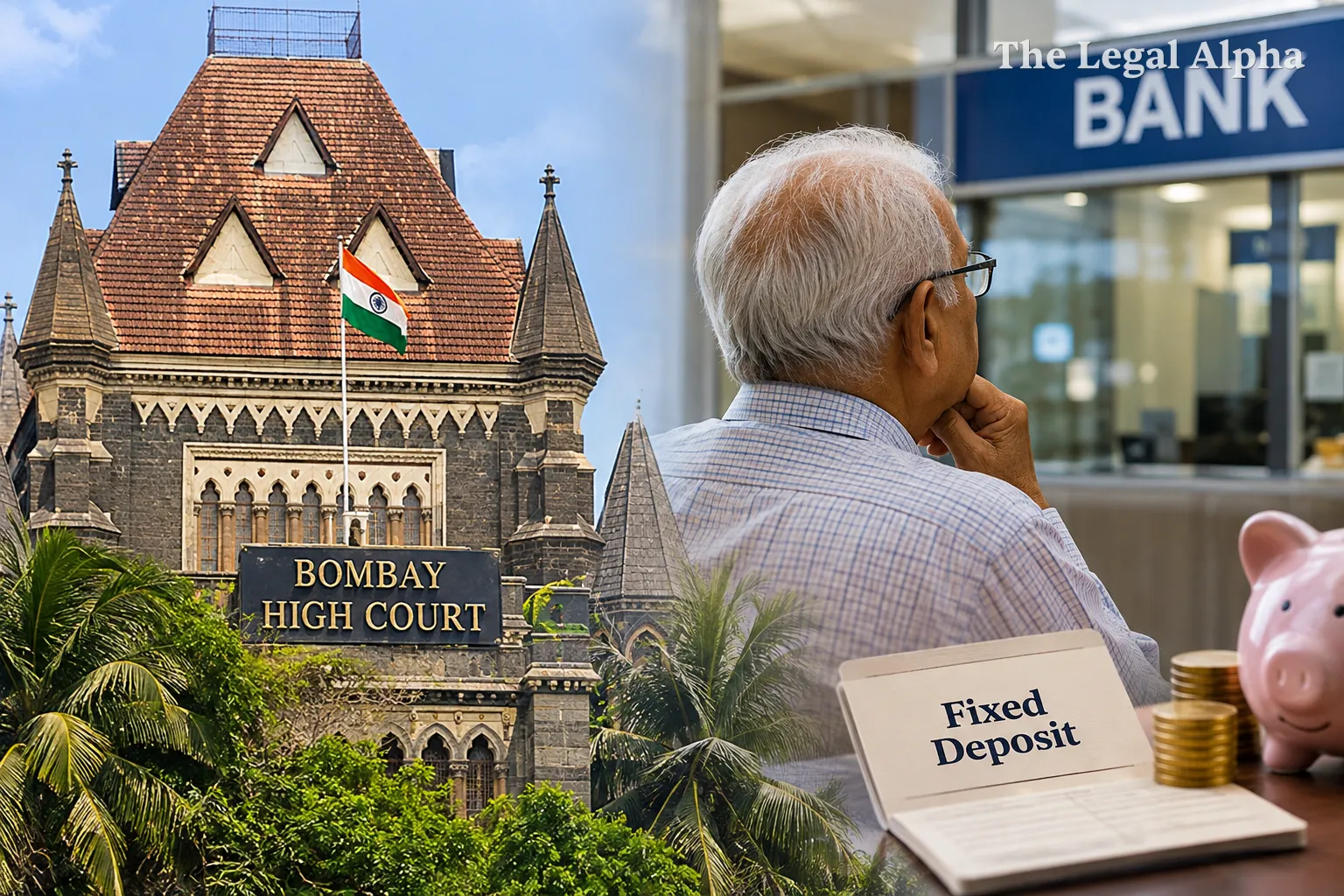
The Bombay High Court has emphasised that banks and financial institutions must adopt a more humane, accountable and customer-friendly approach while dealing with senior citizens, particularly when disputes concern their hard-earned savings.
The observations came while hearing a petition filed by an 80-year-old former Bank of Baroda employee, who challenged the closure of his complaint by the RBI Ombudsman concerning substantial deductions from his fixed deposits. The dispute was ultimately resolved after the bank agreed to pay him ₹1,47,67,508 in full and final settlement.
What Happened?
The petitioner, Ashwin Shantilal Khandwala, an 80-year-old former employee and customer of Bank of Baroda, approached the Bombay High Court under Article 226 of the Constitution after the bank deducted a total of ₹1,20,19,948 from his fixed deposit accounts.
The deductions included ₹89,01,253 from the principal amount and another ₹31,18,695 from interest accrued until maturity.
The petitioner had initially approached the RBI Ombudsman. However, his complaint was closed as non-maintainable on the ground that the dispute arose out of an employer-employee relationship.
Aggrieved by this decision, he approached the High Court seeking judicial intervention.
Legal Topic
Area of Law: Banking and Financial Law
Sub-topic: Banking Ombudsman Scheme, Fixed Deposit Disputes and Consumer Protection for Senior Citizens.
Core Legal Issue
The central issue before the High Court was whether the RBI Ombudsman's decision to close the petitioner's complaint as non-maintainable warranted judicial interference, particularly when the dispute involved substantial deductions from the fixed deposits of a retired bank employee.
The proceedings also raised broader concerns regarding the responsibility of banking institutions towards senior citizens and whether avoidable procedural difficulties should force elderly customers to seek relief through prolonged litigation.
What Did the Court Decide?
During the proceedings, Bank of Baroda maintained that the petitioner had received an additional one per cent interest benefit meant exclusively for retired employees because of a clerical oversight.
However, the High Court expressed prima facie reservations about this explanation. The available record indicated that the additional interest benefit had been extended to the petitioner since 2011 after his eligibility was verified.
Following further hearings, the bank submitted a settlement proposal of ₹1,47,67,508, comprising the deducted amount of ₹1,20,19,948 and ₹27,47,560 towards interest calculated at 10.55 per cent per annum for 26 months.
The bank subsequently transferred the settlement amount, after deduction of tax at source, to the petitioner's account. The petitioner accepted the settlement, following which the High Court disposed of the petition.
Important Observations By The High Court
Courts Should Be The Last Resort For Senior Citizens
The Bench of Chief Justice Mahesh Chandra Tripathi and Justice Advait M. Sethna observed that senior citizens should not repeatedly be compelled to approach courts to resolve banking difficulties that financial institutions could address internally.
The Court particularly highlighted problems involving KYC compliance and other banking procedures that often place unnecessary burdens on elderly customers.
Banks Must Adopt A Humane And Accountable Approach
The Court stressed that banks must deal with senior citizens through practical and humane solutions while remaining within the framework of law.
It further observed that responsibility and accountability must become an essential part of the institutional culture of banks and financial institutions.
Hassle-Free Banking Is Essential For Vulnerable Customers
The Bench connected accessible banking services with the broader vision of Viksit Bharat, emphasising that senior citizens and vulnerable sections must be able to access financial services without unnecessary procedural obstacles.
Key Legal Points
-
Article 226 of the Constitution provides the High Court with writ jurisdiction to examine challenges to decisions of public authorities.
-
The RBI Integrated Ombudsman Scheme, 2021 was invoked to close the petitioner's complaint as non-maintainable.
-
The Court expressed prima facie reservations about the bank's justification for deducting the additional interest benefit.
-
Bank of Baroda ultimately agreed to pay ₹1,47,67,508 as full and final settlement.
-
The High Court clarified that its decision, given the peculiar facts, should not be cited as a precedent as a matter of course.
Relevant Law
Constitution of India
- Article 226 – Power of High Courts to issue writs and directions.
Reserve Bank – Integrated Ombudsman Scheme, 2021
-
Clause 10(1)(h) – Relevant exclusion concerning disputes arising out of an employee-employer relationship.
-
Clause 16(1)(a) – Provision invoked in closing the petitioner's complaint as non-maintainable.
Arguments Of The Parties
Petitioner's Arguments
The petitioner challenged the RBI Ombudsman's decision to close his complaint and contended that Bank of Baroda had unjustifiably deducted ₹1,20,19,948 from his fixed deposits.
His case also relied on the fact that the additional one per cent interest benefit had been extended after verification of his eligibility.
Bank of Baroda's Position
The bank maintained that the additional one per cent interest benefit had been extended due to a clerical oversight, although the High Court expressed prima facie reservations about this explanation.
The bank subsequently offered a settlement of ₹1,47,67,508, which the petitioner accepted.
RBI And RBI Ombudsman's Position
The RBI Ombudsman had closed the complaint on the ground that the dispute involved an employer-employee relationship. The petition challenged that decision.
Why Does It Matter?
The observations are significant for banks and financial institutions dealing with elderly customers, particularly retired employees and long-standing account holders.
Senior citizens often depend on their lifetime savings and fixed deposits for financial security. Unexplained deductions, complicated KYC procedures and prolonged grievance redressal processes can create considerable difficulties for them.
The High Court's observations reinforce the importance of institutional accountability, timely grievance resolution and accessible banking services.
However, the Court expressly clarified that the decision should not be treated as a precedent as a matter of course. Its observations must therefore be understood in the context of the particular dispute rather than as a new binding legal rule governing every banking transaction.
Legal Takeaway
Banks and financial institutions must handle the financial concerns of senior citizens with responsibility, transparency and sensitivity. The Bombay High Court has emphasised that avoidable banking difficulties should not force elderly customers into prolonged litigation to protect their hard-earned savings.
Sources
Primary Source: Ashwin Shantilal Khandwala v. The Reserve Bank of India & Ors., Writ Petition No. 3669 of 2025, Bombay High Court, decided on 26 November 2026.
Read the Bombay High Court judgment (PDF).
Additional Source: Verdictum – Report on the Bombay High Court decision.