Supreme Court Allows Border Barrier Construction in Big Bend Sector While Environmental Challenge Continues
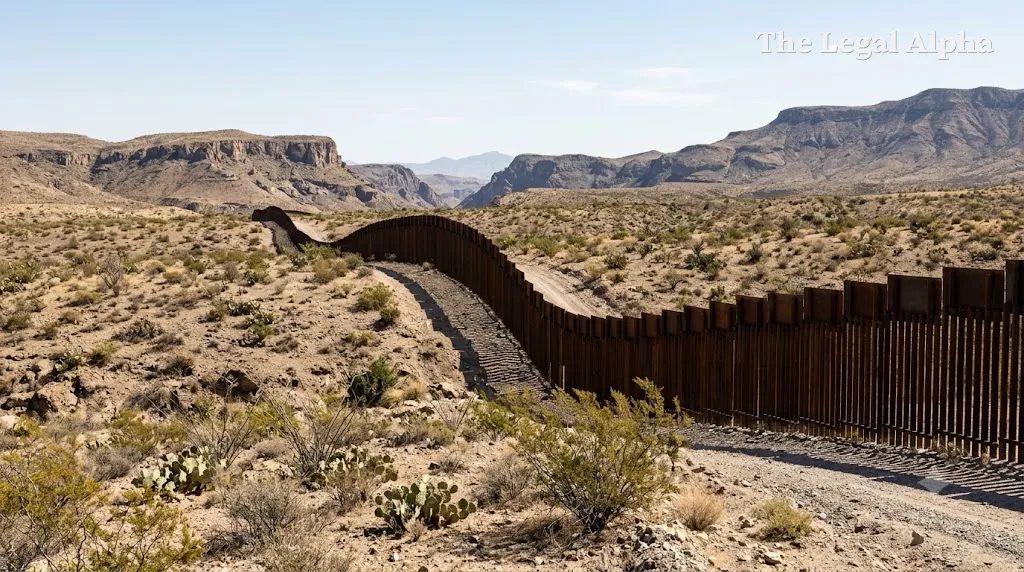
The United States Supreme Court lifted a federal district court injunction that had halted border barrier and road construction across more than 300 miles in the Big Bend region of West Texas, which includes sensitive terrain adjacent to Big Bend National Park.
On November 9, 2026, the Court granted an emergency application filed by the federal government seeking to stay an order issued in October by U.S. District Judge Kathleen Cardone of the Western District of Texas. Judge Cardone had previously blocked construction on the grounds that the Department of Homeland Security (DHS) lacked statutory authority to waive dozens of federal environmental and conservation statutes. By an 8–1 margin, the Supreme Court permitted construction to resume while appeals and further litigation continue.
Legal Topic
Area of Law: Administrative Law / Federal Courts Jurisdiction
Sub-topic: Statutory Environmental Waivers and Judicial Review Bars
Core Legal Issue
The dispute centers on whether federal district courts possess subject-matter jurisdiction under Section 102(c) of the Illegal Immigration Reform and Immigrant Responsibility Act of 1996 (IIRIRA) to hear claims alleging that the Secretary of Homeland Security acted ultra vires—or exceeded statutory authority—under the guise of the "major questions doctrine".
Under IIRIRA, Congress restricted judicial oversight over border barrier waiver determinations exclusively to claims "alleging a violation of the Constitution of the United States". The central legal question before the Supreme Court was whether a claim asserting that an administrative agency exceeded its delegated powers without explicit congressional authorization constitutes a genuine constitutional claim, or merely an ordinary statutory challenge outside the district court's jurisdiction.
What Did the Court Decide?
The Supreme Court granted the government’s emergency application for a stay of the preliminary injunction. In its per curiam order, the Court held that the government is exceedingly likely to prevail on its argument that the district court lacked jurisdiction to adjudicate the plaintiffs' claims.
The Court clarified that repackaging a statutory claim under the "major questions doctrine" does not convert an alleged overreach of statutory authority into a constitutional violation. The justices noted that the stay will remain in effect pending the timely filing and disposition of the federal government's petition for a writ of certiorari. If certiorari is denied, the stay terminates; if granted, the stay extends until the issuance of the Court’s final judgment. The ruling does not resolve the entire case on the merits, but allows physical construction activities to proceed in the interim. Justice Ketanji Brown Jackson noted her dissent without a separate opinion.
Key Legal Points
-
Jurisdictional Bar under IIRIRA: Section 102(c) strictly limits federal district court jurisdiction solely to claims alleging direct violations of the U.S. Constitution, precluding review of routine administrative and statutory claims.
-
Classification of Major Questions Claims: The Court reiterated that an allegation that an agency acted without clear congressional authorization is an inquiry into statutory authority, and there is no independent "constitutional" major questions cause of action to bypass statutory jurisdiction-stripping provisions.
-
Precedential Continuity on Ultra Vires Claims: Relying on established precedent, the Court emphasized that claims asserting an executive officer exceeded delegated statutory powers are not transformed into constitutional claims simply because the Separation of Powers is implicated.
-
Equitable Balancing and Public Interest: The Court weighed unrecoverable financial outlays associated with paused federal contracts—reported at roughly $500,000 per day—alongside compelling federal interests in border security against plaintiffs' recreational and environmental claims.
Relevant Law
-
Illegal Immigration Reform and Immigrant Responsibility Act of 1996 (IIRIRA), § 102(c) (8 U.S.C. § 1103 note): Grants the Secretary of Homeland Security the authority to waive all legal requirements necessary to expedite border barrier construction and strictly confines judicial review to direct constitutional challenges.
-
Dalton v. Specter, 511 U.S. 462 (1994): Supreme Court precedent establishing that claims alleging the executive branch exceeded its statutory authority are fundamentally statutory, not constitutional.
-
Administrative Procedure Act (APA), 5 U.S.C. §§ 701–706: The general statutory framework for reviewing agency actions, which is superseded where Congress explicitly strips or channels judicial review.
-
Major Questions Doctrine: An administrative law interpretive cannon requiring clear congressional authorization when an administrative agency asserts regulatory power over matters of vast economic and political significance.
Arguments of the Parties
Petitioner (Federal Government):
The government argued that the district court had no jurisdiction to issue an injunction because Congress explicitly eliminated non-constitutional judicial review of Section 102 waiver determinations. The Solicitor General maintained that the plaintiffs' challenge was rooted purely in statutory interpretation—whether the Secretary possessed statutory authority to issue broad waivers in the Big Bend Sector—rather than an actionable constitutional infringement. Additionally, the government submitted that ongoing delays in wall construction harmed national security interests and cost the public hundreds of thousands of dollars each day in idle contractor costs.
Respondents (Center for Biological Diversity, Friends of the Ruidosa Church, et al.):
The plaintiffs argued that the sweeping waiver of federal environmental, historical, and conservation statutes—including the Endangered Species Act and National Park Service Organic Act—invoked extraordinary power lacking clear congressional approval. They contended that the major questions doctrine applies directly to enforce constitutional non-delegation and Separation of Powers principles, making their lawsuit an eligible constitutional claim under Section 102(c). They also submitted that physical excavation, road construction, and fence erection would cause irreversible harm to pristine desert ecology and historic community sites before the courts could address the merits.
Why Does It Matter?
This stay demonstrates the high procedural and jurisdictional bar challengers face when disputing federal infrastructure projects executed under broad statutory waiver mandates. By reiterating that the major questions doctrine cannot simply be labeled a "constitutional" violation to escape statutory jurisdiction-stripping clauses, the Supreme Court narrowed an emerging legal pathway frequently used by environmental and administrative litigants.
For public interest organizations, land trusts, and local communities, the order means that halting projects during early-stage litigation will remain exceedingly difficult where Congress has restricted judicial review. As long as the statutory waiver authority remains intact, federal agencies enjoy substantial leeway to expedite designated border security infrastructure over conflicting federal conservation statutes.
Legal Takeaway
A claim asserting that an administrative agency exceeded its statutory mandate under the major questions doctrine is a statutory issue, not a constitutional violation. Where Congress explicitly limits judicial review solely to constitutional claims, federal courts lack jurisdiction to enjoin agency action under that doctrine.
Sources
Primary Source:
Mullin v. Friends of the Ruidosa Church, No. 26A560, 610 U.S. ___ (2026) (Per Curiam Order Granting Stay).
Additional Sources:
-
Illegal Immigration Reform and Immigrant Responsibility Act of 1996 (IIRIRA), Section 102, 8 U.S.C. § 1103 note.
-
Dalton v. Specter, 511 U.S. 462 (1994).
-
Memorandum Opinion and Order in Friends of the Ruidosa Church v. Mullin, No. 3:26-cv-01099 (W.D. Tex. Oct. 2, 2026).