Supreme Court Weighs Asset Attachment and Auction to Plug Funding Gaps in Amrapali Housing Projects
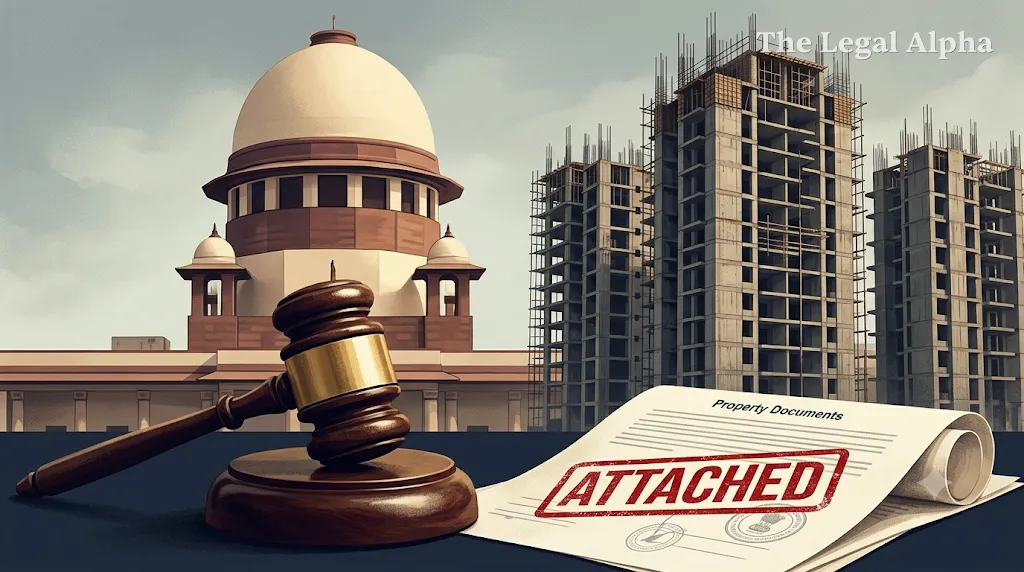
The Supreme Court of India indicated on November 16, 2026, that it may order the attachment and public auction of properties belonging to the promoters and builders of the Amrapali Group to recover funds owed to thousands of pending homebuyers.
A Division Bench comprising Justices J.B. Pardiwala and K. Vinod Chandran took up the long-running real estate dispute and sought comprehensive status reports from key stakeholders overseeing the stalled projects. These include the National Buildings Construction Corporation (NBCC), Attorney General for India R. Venkataramani (serving as the court-appointed receiver), the Enforcement Directorate (ED), and the New Okhla Industrial Development Authority (NOIDA).
The development is significant because, despite the Supreme Court’s landmark 2019 intervention that cancelled Amrapali’s RERA registration and handed construction over to the NBCC, thousands of homebuyers are still waiting for their flats, and massive sums of allegedly diverted buyer funds remain unrecovered.
Legal Topic
Area of Law: Real Estate and Property Law / Corporate Insolvency
Sub-topic: Execution of Judicial Orders, Asset Attachment, and Homebuyer Protection
Core Legal Issue
The central legal issue before the Supreme Court is how to effectively enforce its earlier restitution and project-completion mandates when court-appointed agencies face liquidity shortfalls caused by unrecovered, diverted promoter funds. Specifically, the Court is examining the scope of its continuing mandamus and execution powers to attach and liquidate personal and corporate assets of defaulting real estate promoters to bridge the funding gap required to deliver possession to genuine homebuyers.
What Did the Court Decide?
During the November 16 hearing, the Supreme Court did not pass a final attachment order, keeping the formal directive open for consideration at the next hearing. However, the Bench issued clear procedural directions and made notable observations:
-
Exchange of Status Notes: The Court directed the NBCC, the Court Receiver (Attorney General R. Venkataramani), the Enforcement Directorate, and the NOIDA authorities to file detailed notes outlining the steps taken so far to finish pending construction, trace diverted funds, and hand over flats. Parties were instructed to exchange these notes at least one week prior to the next hearing.
-
Scrutiny of Criminal Probes: The Bench questioned the Enforcement Directorate on the status of ongoing money laundering investigations and inquired about the progress of Economic Offences Wing (EOW) chargesheets and related criminal trials.
-
Verification of Genuine Buyers: The Court emphasized the need to scrutinize claims and weed out dubious or fraudulent buyers who may be attempting to exploit the court-monitored resolution process.
-
Continuity of the Court Receiver: When Attorney General R. Venkataramani expressed frustration over administrative hurdles and sought to step down as court receiver, the Bench declined his request, urging him to continue in the role to see the homebuyers' relief through.
-
Next Steps: The matter is scheduled for further hearing on December 7, 2026, when the Bench will formally consider the homebuyers' plea for attaching and auctioning the builders' properties.
Key Legal Points
-
Continuing Mandamus in Mass Consumer Disputes: The Supreme Court is exercising ongoing supervisory jurisdiction to ensure its July 2019 judgment is not reduced to a paper decree, actively monitoring both construction progress and financial recovery.
-
Piercing the Corporate Veil for Restitution: By signaling the attachment and auction of promoter and builder assets, the Court is reinforcing the principle that developers cannot shield diverted homebuyer funds behind corporate structures.
-
Distinguishing Genuine Claims from Speculative Transactions: Judicial protection in mass real estate defaults is strictly reserved for bona fide homebuyers; courts will actively direct receivers and agencies to filter out collusive or dubious allotments.
-
Coordination Between Civil Recovery and Criminal Enforcement: The Bench’s simultaneous questioning of the NBCC, NOIDA, and the ED highlights that effective homebuyer relief requires synchronizing civil asset liquidation with criminal asset-tracing mechanisms.
Relevant Law
-
Constitution of India, Article 32 and Article 142: Invoked by the Supreme Court in the Amrapali litigation to protect the fundamental rights of homebuyers and pass orders necessary for doing complete justice.
-
Real Estate (Regulation and Development) Act, 2016 (RERA): Governs promoter obligations, prohibition on fund diversion, and registration revocation (under which Amrapali’s registrations were originally cancelled in 2019).
-
Prevention of Money Laundering Act, 2002 (PMLA): Relevant to the Enforcement Directorate’s ongoing investigation and attachment proceedings regarding funds siphoned off by the Amrapali Group.
-
Code of Civil Procedure, 1908 (Order XXI / Order XL): Provides the foundational legal framework governing the appointment of court receivers and the attachment and sale of properties in execution of decrees.
-
Bikram Chatterji & Ors. v. Union of India & Ors. (2019): The landmark Supreme Court judgment in the Amrapali case that cancelled the group's leases, appointed the NBCC to complete stalled projects, and designated the court receiver to manage and monetize assets.
Arguments of the Parties
Homebuyers (Petitioners):
The homebuyers submitted that despite waiting for over a decade and years of court-monitored intervention, thousands of families have still not received possession of their flats. They contended that investigating agencies have failed to act swiftly enough to recover thousands of crores diverted by the promoters, and urged the Court to attach and auction the builders' properties to generate immediate funds for completing the remaining projects.
Court Receiver and State Agencies (Respondents / Stakeholders):
The Attorney General, appearing as the Court Receiver, apprised the Bench of the ground-level administrative difficulties in managing the resolution process and noted that while thousands of units have been completed, roughly 7,000 to 10,900 homebuyers are still awaiting possession, with several buyers yet to come forward to register or deposit balance dues. Counsel for the Enforcement Directorate submitted that investigations into the diverted funds are actively ongoing.
Why Does It Matter?
The Amrapali litigation remains India’s most prominent judicial blueprint for resolving large-scale real estate defaults outside traditional insolvency proceedings. For thousands of middle-class families in Noida and Greater Noida, project completion depends directly on the Court Receiver’s ability to raise capital by liquidating attached assets. Beyond this immediate dispute, the Supreme Court’s willingness to personally pursue and auction promoter assets sends a strong deterrent signal across the Indian real estate sector: regulatory delays or prolonged litigation will not insulate defaulting developers from financial restitution. At the same time, the Court's insistence on weeding out dubious claims sets an important compliance standard for verifying end-user rights in distressed housing projects.
Legal Takeaway
A court judgment awarding relief to homebuyers is only as effective as its execution on the ground. By signaling the attachment and auction of promoter properties and demanding coordinated accountability from investigating and development agencies, the Supreme Court has made clear that diverted homebuyer funds will be recovered directly from the builders' assets to finish stalled homes.
Sources
Primary Source:
Supreme Court of India Proceedings in Bikram Chatterji & Ors. v. Union of India & Ors. (Order/Hearing dated November 16, 2026, before Justices J.B. Pardiwala and K. Vinod Chandran).
Additional Sources:
-
ANI News Report: "SC signals attachment, auction of Amrapali builders’ properties to recover homebuyers’ money" (November 16, 2026)
-
Hindustan Times Report: "SC seeks plan to hand over Amrapali flats" (November 17, 2026)
-
The Statesman Report: "Supreme Court signals attachment, auction of Amrapali builders' properties to recover funds for homebuyers" (November 16, 2026)