Madras High Court Demands Statewide Data and Technological Audit from Tamil Nadu Police Over Stalled Missing-Person Probes
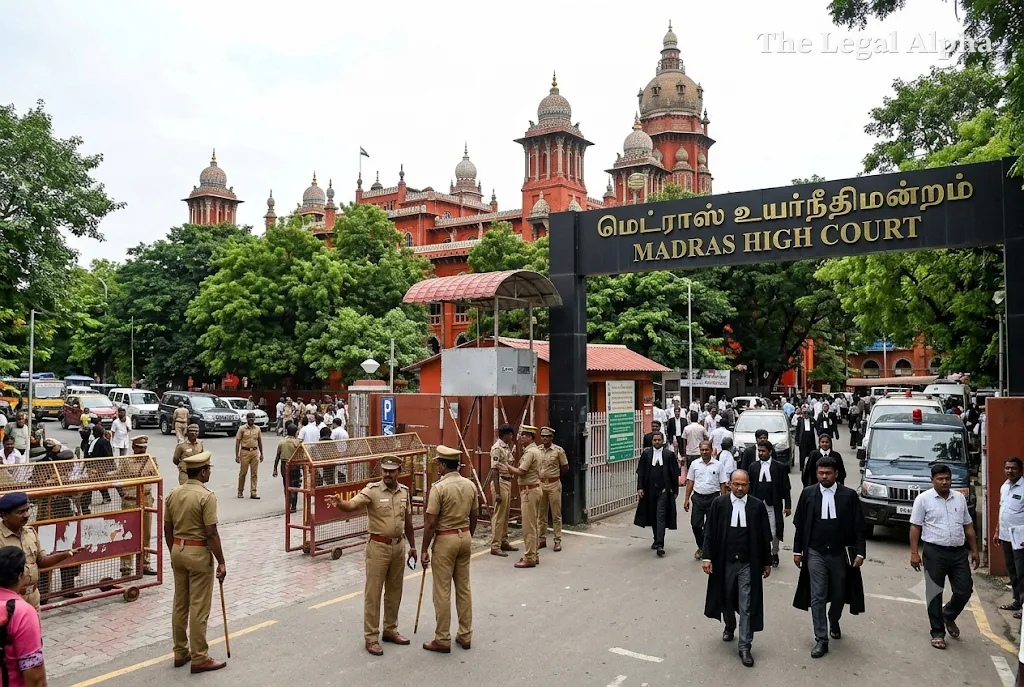
The Madras High Court has expressed strong dissatisfaction with the Tamil Nadu Police for failing to conduct serious and effective investigations into missing-person complaints across the state. Hearing a habeas corpus petition filed by a woman whose husband has been missing since September 2021, a Division Bench comprising Justice A.D. Jagadish Chandira and Justice B. Karthikeyan ordered the state's Director General of Police (DGP) to submit a comprehensive, district-wise report on all pending and resolved missing-person cases within three weeks.
The court’s intervention stems from a petition moved by T. Bhuvaneshwari, a resident of Kallakurichi district, seeking directions to locate and produce her 38-year-old husband, Sankararaj. According to the petitioner, her husband disappeared in September 2021 after travelling to Keezhaiyur village at the invitation of his father, N. Ponnan, and brother, P. Sivaprakasam, where he was allegedly assaulted prior to going missing. Despite a formal complaint being registered with local police in 2021, the petitioner contended that investigators had taken no meaningful action over the past five years.
The bench noted that merely registering a "man-missing" First Information Report (FIR) does not fulfill the statutory and constitutional duties of law enforcement. Questioning whether Tamil Nadu authorities are utilizing modern artificial intelligence (AI) and digital tracking applications adopted by police forces in other states, the High Court expanded the scope of the individual petition to demand statewide accountability.
Legal Topic
-
Area of Law: Constitutional Law / Criminal Procedure
-
Sub-topic: Writ of Habeas Corpus / Police Accountability and Investigation Standards
Core Legal Issue
The central legal question before the Madras High Court is whether the mere registration of a missing-person complaint satisfies the legal obligation of an investigating agency, or whether state police forces are bound to demonstrate active, diligent, and technologically updated investigative efforts to protect an individual’s fundamental right to life and personal liberty.
Additionally, the court is examining when prolonged inaction and lack of investigative seriousness by local police warrant judicial oversight of statewide policing standards or the transfer of an individual probe to a specialized agency like the Crime Branch-Criminal Investigation Department (CB-CID).
What Did the Court / Authority Decide?
The Division Bench issued a set of interim directions aimed at both the specific disappearance case and systemic policing practices across Tamil Nadu, while keeping the main habeas corpus petition pending for further review:
-
Statewide District-Wise Data: The DGP has been directed to file a consolidated, district-wise status report within three weeks detailing the total number of missing-person cases registered, how many individuals have been traced and reunited with their families, the number of cases still under investigation, how many persons remain untraced, and the duration for which these cases have remained pending.
-
Audit of Technological Tools: The DGP must explain the specific institutional measures and modern technological tools—including artificial intelligence applications—currently deployed by the Tamil Nadu Police to locate missing persons.
-
Case-Specific Status Report: The Deputy Superintendent of Police (DSP), Tirukoilur, has been ordered to file a detailed report outlining the exact investigative steps taken thus far to trace Sankararaj.
-
Pending Relief: The petitioner’s primary request to transfer the investigation to the CB-CID and secure the production of her husband remains pending, awaiting compliance with the court's interim reporting directives.
Key Legal Points
-
Registration Is Not Compliance: Recording a "man-missing" complaint is only the procedural starting point; investigating agencies have a continuing legal duty to make every possible effort to trace the missing individual.
-
Judicial Scrutiny of Investigative Quality: Courts hearing habeas corpus petitions are not restricted to checking whether detention is illegal; they can actively scrutinize whether police investigations are being conducted with due seriousness and diligence.
-
Modernization of Policing: The bench highlighted the availability of artificial intelligence applications and advanced tracking tools used in other jurisdictions, signaling that state police forces are expected to keep pace with available investigative technologies.
-
Systemic Oversight via Individual Writs: When an individual petition reveals a recurring pattern of administrative lethargy—despite repeated judicial directives in past cases—a High Court may call for statewide data to evaluate institutional compliance.
Relevant Law
-
Article 226 of the Constitution of India: Empowers High Courts to issue writs, including the writ of habeas corpus, to enforce fundamental rights and compel public authorities to perform their legal duties.
-
Article 21 of the Constitution of India: Guarantees the fundamental right to life and personal liberty, which encompasses the state's obligation to investigate disappearances and protect citizens from unlawful confinement or harm.
-
Bharatiya Nagarik Suraksha Sanhita, 2023 (BNSS) / Code of Criminal Procedure, 1973 (CrPC): Governs the statutory powers and duties of police officers to register information, conduct inquiries, and investigate cognizable offenses or suspicious disappearances (specifically provisions relating to police investigation procedures, such as Sections 173–176 of the BNSS, formerly Sections 154–157 of the CrPC).
Arguments of the Parties
-
Petitioner: Counsel for T. Bhuvaneshwari argued that despite her husband disappearing under suspicious circumstances involving an alleged assault in September 2021, the local police had failed to take any effective steps to trace him over five years. Citing prolonged inaction, the petitioner sought the transfer of the investigation from the local police to the CB-CID.
-
Respondent / State: Appearing for the state police authorities, the Additional Public Prosecutor disputed the claim of inaction, submitting that the investigation and search operations were being pursued earnestly and requesting the dismissal of the habeas corpus petition.
Why Does It Matter?
For thousands of families across India, a missing-person complaint is often treated by local police stations as a routine administrative entry rather than an urgent investigation into potential foul play, trafficking, or unlawful detention. By refusing to accept passive record-keeping as sufficient compliance, the Madras High Court has placed a measurable standard of accountability on law enforcement.
The court’s explicit reference to artificial intelligence and digital tracing tools also marks an important judicial nudge toward modernizing routine criminal investigations. If the DGP's upcoming report reveals high pendency rates or a failure to adopt modern tracking databases, the High Court could establish binding guidelines or standard operating procedures (SOPs) for missing-person probes across Tamil Nadu, directly impacting how district police units handle future disappearances.
Legal Takeaway
Filing a missing-person report does not absolve the police of their duty to actively search for the individual. When local police fail to pursue a disappearance with seriousness, citizens can approach the High Court through a habeas corpus petition to compel transparent reporting, technological intervention, or a transfer of the investigation.
Sources
-
Primary Source: Interim Order of the Division Bench of the Madras High Court (Justice A.D. Jagadish Chandira and Justice B. Karthikeyan) in the Habeas Corpus Petition filed by T. Bhuvaneshwari (dated November 16, 2026).
-
Additional Sources: Legal reporting on the November 16, 2026 Madras High Court proceedings from The Times of India, DT Next, and Deccan Chronicle.