Supreme Court Adjourns Athar Khan’s Delhi Riots Bail Plea by Four Weeks to Permit Filing of Rejoinder
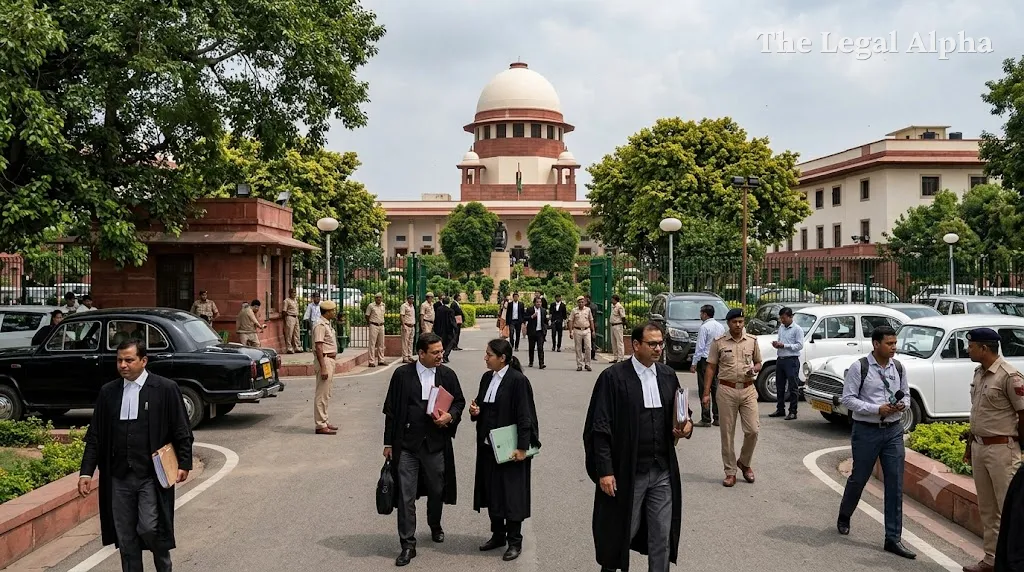
The Supreme Court deferred proceedings on the regular bail petition filed by Athar Khan, an accused in the 2020 northeast Delhi riots larger conspiracy case registered under the Unlawful Activities (Prevention) Act. A Division Bench comprising Justice Aravind Kumar and Justice Vipul M. Pancholi granted Khan four weeks to submit his rejoinder affidavit after taking on record the counter-affidavit filed by the Delhi Police.
Khan, who was arrested in July 2020 for his alleged role in orchestrating and managing protest sites in Chand Bagh, has remained in judicial custody for over six years. The matter reaches the apex court following the dismissal of his bail plea by the Delhi High Court earlier this year.
Legal Topic
Area of Law: Criminal Law / Constitutional Law
Sub-topic: Statutory Bail / Anti-Terror Legislation (UAPA) / Pre-trial Incarceration
Core Legal Issue
The primary legal controversy centers on the interplay between the rigorous statutory embargo on bail under Section 43D(5) of the Unlawful Activities (Prevention) Act, 1967, and the fundamental right to personal liberty under Article 21 of the Constitution. The court is confronted with whether an accused undergoing prolonged pre-trial incarceration can claim parity with co-accused persons who have already been enlarged on bail, notwithstanding serious allegations of participating in an orchestrated conspiracy to trigger violence.
What Did the Court / Authority Decide?
The Supreme Court did not adjudicate upon the merits of the bail plea during the hearing. Instead, it passed a procedural order granting four weeks' time to Athar Khan to file a formal rejoinder in response to the counter-affidavit placed on record by the Delhi Police.
The Bench formally adjourned the matter and scheduled the hearing for consideration after the completion of pleadings, leaving the core question of interim or regular bail pending.
Key Legal Points
-
Procedural Fairness in Statutory Bail Hearings: The Bench ensured that the accused has sufficient opportunity to traverse the factual and evidentiary claims raised in the State's belated counter-affidavit before determining the prima facie truth of the accusations under Section 43D(5) of the UAPA.
-
Revisiting the Principle of Parity: The petition requires judicial examination of whether parity can be invoked as a dispositive ground when co-accused facing identical conspiracy charges under FIR 59/2020 have secured release.
-
Long Incarceration versus Statutory Bar: The case operates within the jurisprudence established in Union of India v. K.A. Najeeb, testing how extensive periods of detention without trial balance against strict statutory bail prohibitions.
Relevant Law
-
Section 43D(5), Unlawful Activities (Prevention) Act, 1967: Creates a statutory bar on the grant of bail if the court, perusing the case diary or report, forms an opinion that reasonable grounds exist for believing the accusation is prima facie true.
-
Article 21, Constitution of India: The fundamental guarantee of the protection of life and personal liberty, including the right to a speedy trial.
-
Sections 13, 16, 17, and 18, Unlawful Activities (Prevention) Act, 1967: Substantive provisions dealing with unlawful activities, terrorist acts, raising funds for terrorist acts, and conspiracy.
-
Sections 120B, 124A, 302, and 307, Indian Penal Code, 1860: IPC provisions concerning criminal conspiracy, sedition, murder, and attempt to murder invoked in FIR 59/2020.
-
Union of India v. K.A. Najeeb (2021): Landmark Supreme Court precedent affirming that statutory restrictions under special laws do not oust constitutional courts' jurisdiction to grant bail on grounds of undue delay and prolonged incarceration.
Arguments of the Parties
Petitioner / Applicant / Appellant
Counsel appearing for Athar Khan contended that the petitioner has endured prolonged custody since mid-2020 with the trial nowhere near conclusion. The defense submitted that Khan is entitled to bail on grounds of parity with similarly placed co-accused in the same FIR who have previously been granted bail. It was further urged that the prosecution has placed no objective material, such as CCTV footage, demonstrating his active participation in acts of violence.
Respondent / State / Opposing Party
The Delhi Police, through its counter-affidavit, opposed the grant of bail, contending that Khan was not an ordinary protestor but played an instrumental role in managing the Chand Bagh protest site as part of a premeditated conspiracy to trigger communal unrest. The State maintained that the evidence collected establishes a prima facie case against the accused, thereby attracting the statutory bar under Section 43D(5) of the UAPA and precluding the routine application of parity.
Why Does It Matter?
This proceeding forms part of a critical series of challenges arising from the northeast Delhi riots conspiracy cases, where constitutional courts are routinely asked to calibrate the boundary between stringent anti-terror provisions and constitutional guarantees. A definitive determination on Khan's petition will contribute to evolving jurisprudence on how individual culpability is assessed when deciding bail applications in multi-accused conspiracy trials, particularly where several co-accused have already secured relief while trials remain protracted.
Legal Takeaway
The grant of an adjournment underscores that statutory bail proceedings under the UAPA necessitate a complete and traversed factual record before constitutional courts examine the statutory bar under Section 43D(5). For defense practitioners and prosecutors alike, the matter reinforces that arguments grounded in parity and prolonged detention must be supported by a full evidentiary record addressing the specific allegations in the state's reply.
Sources
Primary Source:
Proceedings before the Supreme Court of India in Athar Khan v. State of NCT of Delhi (Bench of Justices Aravind Kumar and Vipul M. Pancholi, order dated October 16, 2026); and Judgment of the High Court of Delhi in Athar Khan v. State of NCT of Delhi (CRL.A. 137/2026, decided on July 7, 2026).
Additional Sources:
Delhi Police Special Cell Chargesheet records in FIR No. 59/2020; precedents cited including Union of India v. K.A. Najeeb (2021) 3 SCC 713.