Punjab & Haryana High Court Overrules Union Government's Denial of Foreign Travel Clearance for Punjab Chief Minister
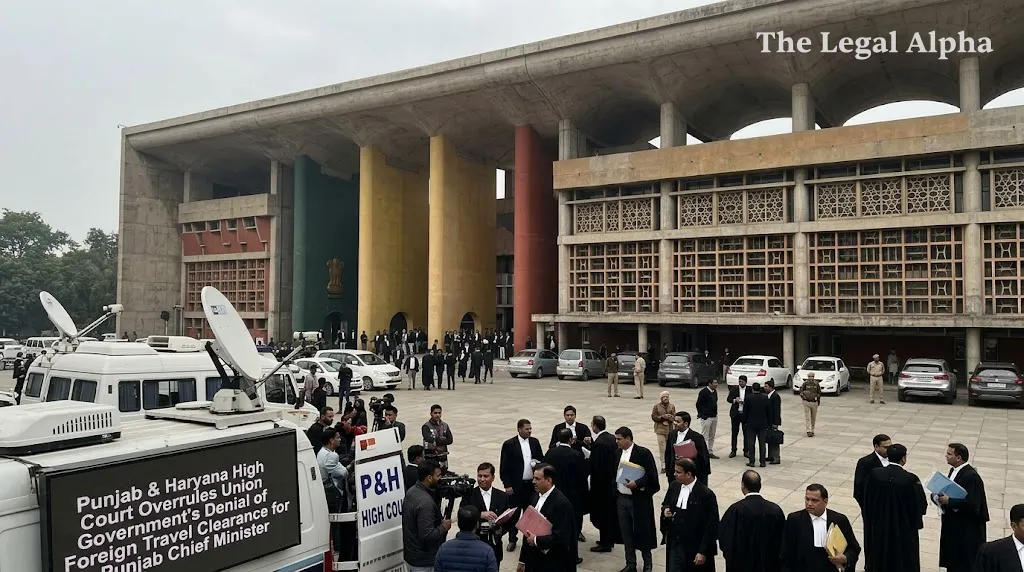
The Punjab and Haryana High Court set aside an order issued by the Ministry of External Affairs that had denied political clearance to Punjab Chief Minister Bhagwant Mann for an official delegation visit to France.
The state government had organized an official delegation visit scheduled between October 15 and 21, 2026, to participate in the international food trade fair SIAL Paris 2026 to promote agro-industry and attract trade investments. After the Centre refused political clearance without initially citing substantive reasons, the Punjab government approached the High Court on an urgent writ petition. Justice Tribhuvan Dahiya heard the petition and allowed the state government's plea, paving the way for the Chief Minister's official overseas travel.
Legal Topic
Area of Law: Constitutional Law / Administrative Law
Sub-topic: Federalism / Administrative Discretion in Political Clearances for Constitutional Functionaries
Core Legal Issue
The controversy centers on whether the Union Executive possesses unchecked administrative discretion under executive guidelines to refuse political clearance to an elected constitutional functionary—specifically a State Chief Minister—undertaking an official foreign visit to represent state trade interests, or whether such a denial requires reasoned justification, procedural fairness, and adherence to federal norms.
What Did the Court / Authority Decide?
The single bench of Justice Tribhuvan Dahiya allowed the writ petition filed by the State of Punjab, setting aside the Union Government's decision withholding political clearance.
While the Centre submitted an affidavit raising foreign security logistics and the absence of a direct host government invitation, the High Court accepted the petitioner's challenge and granted permission for the official visit. The formal, detailed reasoned judgment recording the specific operative directions is awaited.
Key Legal Points
-
Limits of Executive Discretion: Clearances mandated under executive guidelines for official foreign travel by constitutional authorities cannot be exercised arbitrarily, in a summary manner, or without speaking grounds.
-
Federal Structure and Autonomy: The judgment reinforces the constitutional autonomy of state executives to represent sub-national trade, economic, and investment interests internationally within legitimate executive bounds.
-
Scrutiny of Security Grounds: Administrative justifications based on overseas security and protocol requirements remain subject to judicial review for proportionality and substantive verification.
-
Parity and Non-Discrimination: State administrative actions cannot be subjected to disparate treatment when similarly situated heads of other state executives receive clearance under identical travel guidelines.
Relevant Law
-
Article 226 of the Constitution of India: Power of High Courts to issue prerogative writs to state instrumentalities against arbitrary administrative action.
-
Article 21 of the Constitution of India: Right to personal liberty and overseas travel, as established in Maneka Gandhi v. Union of India (1978).
-
Cabinet Secretariat & Ministry of External Affairs Guidelines: Executive instructions governing political clearances for ministers and senior state officials travelling abroad.
-
Federal Scheme under Part XI of the Constitution: Constitutional delineation of Centre-State executive relations.
Arguments of the Parties
Petitioner / State of Punjab
-
The State argued that the Ministry of External Affairs' refusal was non-speaking, completely arbitrary, and executed without authority of law, directly undermining the federal structure.
-
It submitted that the primary objective of the visit was promoting investment and agricultural trade at an internationally recognized forum (SIAL Paris 2026), where a state entity (MARKFED) was allocated pavilion space under the central agency APEDA.
-
The petitioner alleged discriminatory application of clearance rules, citing that clearances had recently been accorded to counterparts from other states while Punjab's delegation faced arbitrary rejections.
Respondent / Union of India
-
The Additional Solicitor General contended that political clearance is tied to international security considerations and state protocol abroad.
-
The Centre submitted through an affidavit that relevant intelligence inputs indicated potential security threats to the Chief Minister, asserting that formal security could not be fully assured by the host country in the absence of a direct state-level diplomatic invitation.
Why Does It Matter?
This development clarifies the judicial boundaries governing the Union Government's clearance mechanisms for state functionaries. Over the past decade, political clearances have repeatedly triggered friction between the Centre and various state governments, often being criticized as a tool for administrative overreach. By setting aside the denial, the High Court indicates that security concerns and foreign protocol rationales must meet standards of tangible justification and proportionality when restricting the official duties of an elected head of a state government.
Legal Takeaway
Executive guidelines requiring political clearance for foreign travel cannot operate as an unguided veto over elected constitutional authorities. When the Centre denies travel permission for an official trade delegation, its decision remains subject to judicial review under Article 226 on grounds of arbitrariness, procedural fairness, and federal balance.
Sources
Primary Source:
-
State of Punjab v. Union of India & Ors., Civil Writ Petition, Punjab and Haryana High Court (Bench of Justice Tribhuvan Dahiya, order dated October 16, 2026).
Additional Sources:
-
Official Communications, Ministry of External Affairs (Political Clearance Division).
-
Proceedings before the Punjab & Haryana High Court reported via LiveLaw and The Indian Express.