Rising Air Quality Crisis: Bombay High Court Fixes Police and Civic Accountability Over Mumbai Smog
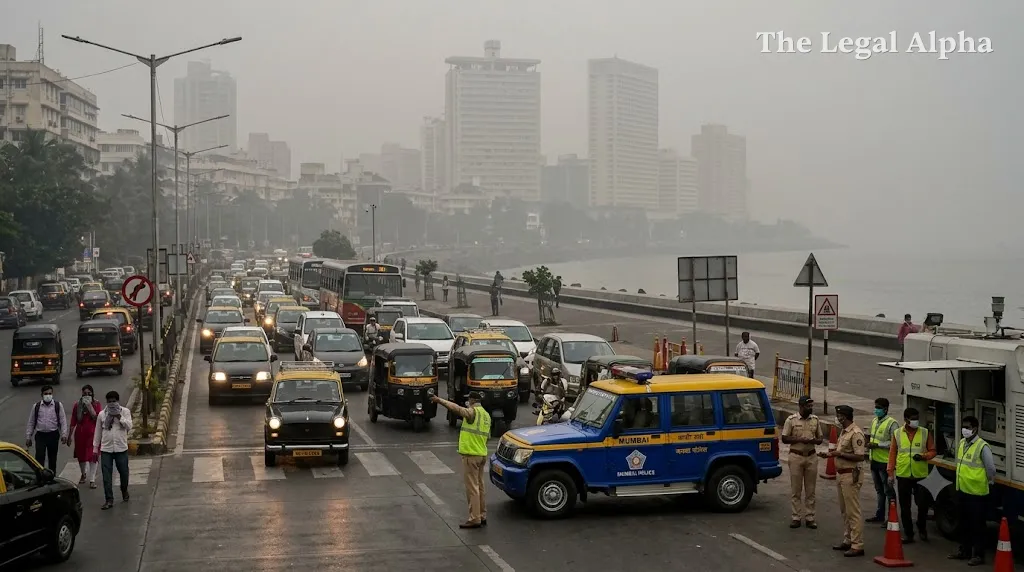
The Bombay High Court sounded an urgent alarm over Mumbai’s deteriorating ambient air quality, remarking that the coastal financial capital outpacing New Delhi in pollution levels reflects a severe governance crisis.
Hearing a suo motu public interest litigation on worsening environmental standards, noise violations, and unregulated firecracker bursting, a division bench led by Justice Girish S. Kulkarni warned civic bodies and law enforcement agencies that administrative lethargy directly compromises public health. The High Court directed the Mumbai Commissioner of Police to issue a binding Standard Operating Procedure (SOP) across all municipal police stations to curb illegal bursting of crackers and unauthorized public sound systems, ordering municipal and environmental regulators to submit compliance affidavits ahead of scheduled hearings.
Legal Topic
Area of Law: Environmental Law
Sub-topic: Air and Noise Pollution Regulation / Constitutional Enforcement under Article 21
Core Legal Issue
The fundamental legal question before the High Court is whether administrative inaction in curtailing urban emission drivers—specifically festival firecrackers, unpermitted loudspeakers, and municipal particulate matter—amounts to an actionable breach of citizens' fundamental rights to life, clean air, and health.
The court examined the failure of municipal agencies to enforce statutory safeguards, probing how the state’s executive arm can be held individually and institutionally accountable when dereliction of regulatory duties degrades living standards to an environmental emergency.
What Did the Court Decide?
The High Court issued explicit compliance deadlines and judicial warnings:
-
Accountability for Police Machinery: The court cautioned that any police dereliction in curbing prohibited firecrackers on public streets and silence zones will be treated as an infringement of Articles 14 and 21, warning that individual station in-charges will face disciplinary and judicial accountability for non-enforcement.
-
Standard Operating Procedure: The Mumbai Police Commissioner was instructed to convene a mandatory coordination meeting with all police station chiefs to draft and operationalize a formal SOP enforcing noise and firecracker restrictions.
-
Public Awareness Mandate: The Brihanmumbai Municipal Corporation (BMC) and the Maharashtra Pollution Control Board (MPCB) were directed to publish widespread public interest notices across digital and print media detailing prohibited activities and health warnings.
-
Compliance Affidavits: The State Government, BMC, and MPCB were ordered to place comprehensive action-taken reports and sworn affidavits on record, with the bench listing the matter for immediate follow-up scrutiny on October 26.
Key Legal Points
-
Fundamental Right to Breathable Air: The court reiterated that the right to clean air and a pollution-free environment is an inseparable component of the right to life under Article 21 of the Constitution.
-
Enforceability of Prior Bans: The bench underscored that judicial orders prohibiting firecrackers on public roads, around hospitals, educational institutions, and demarcated silence zones are year-round directives, not discretionary guidelines.
-
Shift to Personal Official Liability: The bench made it clear that institutional blame-shifting will not shield supervisory officers; individual police and civic heads will be held accountable if violations occur unchecked within their jurisdictions.
-
Balancing Festivities with Public Health: The High Court observed that brief, momentary leisure cannot take precedence over collective public health, particularly when urban smog creates severe respiratory vulnerability across the general populace.
Relevant Law
-
Constitution of India:
-
Article 21 (Protection of life and personal liberty, which encompasses the right to clean air, health, and a safe environment).
-
Article 14 (Equality before the law and protection against arbitrary state inaction).
-
Article 48A (Directive Principle instructing the State to protect and improve the environment).
-
-
The Air (Prevention and Control of Pollution) Act, 1981: Statutory framework governing ambient air monitoring and emission curbs.
-
The Environment (Protection) Act, 1986 & Noise Pollution (Regulation and Control) Rules, 2000: Provisions restricting decibel limits, public address systems, and firecracker discharges in urban clusters and silence zones.
Arguments of the Parties
-
The Court / Amici Curiae: Senior legal counsel assisting the court as amici curiae submitted that toxic particulate spikes and rampant defiance of firecracker and loudspeaker bans continue unabated due to a near-total absence of street-level enforcement by municipal and police units.
-
The State of Maharashtra & BMC: State pleaders and municipal counsel submitted that administrative circulars had been notified to field staff and assured the bench that coordinated multi-agency drives would be deployed, pledging full compliance with the court's procedural roadmap through timely affidavits.
-
Maharashtra Pollution Control Board (MPCB): Counsel representing the environmental regulator maintained that air monitoring stations are capturing urban spikes and that advisory circulars are routinely communicated to regional municipal authorities for ground-level action.
Why Does It Matter?
For decades, seasonal smog crises in India were litigated primarily around northern landlocked belts like the National Capital Region. The Bombay High Court's urgent intervention reflects a pivotal development: coastal geography no longer insulates mega-cities from catastrophic air inversions when local emission controls fail.
By threatening direct consequences against supervisory police personnel and civic administrators, the High Court is closing the implementation gap between judicial environmental edicts and ground-level police action. This sets a clear precedent for urban governance across India, clarifying that regulatory inaction on public nuisances is legally punishable when public health is placed in jeopardy.
Legal Takeaway
The Bombay High Court has affirmed that executive non-enforcement of environmental norms constitutes an actionable constitutional violation under Article 21. Regulatory authorities and local police officers carry a mandatory legal duty—not discretionary leeway—to enforce air and noise quality standards, facing personal accountability if statutory safeguards are ignored.
Sources
-
Primary Source: High Court of Judicature at Bombay, Order in Suo Motu Public Interest Litigation (In re: Noise and Environmental Pollution), Coram: Justice Girish S. Kulkarni and Bench, October 2026.
-
Additional Sources: Bar & Bench Legal News Service; Bombay High Court Official Causelists; Notifications issued under the Environment (Protection) Act, 1986 and Noise Pollution Rules, 2000.