Punjab Police Officer Shot Dead in Tarn Taran: Counter-Intelligence ASI Targeted in Point-Blank Shooting
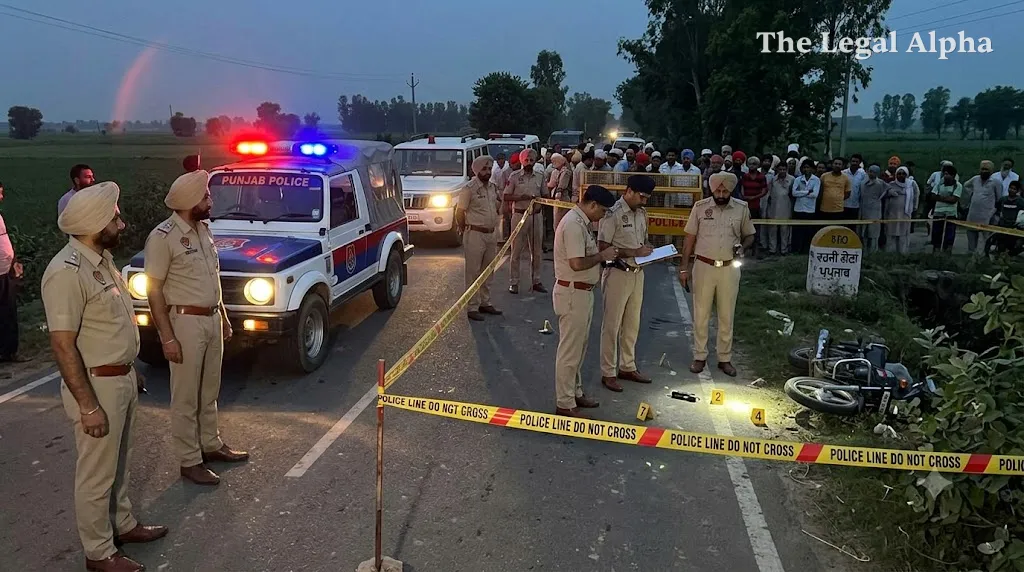
Assistant Sub-Inspector Iqbal Singh, an officer attached to the Punjab Police Counter-Intelligence wing, was shot dead by unidentified motorcycle-borne assailants on the Naushera Pannuan–Lohka road in Tarn Taran district. The attackers intercepted the officer and discharged multiple rounds at point-blank range, inflicting fatal wounds to his upper body.
The incident occurred while Singh was traveling on his two-wheeler, returning home on Sunday evening. District police authorities, led by Senior Superintendent of Police Surendra Lamba, cordoned off the crime scene, commenced forensic analysis, and initiated an investigation into whether the targeted execution is linked to cross-border networks or recent gang retaliations.
Legal Topic
Area of Law: Criminal Law / Constitutional Law
Sub-topic: Homicide, Firearms Violations, and State Law Enforcement Liability
Core Legal Issue
The core legal question centers on the invocation of targeted murder charges and the procedural standards governing investigations under the Bharatiya Nyaya Sanhita (BNS) and the Arms Act when public officials and state intelligence functionaries are subjected to targeted execution.
Beyond substantive homicide charges, the case touches upon the constitutional obligations of the State administration under Entry 1 and Entry 2 of List II (State List) of the Seventh Schedule of the Constitution of India, which vest exclusive responsibility for public order and policing within the State executive.
What Did the Court / Authority Decide?
The judicial system has not yet issued orders, as the matter remains in the pre-trial investigative stage under police jurisdiction. Tarn Taran Police have:
-
Registered a First Information Report (FIR) under statutory provisions dealing with murder and unauthorized possession/use of prohibited arms.
-
Seized surveillance footage and forensic ballistic materials from the scene for chain-of-custody documentation.
-
Initiated coordinated search operations across inter-district checkposts to apprehend the unidentified shooters.
Any arrested suspects will be produced before the jurisdictional Judicial Magistrate within the statutory 24-hour window for police remand and evidentiary procedures.
Key Legal Points
-
Invocation of Homicide Statutes: The intentional discharge of lethal firearms at point-blank range establishes prima facie ingredients for premeditated murder under Section 103 of the Bharatiya Nyaya Sanhita, 2023 (or equivalent Section 302 IPC frameworks) alongside Section 25 and Section 27 of the Arms Act, 1959.
-
Potential Invocation of Anti-Terror Provisions: Should investigators establish organized interstate syndicates or foreign-based involvement, authorities retain statutory power to invoke provisions of the Unlawful Activities (Prevention) Act, 1967 (UAPA).
-
Evidentiary Rigor in Assassinations: The legal threshold requires the prosecution to prove common intention, conspiracy under Section 61 BNS, ballistics match, and call-detail record (CDR) attribution connecting the on-ground shooters with potential conspirators.
-
Maintenance of State Law and Order: The targeting of state security personnel directly impacts executive accountability regarding witness and officer protection doctrines governed under administrative law.
Relevant Law
-
Bharatiya Nyaya Sanhita, 2023: Section 103 (Punishment for murder), Section 61 (Criminal conspiracy), and Section 109 (Attempt to murder).
-
The Arms Act, 1959: Sections 25 and 27 (Punishment for use of arms, ammunition, and prohibited weapons).
-
Code of Criminal Procedure, 1973 / Bharatiya Nagarik Suraksha Sanhita, 2023: Section 154 (Registration of FIR), Section 161/Section 180 (Examination of witnesses), and Section 167/Section 187 (Procedure when investigation cannot be completed in 24 hours).
-
Constitution of India: Seventh Schedule, List II, Entries 1 and 2 (Public order and Police powers).
Arguments of the Parties
The Investigating Agency / State The police submit that preliminary findings point toward a calculated ambush carried out by armed assailants. Investigators are actively assessing links between this killing and the previous murder of the officer's nephew, who faced trial in connection with high-profile offenses, to ascertain whether organized criminal syndicates or external outfits ordered the strike.
The Defense / Accused Perspective The accused parties remain unidentified; no formal defense submissions have been entered before a court of record. Once arrests are effected, defense counsel typically challenges the validity of identification parades, test identification evidence, ballistic recovery chains, and the evidentiary basis behind conspiracy allegations.
Why Does It Matter?
Targeted assaults on state intelligence and counter-terrorism officials test the capacity of regional law enforcement agencies to handle coordinated syndicates. From a criminal jurisprudence standpoint, establishing conspiracy chains in gang-instigated or cross-border assassinations requires strict adherence to digital evidence laws, ballistics verification, and procedural safeguards under newly revised criminal codes.
Systemically, repeated breaches of security involving law enforcement personnel raise administrative questions regarding state police welfare, intelligence confidentiality, and the adequacy of security protocols for field operatives handling sensitive criminal dossiers.
Legal Takeaway
When targeted assassinations occur, the criminal justice process hinges entirely on statutory compliance during the initial 48 hours—securing forensic ballistics, preserving digital footprint evidence, and establishing clear conspiracy linkages under penal law. For prosecutors, proving premeditation and conspiracy against non-present conspirators remains the primary legal barrier in organized contract-killing cases.
Sources
Primary Source:
-
Official statements issued by Senior Superintendent of Police (SSP) Tarn Taran and the District Police Office regarding the registration of the FIR and crime scene inspection.
Additional Sources:
-
Indian Express reporting on the Tarn Taran shooting and forensic investigation procedures (October 2026).
-
Times of India dispatch detailing police statements on the Naushera Pannuan–Lohka road incident (October 2026).