Mandatory Safeguards Under BNSS Cannot Be Bypassed: Allahabad High Court Sets Aside FIR Direction Against Police Personnel
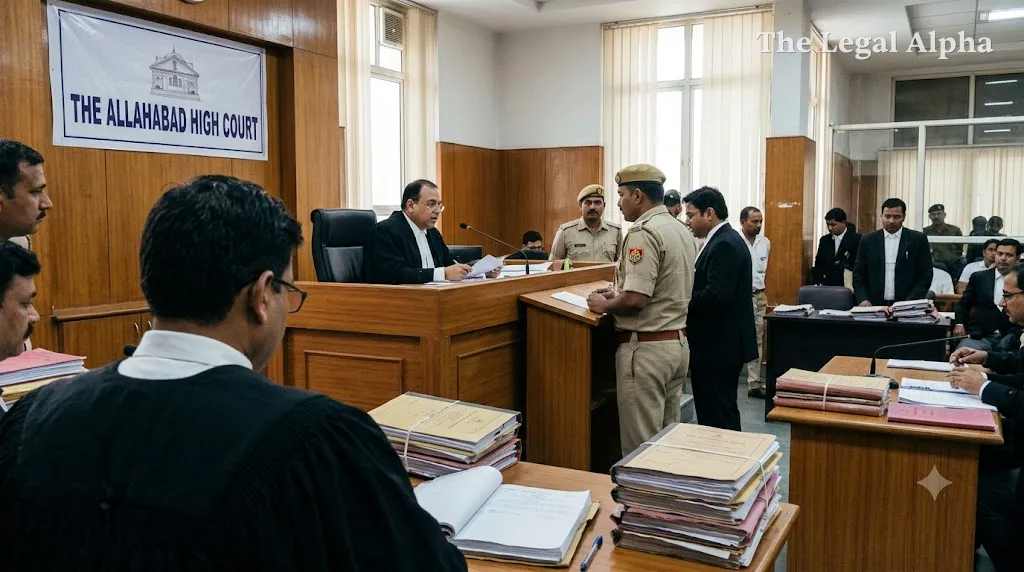
The Allahabad High Court has set aside an order issued by the Special Judge (SC/ST Act), Maharajganj, which had directed the registration of a First Information Report against a sub-inspector, a head constable, and around 20 unnamed police personnel. The underlying complaint arose from a police search conducted at a residential property, following which the complainant alleged misconduct, intimidation, and caste-based abuse. The High Court ruled that the Special Court acted casually and bypassed essential statutory procedural mandates governing complaints filed against public servants.
Legal Topic
Area of Law: Criminal Procedure & Human Rights
Sub-topic: Judicial Inquiry Before FIR Registration / Public Servant Protections
Core Legal Issue
The primary legal issue was whether a Special Court exercising powers under Section 175(3) of the Bharatiya Nagarik Suraksha Sanhita, 2023 can mechanically direct the registration of an FIR against public servants performing official duties without first conducting a preliminary inquiry or explicitly assigning recorded, cogent reasons for dispensing with it. A subsidiary question examined whether allegations of caste-based insults occurring exclusively within private residential premises prima facie satisfy the essential ingredient of being within "public view" under the SC/ST Act.
What Did the Court Decide?
In its judgment, the High Court quashed the Special Court's directive. It held that the Special Judge failed to exercise jurisdiction in line with the mandatory statutory provisions laid down under Sections 175(3) and 175(4) of the BNSS. The Court emphasized that subordinate courts cannot act as mere post offices to direct criminal investigations against public officers acting in the line of duty without applying judicial mind.
The matter was remitted back for reconsideration in strict conformity with statutory procedural safeguards.
Key Legal Points
-
Statutory Compliance Under BNSS: Directing an investigation or FIR under Section 175(3) of the BNSS requires active judicial screening, particularly when complaints target public servants discharging official responsibilities.
-
Mandatory Reasons for Dispensing Inquiry: If a court decides to bypass the preliminary inquiry contemplated under Section 175(3), Section 175(4) mandates recording specific, cogent reasons on record. A cryptic or routine direction violates procedural law.
-
Threshold of "Public View": For an offence under Section 3(1)(r) or 3(1)(s) of the SC/ST (Prevention of Atrocities) Act, the alleged caste-based abuse must occur within "public view"; generalized allegations arising inside private residences do not automatically qualify.
-
Protection Against Retaliatory Complaints: Judicial magistrates and special judges must guard against motivated, omnibus allegations leveled against law enforcement officers conducting bona fide official searches.
Relevant Law
-
Bharatiya Nagarik Suraksha Sanhita, 2023 (BNSS): Sections 175(3) and 175(4) (governing magistrate orders directing police investigation and mandatory inquiry safeguards).
-
Scheduled Castes and the Scheduled Tribes (Prevention of Atrocities) Act, 1989: Section 3(1)(r) and Section 3(1)(s) (prescribing penalties for casteist insults in public view).
-
Code of Criminal Procedure, 1973 (CrPC): Section 156(3) (corresponding predecessor provision).
Arguments of the Parties
Appellants (Police Personnel) The appellants contended that the allegations of physical search, indecent behavior, and intimidation were vague, omnibus, and retaliatory in nature. They submitted that the incident occurred within private residential premises during an official search, which meant the statutory requirement of "public view" under the SC/ST Act was not fulfilled. Furthermore, they argued that the Special Court completely ignored the mandatory statutory filters provided under Section 175 of the BNSS designed to prevent frivolous prosecution of public servants.
Respondent / State The opposing party maintained that the complaint disclosed cognizable offences involving casteist slurs and overreach during a police search, warranting an immediate and impartial investigation by an independent authority.
Why Does It Matter?
This decision clarifies the practical implementation of the newly enacted procedural provisions under the BNSS. Sections 175(3) and 175(4) introduce explicit legislative checks against the automatic weaponization of criminal complaints against police officers and public functionaries. By demanding reasoned orders, the High Court ensures that subordinate courts apply rigorous judicial scrutiny before triggering formal police investigations, thereby balancing accountability with protection from retaliatory litigation.
Legal Takeaway
Subordinate criminal courts cannot routinely direct FIR registrations against public servants without adhering to the statutory inquiry framework of the BNSS. Dispensing with a preliminary inquiry requires recorded, cogent reasons, and generalized allegations inside private residences will not satisfy the threshold of the SC/ST Act.
Sources
Primary Source:
Judgment of the Allahabad High Court in Rakesh Kumar Yadav & Ors. v. State of U.P. (Delivered October 9, 2026).
Additional Sources:
-
The Pioneer, "Allahabad HC quashes FIR against police officers, questions special court’s order," October 12, 2026.
-
India Today, "Allahabad HC quashes Maharajganj FIR order against UP police personnel under BNSS," October 11, 2026.