Journalism Cannot Be Criminalised Without Essential Offences Disclosed: Calcutta High Court Sets Aside Police Case Against News Portal Over RG Kar Reporting
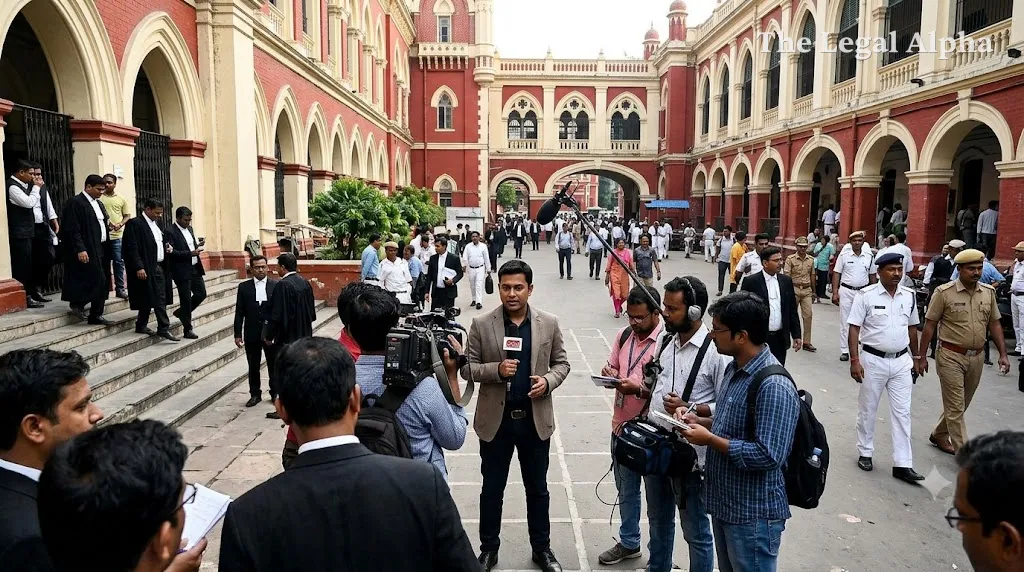
The Calcutta High Court set aside a First Information Report filed by state authorities against a journalist operating the digital news platform Arambagh TV. The criminal proceedings had been instituted following a broadcast reporting on alleged institutional irregularities at Kolkata’s RG Kar Medical College and Hospital. Local police registered the complaint asserting that the broadcast circulated unverified or misleading claims concerning the state-run medical institution. The journalist petitioned the High Court under Section 482 of the Code of Criminal Procedure seeking to quash the criminal complaint and halt subsequent investigative steps, contending that legitimate reporting had been penalized without any prima facie criminal foundation.
Legal Topic
Area of Law: Criminal Law / Constitutional Law
Sub-topic: Quashing of FIR / Press Freedom and Speech Protections
Core Legal Issue
The primary issue before the High Court was whether a criminal prosecution initiated against a journalist over an investigative news broadcast can be sustained when the initial allegations and complaint materials fail to disclose the fundamental statutory elements of the charged criminal offences.
A secondary question was whether state machinery can initiate criminal proceedings against media reporting without demonstrating malicious intent, incitement, or tangible injury to public order.
What Did the Court Decide?
The High Court allowed the journalist's petition and quashed the FIR alongside all consequential criminal proceedings.
The Court ruled that the allegations in the initial complaint, even if accepted at face value, failed to fulfill the foundational ingredients needed to constitute criminal liability. Because the requisite statutory elements were entirely absent from the police report, allowing the investigation to proceed would amount to an abuse of the judicial process.
Key Legal Points
-
Investigating agencies cannot register or pursue criminal complaints merely because an official institution disputes or finds discomfort with a journalistic broadcast.
-
To sustain criminal proceedings, the foundational complaint must clearly demonstrate the essential ingredients of the penal provisions invoked rather than relying on broad allegations of misinformation.
-
The inherent jurisdiction of the High Court to quash an FIR is properly engaged when allegations fail to show a prima facie cognizable offence, preventing judicial processes from becoming tools of executive harassment.
Relevant Law
-
Section 482 of the Code of Criminal Procedure, 1973 (CrPC) / Section 528 of the Bharatiya Nagarik Suraksha Sanhita, 2023 (BNSS): Inherent powers of the High Court to prevent abuse of the process of any court and secure the ends of justice.
-
Article 19(1)(a) read with Article 19(2) of the Constitution of India: Freedom of speech and expression encompassing press freedom, subject only to reasonable restrictions defined by statute.
-
State of Haryana v. Bhajan Lal (1992 Supp (1) SCC 335): Foundational guidelines governing the quashing of criminal proceedings where uncontroverted allegations do not establish the commission of an offence.
Arguments of the Parties
Petitioner
The journalist submitted that the broadcast constituted standard journalistic inquiry into institutional administration. Counsel argued that penal statutes were being misapplied by police authorities to suppress scrutiny, pointing out that none of the elements required to show malicious fabrication or statutory violations were disclosed in the police complaint.
Respondent / State
The State contended that the broadcast disseminated misleading details regarding administrative and medical functioning at RG Kar Medical College and Hospital. Authorities argued that the report risked misleading the public during sensitive institutional inquiries and that police officers were justified in examining whether the news channel committed an offence.
Why Does It Matter?
The decision reinforces judicial barriers against the weaponization of the criminal process against digital and independent media platforms. Law enforcement agencies increasingly register complaints under public order and misinformation statutes in response to critical reportage of state-run institutions.
By insisting on strict scrutiny of the statutory elements before an investigation can proceed, the High Court confirmed that factual discrepancies or official dissatisfaction with news coverage cannot serve as automatic triggers for criminal law. It clarifies that reporting on public institutions is protected unless clear, tangible statutory transgressions are demonstrably made out.
Legal Takeaway
A criminal case against reporting cannot survive merely because authorities claim a news broadcast is inaccurate. Unless the first information report explicitly establishes the basic statutory components of a recognised offence, High Courts will intervene to quash the proceedings to prevent the criminal justice system from chilling legitimate journalism.
Sources
Primary Source:
Calcutta High Court, Order quashing FIR arising out of Arambagh TV broadcast on RG Kar Medical College and Hospital (2026).
Additional Sources:
LiveLaw, "Calcutta High Court Quashes FIR Against Journalist Over Allegedly False Report On Kolkata's RG Kar Hospital" (October 2026).