Obscene Words Without Sexual Remarks Not Sexual Harassment: Kerala HC Quashes Section 354A IPC Charge
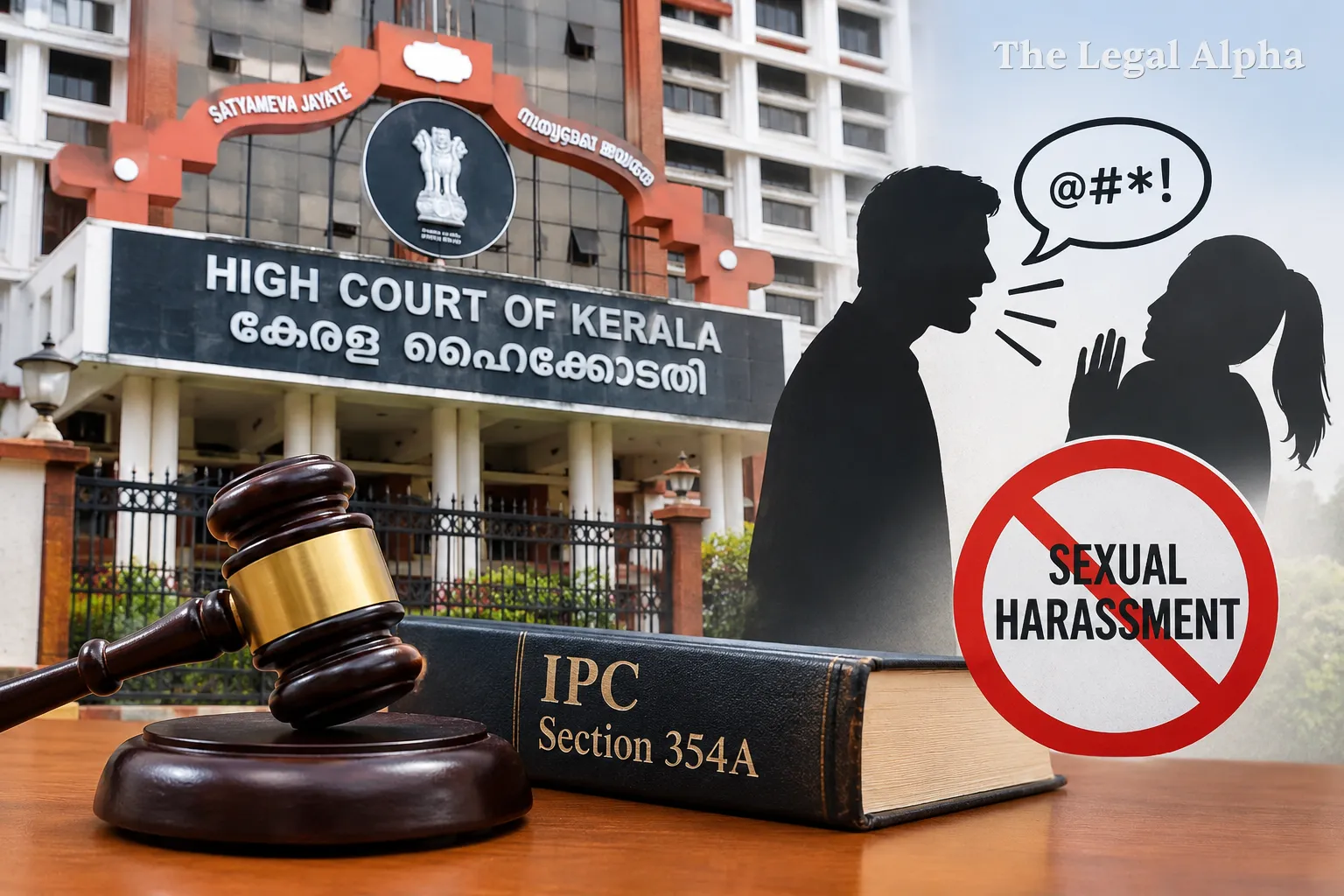
Court: High Court of Kerala at Ernakulam
Bench: Justice Jobin Sebastian
Case Record: Crl.MC No. 1240 of 2026 | Citation: [2026 LiveLaw (Ker) 563]
Crime Record: Crime No. 209/2024 of Kalpetta Police Station (C.C. No. 274/2024, CJM Kalpetta)
Date of Pronouncement: September 16, 2026 | Reported: October 08, 2026 (LiveLaw ID: 553723)
Subject: Indian Penal Code (Section 354A(1)(iv) vs Sections 294(b) & 509) | Sexual Harassment
The criminal proceedings originated from Crime No. 209 of 2024 registered at the Kalpetta Police Station in Wayanad, Kerala, based on a First Information Statement (FIS) lodged by the de facto complainant, a 55-year-old woman residing in Puliyarmala. According to the prosecution case, on March 9, 2024, while the complainant was walking home along with her daughter-in-law, the petitioner-accused, Prasad Mahendragiri (aged 54), stood in a public place near a residential pathway and hurled abusive and obscene words at her, accompanied by threats of bodily harm.
Following investigation, the Kalpetta Police filed a Final Report (Charge Sheet No. 1529800824020901) before the Chief Judicial Magistrate Court, Kalpetta, where it was registered as C.C. No. 274 of 2024. The police charged the petitioner with offences punishable under Section 294(b) (uttering obscene words in a public place), Section 506(ii) (criminal intimidation), Section 509 (word, gesture or act intended to insult the modesty of a woman), and Section 354A(1)(iv) (sexual harassment by making sexually coloured remarks) of the Indian Penal Code, 1860.
Seeking to quash the charge sheet and ongoing criminal proceedings, the petitioner invoked the inherent powers of the High Court of Kerala under Section 482 of the Code of Criminal Procedure, 1973 (CrPC) [Crl.MC No. 1240 of 2026]. The petitioner contended that the allegations, even if accepted on their face, comprised general verbal abuse and expletives without any sexual connotation, and therefore the essential ingredients of sexual harassment under Section 354A(1)(iv) were completely absent.
Legal Topic
Criminal Jurisprudence & Gender Offences – Section 354A(1)(iv), Indian Penal Code, 1860 (Offence of Sexual Harassment by Making Sexually Coloured Remarks); Distinction between Obscene Language under Section 294(b), Insulting Modesty under Section 509, and Sexually Coloured Remarks under Section 354A(1)(iv); Inherent Powers of High Court under Section 482 CrPC to Quash Unsustainable Charges at the Threshold.
Core Legal Issue
Whether the mere utterance of general abuses or obscene words directed at a woman in a public place, in the absence of any specific allegation or evidence of a sexually coloured remark, can legally sustain a charge of sexual harassment under Section 354A(1)(iv) of the Indian Penal Code.
What Did the Court / Authority Decide?
The High Court of Kerala at Ernakulam, through a Single Judge Bench comprising Justice Jobin Sebastian, partly allowed the criminal miscellaneous petition [Crl.MC No. 1240 of 2026, Citation: [2026 LiveLaw (Ker) 563]], quashing the charge under Section 354A(1)(iv) of the IPC while permitting the trial to proceed for the offences under Sections 294(b), 506(ii), and 509 of the IPC.
Justice Jobin Sebastian held that the offence of sexual harassment under Section 354A(1)(iv) requires that the accused must have made "sexually coloured remarks". The Court observed: "The mere utterance of obscene words would not, by itself, attract the offence of sexual harassment under Section 354A(1)(iv) of the IPC. There must be a specific sexually coloured remark. In the absence of any allegation or material demonstrating that the words uttered had a sexual connotation, the charge under Section 354A(1)(iv) is unsustainable and liable to be quashed." However, regarding the charges under Section 294(b) and Section 509, the Court held that whether the abusive words caused annoyance in a public place or whether the accused intended to insult the modesty of the complainant are questions of fact that can only be determined through evidence at trial. Consequently, the High Court quashed the Section 354A(1)(iv) charge and directed the Chief Judicial Magistrate Court, Kalpetta, to proceed with the trial strictly for the remaining offences.
Key Legal Points
- Specific Ingredient of Sexually Coloured Remark: Justice Jobin Sebastian held that Section 354A(1)(iv) IPC is a specific statutory penal provision that strictly penalizes "making sexually coloured remarks". General vulgarity, abusive slurs, or foul language cannot be elevated to the offence of sexual harassment without a demonstrated sexual connotation.
- Distinction between Sections 294(b), 509, and 354A IPC: The High Court clearly demarcated the boundaries of penal provisions: Section 294(b) addresses obscenity causing public annoyance; Section 509 penalizes intent to insult a woman's modesty; whereas Section 354A requires explicit sexually coloured conduct or remarks.
- Quashing of Over-Charged Offences at Threshold: The Court reiterated that where the uncontroverted allegations in the FIR and final report fail to disclose the foundational ingredients of a specific aggravated offence, the High Court has a duty under Section 482 CrPC to quash that charge to prevent harassment and abuse of judicial process.
- Trial Permitted for Factual Determinations: The Bench declined to quash the charges under Sections 294(b), 506(ii), and 509 of the IPC, noting that whether the words generated impure thoughts or insulted the modesty of the complainant are disputed questions of fact that must be tested during trial upon appreciation of witness testimony.
- Pragmatic Judicial Restraint: The Court balanced protection against over-criminalization with the complainant's right to prove public obscenity and insult to modesty, directing the trial court to conclude proceedings expeditiously.
Relevant Law
- Section 354A(1)(iv), Indian Penal Code, 1860: Introduced via the Criminal Law (Amendment) Act, 2013, making "making sexually coloured remarks" an offence of sexual harassment punishable with imprisonment up to one year, or fine, or both.
- Section 294(b), Indian Penal Code, 1860: Penalizes uttering any obscene song, ballad, or words in or near any public place causing annoyance to others.
- Section 509, Indian Penal Code, 1860: Penalizes uttering any word, making any sound or gesture intending that such word or sound shall be heard, or that such gesture shall be seen by a woman, or intruding upon her privacy, intending to insult her modesty.
- Section 482, Code of Criminal Procedure, 1973 (CrPC): Preserves the inherent power of the High Court to make such orders as may be necessary to prevent abuse of the process of any court or to secure the ends of justice.
- State of Haryana v. Bhajan Lal (1992 Supp (1) SCC 335): Landmark Supreme Court precedent establishing that criminal proceedings may be quashed where allegations in the FIR, even if taken at face value, do not disclose the commission of the alleged offence.
Arguments of the Parties
- Contentions of the Petitioner (Prasad Mahendragiri):
- Represented by Advocates S. Sabarinadh, A. Jayasankar, and Indulekha Joseph, the petitioner submitted that a perusal of the First Information Statement (FIS) and Section 164 CrPC statement revealed that the alleged dispute arose from a neighbourhood confrontation.
- Counsel argued that the words allegedly used were general colloquial abuses and did not contain any sexually suggestive, explicit, or sexually coloured innuendos.
- It was contended that slapping Section 354A(1)(iv) on top of Sections 294(b) and 509 was an instance of malicious over-charging by the investigating agency, causing grave stigma and prejudice.
- Contentions of the Respondents (State of Kerala & De Facto Complainant):
- Represented by Public Prosecutor V.R. Ramlal, the State submitted that the petitioner publicly targeted a 55-year-old woman with filthy, humiliating abuses, causing immense mental trauma and public annoyance.
- The prosecution contended that the words used were obscene and degraded the modesty and dignity of the victim, justifying charges under Sections 294(b), 509, and 354A(1)(iv).
- The State argued that whether the remarks carried a sexual undertone was a matter of interpretation and contextual evidence to be evaluated during trial.
Why Does It Matter?
Following the 2013 amendments to the Indian Penal Code, police stations across India have frequently adopted a practice of mechanically appending Section 354A(1)(iv) (sexual harassment) to every FIR involving altercations between men and women where foul language is alleged, regardless of whether any sexual overtone was present. This practice often blurs the legislative distinction between ordinary verbal abuse, public obscenity under Section 294(b), insult to modesty under Section 509, and the grave social and legal stigma associated with sexual harassment.
Justice Jobin Sebastian’s judgment in Prasad Mahendragiri provides essential judicial clarity and discipline in police investigations. By reaffirming that sexual harassment requires a specific "sexually coloured remark", the Kerala High Court prevents the weaponization of Section 354A as an automatic add-on in neighbourhood quarrels or heated civil disputes. The ruling ensures that while public obscenity and insults to female modesty remain fully prosecutable under Sections 294(b) and 509, the severe charge of sexual harassment is reserved strictly for conduct carrying genuine sexual intent, upholding both victim dignity and statutory precision.
Legal Takeaway
The mere utterance of general abuses or obscene words at a woman does not constitute the offence of sexual harassment under Section 354A(1)(iv) of the Indian Penal Code in the absence of a specific sexually coloured remark. While such conduct may remain subject to prosecution under Section 294(b) for public obscenity or Section 509 for insulting modesty depending on trial evidence, a charge under Section 354A(1)(iv) devoid of sexual connotation cannot survive and is liable to be quashed under Section 482 CrPC.
Sources (Primary & Additional)
- Primary Judicial Order: High Court of Kerala at Ernakulam, Prasad Mahendragiri v. State of Kerala & Anr. [Crl.MC No. 1240 of 2026, Neutral Citation: [2026 LiveLaw (Ker) 563], Decided on September 16, 2026 / Reported October 08, 2026], per Justice Jobin Sebastian. Kerala High Court Judgment Repository / CaseMine.
- Authoritative Legal Reporting (LiveLaw): K. Salma Jennath, \"Obscene Words, General Abuse At Woman Not Offence U/S 354A(1)(iv) IPC If No Allegation Of Sexually Coloured Remark: Kerala High Court\" (Article ID: 553723, Published on October 08, 2026). LiveLaw Article.
- Criminal Law Jurisprudence Digest (LawChakra): Legal Bureau, \"Section 354A IPC: General Abuse Of Woman Not An Offence Without Sexually Coloured Remark, Says Kerala High Court\" (Published on October 08, 2026). LawChakra Legal Analysis.