New Factual Pleas Barred in Section 37 Appeals: Calcutta High Court Rebuffs BSNL
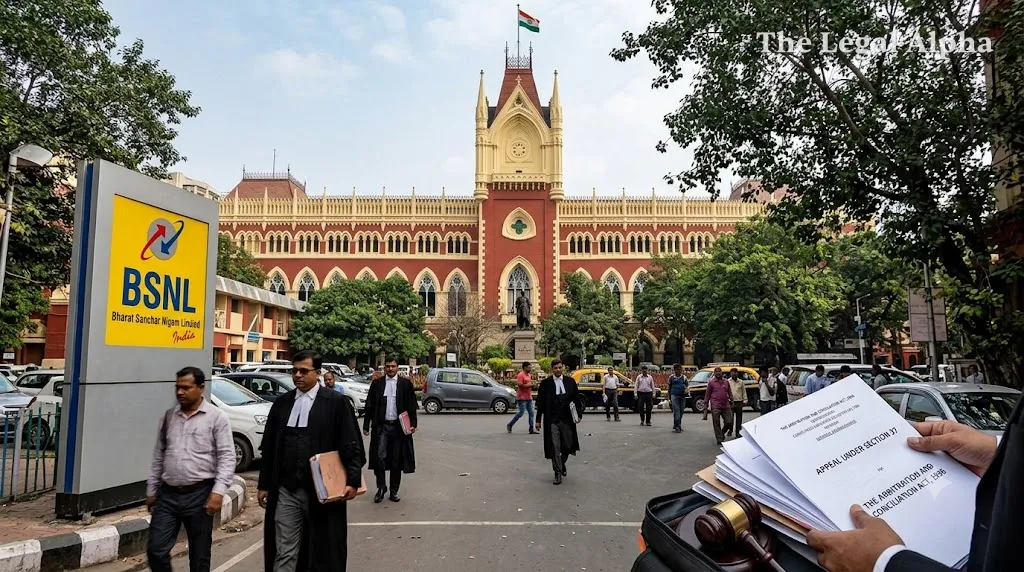
Case Name: Bharat Sanchar Nigam Limited (BSNL) v. Joysri Sengupta & Anr.
Court: High Court at Calcutta (Civil Appellate Jurisdiction)
Bench: Justice Debangsu Basak & Justice Aryak Dutt
Case Record: FMAT No. 219 of 2021
Date of Pronouncement: October 06-07, 2026 | Reported: October 07, 2026 (LiveLawBiz ID: 553582)
Subject: Arbitration Act (Section 34 & Section 37) | Bar on Fresh Factual Pleas in Appeal
Category
Judgements / Commercial Arbitration & Tenancy Law
The dispute originated from a 25-year lease executed in favour of the President of India (Calcutta Telephones) for commercial premises situated at 47 and 47/1/1, Basudebpur Road, Shyamnagar, North 24-Parganas, West Bengal, comprising 2,662 sq. ft. of covered area and 1,150 sq. ft. of open land. The tenancy was granted by the original lessor, Anjan Kumar Sengupta, for installing and operating a telephone exchange. Following corporatisation, the leasehold interest came to vest in public sector telecom major Bharat Sanchar Nigam Limited (BSNL).
Following neighbour noise complaints regarding an industrial diesel generator set installed on site, the Appellate Authority of the West Bengal Pollution Control Board directed that the exchange be shifted, permitting operations at the site only until August 31, 2006. In compliance, BSNL shifted its active electronic exchange machinery to adjacent premises. However, BSNL did not restore vacant physical possession to the lessor. Instead, BSNL left behind a heavy industrial diesel generator, control panels, and bulky ancillary equipment within the demised premises, continuing to occupy the space without paying agreed lease rentals or occupation charges.
When BSNL attempted to demolish a partition wall of the generator room to retrieve the equipment without settling rental arrears, the lessor objected, leading to litigation and eventual reference to a Sole Arbitrator. Before the Arbitrator, BSNL claimed it had vacated the premises and filed a counter-claim for business obstruction damages. On May 13, 2016, the Sole Arbitrator passed an award directing BSNL to pay unpaid rent/damages for unauthorized retention of possession, dismissed BSNL's counter-claim for lack of credible witness testimony, and awarded ₹3 Lakh towards arbitral costs. BSNL’s petition under Section 34 of the Arbitration and Conciliation Act, 1996 was dismissed by the Additional District Judge, Barrackpore, on March 16, 2020.
Aggrieved, BSNL preferred a commercial appeal under Section 37 of the Act [FMAT No. 219 of 2021] before the Calcutta High Court. In its Section 37 appeal, BSNL raised entirely new factual defenses never urged before the Arbitrator: it contended that the lease stood statutorily terminated under Section 106 of the Transfer of Property Act, 1882, and alternatively, that the lease became void under Section 108(B)(e) because the Pollution Board's order rendered the premises permanently unfit for use.
Legal Topic
Commercial Arbitration & Tenancy Law – Scope of Appellate Review under Section 37 of the Arbitration and Conciliation Act, 1996; Strict Prohibition Against Raising New Factual Pleas in Section 37 Appeals; Transfer of Property Act, 1882 (Section 106 Notice to Quit vs. Section 108(B)(e) Right to Avoid Lease for Frustration/Permanent Unfitness); Arbitrator’s Jurisdiction on Costs under Section 31A; Supervisory Limits of Section 34 and Section 37 Courts.
Core Legal Issue
Whether an appellant can raise entirely new, fact-dependent pleas—such as statutory lease termination under Section 106 or lease avoidance under Section 108(B)(e) of the Transfer of Property Act—for the first time in an appeal under Section 37 of the Arbitration Act to impeach an arbitral award, when such grounds were never pleaded or substantiated before the Arbitrator or the Section 34 Court.
What Did the Court / Authority Decide?
A Division Bench of the High Court at Calcutta, comprising Justice Debangsu Basak and Justice Aryak Dutt (with the judgment authored by Justice Aryak Dutt), dismissed BSNL's appeal [FMAT No. 219 of 2021], affirmed the Additional District Judge's order dated March 16, 2020, and upheld the arbitral award dated May 13, 2016 in its entirety.
Justice Aryak Dutt held that a new plea which depends on facts cannot be raised for the first time in an appeal under Section 37 of the Arbitration and Conciliation Act, 1996 to impeach an arbitral award. The Bench held that whether a lease was validly determined under Section 106 is a mixed question of fact and law that required specific pleading and evidentiary proof before the Arbitrator. Having failed to make out such a case before the tribunal, BSNL could not invent new factual defenses in Section 37 appellate proceedings. The Court also rejected BSNL’s plea under Section 108(B)(e) of the Transfer of Property Act, observing: "The direction of the Appellate Authority of the West Bengal Pollution Control Board required BSNL to stop operating, and to shift the exchange. BSNL complied by moving the exchange to adjoining premises. That was its case before the learned Arbitrator. The Transfer of Property Act, 1882, deals separately with a lessee's right to avoid the lease where the property is rendered substantially and permanently unfit for the purpose for which it was let out. No such case was made out by the appellant." Finding that BSNL retained actual possession with its heavy generator, the Court affirmed the award of rental arrears and held the ₹3 Lakh cost award to be well within the arbitrator's discretion.
Key Legal Points
- Absolute Bar on Fresh Factual Pleas in Section 37 Appeals: The Division Bench ruled that an appeal under Section 37 is not an ordinary regular civil appeal. A party cannot introduce fresh grounds depending on disputed facts (such as Section 106 lease termination) for the first time before the High Court.
- Rejection of Lease Frustration Defense: The High Court held that the Pollution Control Board's directive to shift the active exchange did not render the leased premises 'substantially and permanently unfit' under Section 108(B)(e) of the Transfer of Property Act, particularly since BSNL voluntarily retained possession for storing heavy generator equipment.
- Retention of Equipment Equals Retention of Possession: Leaving a massive diesel generator and electrical apparatus within a landlord’s premises amounts to continuous occupation, obligating the tenant to pay rent and occupation charges until complete physical handover.
- Sanctity of Arbitrator's Evidentiary Findings: The Bench emphasized that the evaluation of evidence and witness credibility lies exclusively within the arbitral tribunal’s domain. The arbitrator’s finding that BSNL’s witness lacked personal knowledge was a plausible view immune from appellate reappreciation.
- Arbitrator's Discretion on Costs Upheld: The award of ₹3 Lakh costs in favour of the deceased lessor’s legal heirs was held to be a lawful exercise of arbitral discretion under Section 31A of the Act.
Relevant Law
- Section 37, Arbitration and Conciliation Act, 1996: Limits the appellate powers of the High Court to reviewing whether the Section 34 court properly applied the narrow grounds of patent illegality and public policy.
- Section 34, Arbitration and Conciliation Act, 1996: Restricts judicial interference with arbitral awards, barring courts from re-appreciating evidence or acting as appellate courts.
- Section 106, Transfer of Property Act, 1882: Governs duration of leases and statutory requirements for notices to quit in the absence of written contracts.
- Section 108(B)(e), Transfer of Property Act, 1882: Permits a lessee to treat a lease as void only if the material part of the property is rendered substantially and permanently unfit for the purpose for which it was let by fire, flood, violence, or other irresistible force.
- MMTC Ltd. v. Vedanta Ltd. (2019) 4 SCC 163: Landmark Supreme Court precedent establishing that Section 37 appellate review is confined strictly to checking whether the Section 34 court exceeded its supervisory boundaries.
Arguments of the Parties
- Contentions of the Appellant (Bharat Sanchar Nigam Limited):
- Represented by learned counsel, BSNL submitted that it had shifted its telephone exchange in 2006 pursuant to statutory orders from the West Bengal Pollution Control Board, thereby frustrating the purpose of the lease.
- BSNL argued for the first time that the lease stood terminated by operation of Section 106 of the Transfer of Property Act, 1882.
- It was contended that under Section 108(B)(e) of the Transfer of Property Act, the premises had become permanently unfit for a telephone exchange, discharging BSNL from any liability to pay future rent or occupation charges.
- BSNL argued that the lessor had illegally obstructed the removal of its generator set and that the arbitrator erred in rejecting its counter-claim for damages.
- Contentions of the Respondents (Joysri Sengupta & Anr., Legal Heirs of Landlord):
- Represented by learned counsel, the respondents submitted that BSNL never surrendered vacant possession and continued to occupy the demised premises with its heavy diesel generator and electrical machinery.
- Counsel proved that BSNL never raised the plea of Section 106 termination or Section 108(B)(e) avoidance before the Arbitrator, making these new factual pleas impermissible in a Section 37 appeal.
- It was argued that the arbitrator’s findings on rent arrears, rejection of the unsubstantiated counter-claim, and award of costs were well-reasoned and supported by the record.
Why Does It Matter?
In commercial and institutional arbitration across India, losing litigants—particularly public sector undertakings and government entities—routinely attempt to treat Section 37 appeals before High Courts as a second bite at the apple. When their initial contractual defenses are rejected by the arbitrator and the Section 34 court, state corporations often retain new senior counsel who scour the statute books to introduce novel statutory arguments under the Transfer of Property Act or Contract Act that were never pleaded during the arbitral trial.
The Calcutta High Court’s Division Bench judgment in BSNL v. Joysri Sengupta firmly shuts the door on this dilatory litigation tactic. By ruling that Section 37 appellate review strictly prohibits the introduction of new factual pleas, Justices Debangsu Basak and Aryak Dutt reinforce the finality of arbitral awards and enforce procedural discipline against state litigants. Furthermore, the decision clarifies that public utilities cannot occupy private land with heavy machinery and claim immunity from rent under environmental orders, providing vital protection to private property owners against state exploitation.
Legal Takeaway
An appeal under Section 37 of the Arbitration and Conciliation Act, 1996 cannot be used to introduce new pleas that depend on disputed facts. Statutory lease termination under Section 106 or lease avoidance under Section 108(B)(e) of the Transfer of Property Act are mixed questions of fact and law that must be specifically pleaded and proven during arbitral proceedings. A tenant that retains heavy machinery on demised premises remains liable for rent and occupation charges, and an arbitral award enforcing such liability cannot be impeached on after-thought statutory defenses raised for the first time in appeal.
Sources (Primary & Additional)
- Primary Judicial Order: High Court at Calcutta (Civil Appellate Jurisdiction), Bharat Sanchar Nigam Limited (BSNL) v. Joysri Sengupta & Anr. [FMAT No. 219 of 2021 with CAN 1 of 2021 & CAN 2 of 2021, Decided on October 06-07, 2026], per Justice Debangsu Basak and Justice Aryak Dutt. Calcutta High Court Judgment PDF Repository / LiveLawBiz.
- Authoritative Legal Reporting (LiveLawBiz): Legal Editorial Desk, \"New Factual Plea Cannot Be Raised For First Time In Appeal Against Arbitral Award: Calcutta High Court\" (Article ID: 553582, Published on October 07, 2026). LiveLawBiz Article.
- Arbitration Appellate Jurisprudence: Supreme Court of India, MMTC Ltd. v. Vedanta Ltd. (2019) 4 SCC 163, affirming strict limits of judicial interference under Section 37 of the Arbitration Act. Supreme Court Precedent Archive / IndianKanoon.