Massachusetts Appeals Court Upholds $3.7 Million Verdict Against Neighbours Over Hostile Interference with Home Construction
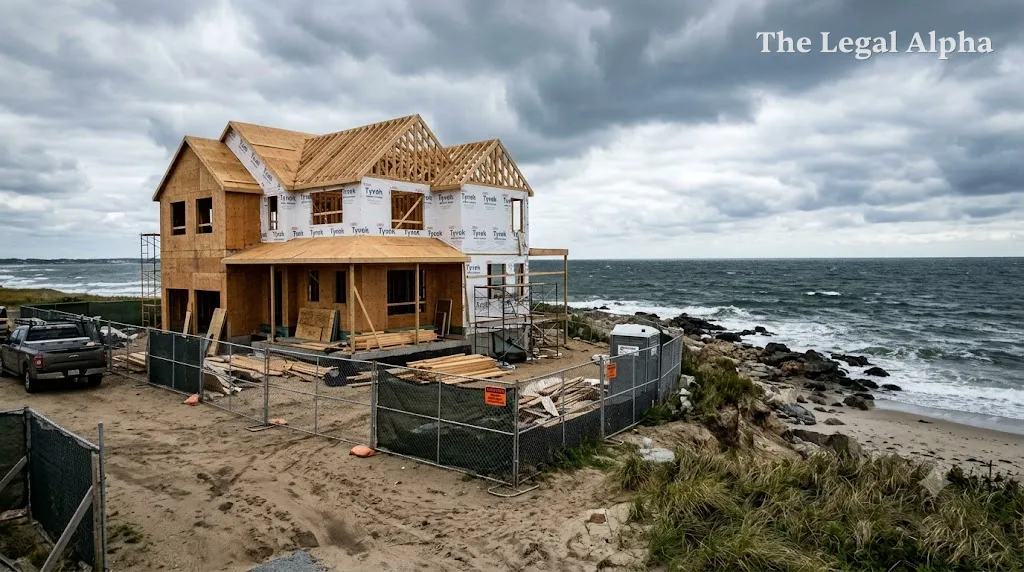
The Massachusetts Appeals Court affirmed a $3.7 million jury award and a permanent injunction against two property owners who mounted a years-long campaign of harassment to stop their neighbours from building an oceanfront residence.
The dispute originated after Margaret Reichenbach and her spouse acquired oceanfront land in 2008 and began constructing a home in 2009. Abutting neighbours Timothy Haydock and Susan Moss initially contested the project through municipal administrative channels, lodging repeated objections before the local conservation commission and state environmental authorities. When administrative and permitting challenges failed, their opposition escalated into persistent on-site obstruction, physical intimidation of workers, and intentional disruption that stretched the construction timeline over several years.
A Superior Court jury found the defendants liable for civil rights violations, common-law trespass, and tortious interference with contractual relations, awarding damages that the state appellate bench has now fully upheld.
Legal Topic
Area of Law: Real Property / Civil Rights / Tort Law Sub-topic: Massachusetts Civil Rights Act, Tortious Interference with Contracts, and Trespass
Core Legal Issue
The primary legal questions were whether persistent non-physical intimidation, continuous surveillance, and disruption directed at a landowner and their contractors satisfy the statutory threshold of "threats, intimidation, or coercion" under the Massachusetts Civil Rights Act, and whether making a party’s contractual performance significantly more burdensome and costly—absent a total breach—supports substantial tortious interference damages.
The appellate bench also had to resolve whether the trial judge abused discretion in admitting evidence across the prolonged dispute and whether the resulting multimillion-dollar damages and post-trial injunctive restrictions were excessive or overbroad.
What Did the Court Decide?
The Massachusetts Appeals Court affirmed the Superior Court judgments in their entirety, preserving the full $3.7 million verdict and the permanent injunction against Haydock and Moss.
The court held that:
-
The trial record contained sufficient evidence for a reasonable jury to conclude that the defendants used threats, intimidation, or coercion to interfere with the plaintiffs' exercise and enjoyment of their constitutional property rights under General Laws c. 12, §§ 11H and 11I.
-
The $2 million tortious interference award was justified because the law compensates a plaintiff when third-party conduct makes their contractual performance far more burdensome and financially draining, even if the underlying construction contract was completed rather than terminated.
-
The permanent injunction, which prohibits the defendants from surveilling, threatening, or coercing the owners, their immediate family, workers, and guests, rests on clear objective standards and is not unconstitutionally vague or overbroad.
-
The plaintiffs are statutorily entitled to recover their appellate attorney's fees and litigation costs under General Laws c. 12, § 11I.
Key Legal Points
-
Establishing an MCRA claim does not require physical violence; recurring adversarial surveillance, targeted shouting, vehicular obstruction, and menacing conduct satisfy the statutory standard of intimidation or coercion.
-
Under the Restatement (Second) of Torts § 766A, liability for intentional interference with contractual relations attaches where a defendant makes performance more burdensome or expensive, removing any requirement that the contract must be formally breached.
-
A jury’s damages allocation across distinct legal theories—here, $1.5 million for civil rights violations, $200,000 for trespass, and $2 million for tortious interference—will stand if clear jury instructions against double recovery are delivered and the evidence supports tangible and intangible harms.
-
Narrowly tailored injunctions prohibiting targeted surveillance, hovering near boundaries, and confronting private contractors on an owner's land do not infringe upon protected liberties when grounded in proven tortious conduct.
Relevant Law
-
Massachusetts Civil Rights Act (MCRA), G. L. c. 12, §§ 11H, 11I (providing private remedies, injunctive relief, and fee-shifting for interference with secured rights by threats, intimidation, or coercion).
-
Massachusetts Anti-SLAPP Statute, G. L. c. 231, § 59H (previously invoked by the defendants regarding municipal petitioning, with non-petitioning tortious acts proceeding to trial).
-
Restatement (Second) of Torts § 766A (intentional interference making another's performance of contract more onerous).
-
Common Law Trespass (unauthorized, non-privileged entry or physical encroachment upon real property in another's possession).
Arguments of the Parties
Appellants (Haydock and Moss) The defendants contended that the damages awarded were markedly against the weight of the evidence and unconstitutionally excessive. They asserted that the trial judge committed reversible error by admitting evidence outside relevant limitations periods, argued their activities did not rise to the legal threshold of coercive civil rights violations, and challenged the permanent injunction as impermissibly vague and overbroad.
Appellees (The Reichenbachs) The plaintiffs submitted that the defendants had engaged in continuous extra-legal harassment that escalated far beyond legitimate administrative petitioning. They demonstrated that the defendants repeatedly entered their property without authorization, stalked workers, blocked site access, surveilled their disabled child from adjoining bushes, and forced massive cost overruns and construction delays on their contractual agreements.
Why Does It Matter?
This ruling underscores the legal boundary between exercising rights of administrative petition and engaging in actionable, unlawful harassment. In high-stakes real estate disputes, aggrieved property owners frequently rely on administrative bodies, zoning boards, and environmental agencies to challenge adjacent developments. However, this decision affirms that when a neighbour abandons formal legal avenues and resort to intimidation, harassment of independent contractors, and boundary disruptions, they forfeit statutory protections and face severe liability under state civil rights and tort frameworks.
Moreover, the decision reinforces the practical reach of the Massachusetts Civil Rights Act into private boundary disputes and confirms that damages for intentional interference with contract can be substantial even without an outright contractual breach.
Legal Takeaway
Opposition to a neighbour's construction project must remain strictly confined to lawful administrative and judicial channels. Taking direct extra-judicial action—such as intimidating contractors, encroaching on site boundaries, and menacing landowners—exposes parties to significant personal liability, fee-shifting, and permanent injunctive restraints under civil rights and common-law tort doctrines.
Sources
Primary Source: Appeals Court of Massachusetts, Margaret Reichenbach v. Timothy Haydock, Docket No. 25-P-392 (decided July 29, 2026).
Additional Sources: Massachusetts General Laws Chapter 12, Sections 11H and 11I; Massachusetts General Laws Chapter 231, Section 59H; Superior Court trial proceedings.