Madras High Court Rules Hindu Marriage Act Cannot Validate Marriage Between Hindu and Christian
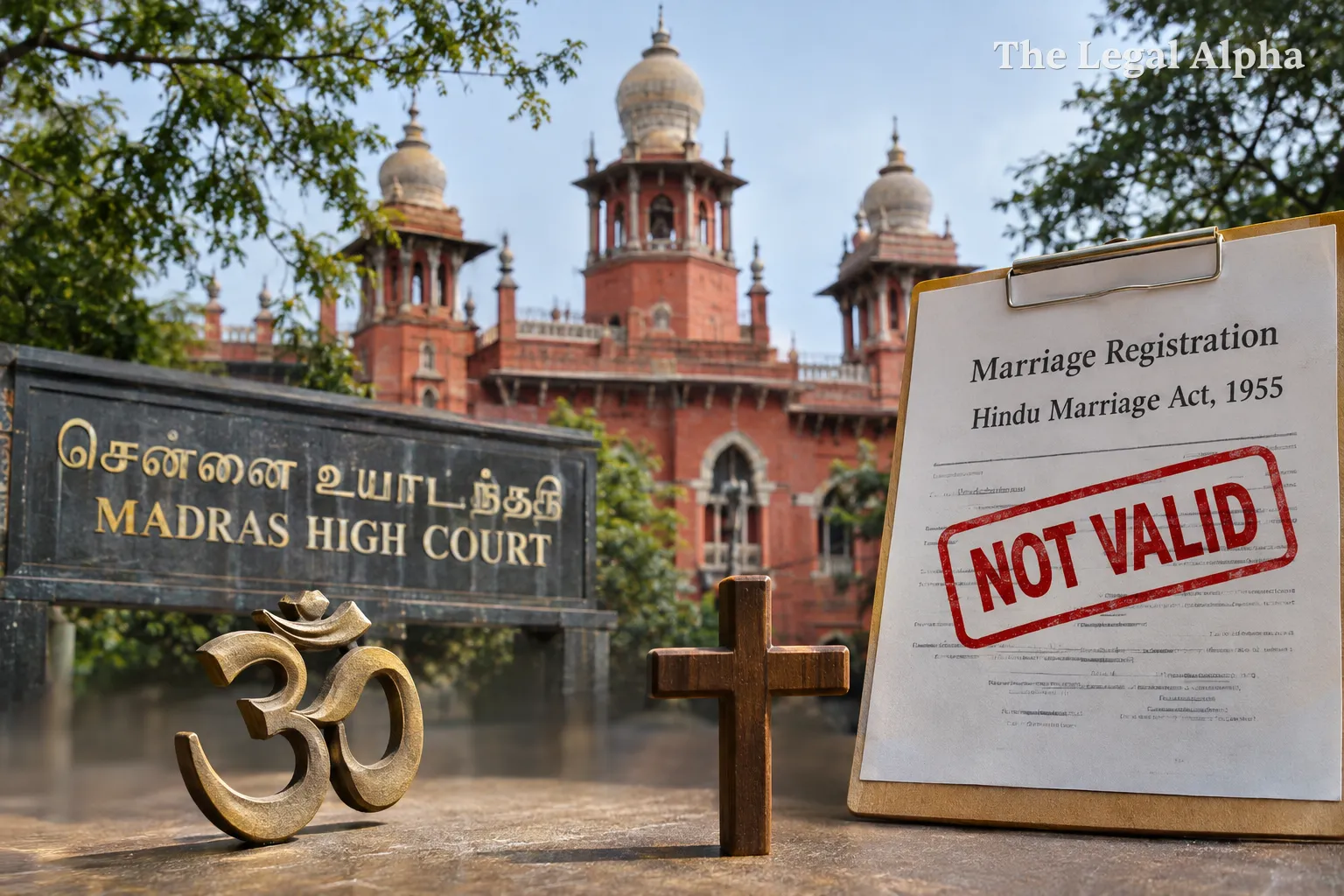
The Madras High Court has ruled that a marriage between a Hindu and a Christian cannot be solemnised or legally validated through registration under the Hindu Marriage Act, 1955.
A Division Bench comprising Justice C.V. Karthikeyan and Justice S. Raveekumar delivered the ruling on November 19, 2026, while allowing an appeal in A. Naveen Kumar v. K. Vigneswari.
The dispute concerned a marriage registered in February 2009. The husband challenged the registration, arguing that he was a Christian at the time and that no marriage ceremony had actually taken place before the registration.
The High Court ultimately declared the marriage registration null and void, holding that the Hindu Marriage Act cannot be used to validate a marriage where one party does not profess Hinduism.
Legal Topic
Area of Law: Family Law and Matrimonial Law
Sub-topic: Interfaith Marriage, Validity of Marriage and Registration under the Hindu Marriage Act, 1955.
Core Legal Issue
The central question before the High Court was whether a marriage between a Hindu and a Christian could be solemnised and registered under the Hindu Marriage Act, 1955.
The Bench examined whether registration under Section 8 could validate a marriage that did not satisfy the eligibility requirements under Section 5 of the Act. It also considered whether the evidence established that the husband was a Christian when the marriage was registered.
What Did the Court Decide?
The High Court allowed the husband's appeal and set aside the judgment of the V Additional Family Court, Chennai, dated November 13, 2019.
The Bench reached its conclusion after examining the baptism certificates, marriage registration documents and evidence presented during the family court proceedings.
The Court found that:
-
The husband had undergone baptism in 1998 and again in 2006, when he adopted the Pentecostal faith. The two dates did not establish a contradiction, as the subsequent baptism was connected with his move to a different Christian denomination.
-
The husband was a Christian at the time of the alleged marriage in February 2009.
-
The marriage certificate contained incorrect particulars, and the respondent admitted during cross-examination that no marriage ceremony had taken place before registration.
-
Section 7A of the Hindu Marriage Act, which recognises self-respect marriages in Tamil Nadu, could not be invoked because both parties must be Hindus.
-
Registration under Section 8 could not cure the legal defect.
The Court declared the marriage registered under Serial No. 157 of 2009, dated February 20, 2009, null and void. It also directed that a copy of the judgment be circulated to marriage registrars across Tamil Nadu for their information and guidance.
Key Legal Points
-
Hindu Marriage Act applies to Hindus: Section 5 requires both parties to a marriage solemnised under the Act to be Hindus.
-
Registration cannot cure an invalid marriage: Section 8 provides for registration of Hindu marriages already solemnised in accordance with law.
-
Religious identity must be established through evidence: A person's name or entries in general government identity documents cannot, by themselves, determine their religion.
-
Self-respect marriages have eligibility requirements: Section 7A does not extend to marriages where one party is not Hindu.
-
Interfaith marriages have alternative legal routes: The Indian Christian Marriage Act, 1872, and the Special Marriage Act, 1954, provide statutory frameworks for marriages involving persons of different religions, subject to their respective requirements.
Relevant Law
Hindu Marriage Act, 1955
-
Section 5 – Conditions for a Hindu marriage.
-
Section 7 – Ceremonies for a Hindu marriage.
-
Section 7A – Special provision relating to self-respect marriages in Tamil Nadu.
-
Section 8 – Registration of Hindu marriages.
Indian Christian Marriage Act, 1872
-
Section 4 – Marriages involving Christians must comply with the Act.
-
Section 5 – Persons authorised to solemnise marriages.
-
Sections 38–42 – Procedures relating to notice and certification.
-
Sections 51–54 – Solemnisation and registration requirements.
Special Marriage Act, 1954
-
Section 4 – Conditions for solemnisation of special marriages.
-
Sections 4–14 – Procedure for solemnisation.
-
Sections 15, 16 and 18 – Registration of marriages celebrated in other forms and the legal effect of registration.
Important Supreme Court Precedent
Gullipilli Sowria Raj v. Bandaru Pavani (2009) 1 SCC 714.
The Supreme Court held that a marriage between a Hindu and a person professing another religion is not recognised under Section 5 of the Hindu Marriage Act and cannot be validated merely through registration under Section 8.
Arguments of the Parties
Appellant (Husband)
The husband argued that he was a Christian when the marriage was registered and that the registration violated Section 5 of the Hindu Marriage Act. He also alleged that he had been misled into visiting the Registrar's Office under the impression that he would sign as a witness to another marriage.
His counsel further argued that no marriage ceremony had taken place and that the registration certificate contained incorrect information.
Respondent (Wife)
The wife disputed the husband's account and maintained that he had proposed the marriage himself. She claimed that both families initially opposed their relationship and that the marriage was registered with his knowledge and participation.
She also alleged that the husband's family subsequently opposed the marriage and prevented them from living together.
The respondent did not appear before the High Court despite being given opportunities to participate in the appeal.
Why Does It Matter?
The judgment reinforces the distinction between solemnisation of a marriage and its subsequent registration.
It makes clear that a marriage certificate cannot independently establish legal validity when the underlying marriage does not satisfy the statutory requirements.
The ruling is particularly relevant for:
-
Interfaith couples: It clarifies the statutory routes available for marriages involving Hindus and Christians.
-
Marriage registrars: Authorities must verify the religious particulars and other relevant information before registering marriages.
-
Family courts: The judgment provides guidance on examining religious identity and documentary evidence in matrimonial disputes.
-
Individuals entering marriage: Couples must follow the appropriate legal procedure rather than assume that registration under any marriage law automatically makes their union valid.
The Court's direction to circulate the judgment among marriage registrars and Family Courts in Tamil Nadu also highlights the importance of accurate documentation and compliance with statutory procedures.
Legal Takeaway
The Hindu Marriage Act, 1955, does not provide a legal mechanism for solemnising a marriage between a Hindu and a Christian. Registration under Section 8 cannot cure this fundamental defect. Interfaith couples must follow the applicable statutory procedure under the Indian Christian Marriage Act, 1872, or the Special Marriage Act, 1954.
Sources
Primary Source:
- A. Naveen Kumar v. K. Vigneswari, A.S. No. 79 of 2020, 2026:MHC:4630, Madras High Court, judgment dated November 19, 2026. Read the full judgment.
Additional Sources: