Supreme Court Rules DDA Cannot Withhold Retired Employees’ Gratuity Merely Due to Pending Appeal Against Acquittal
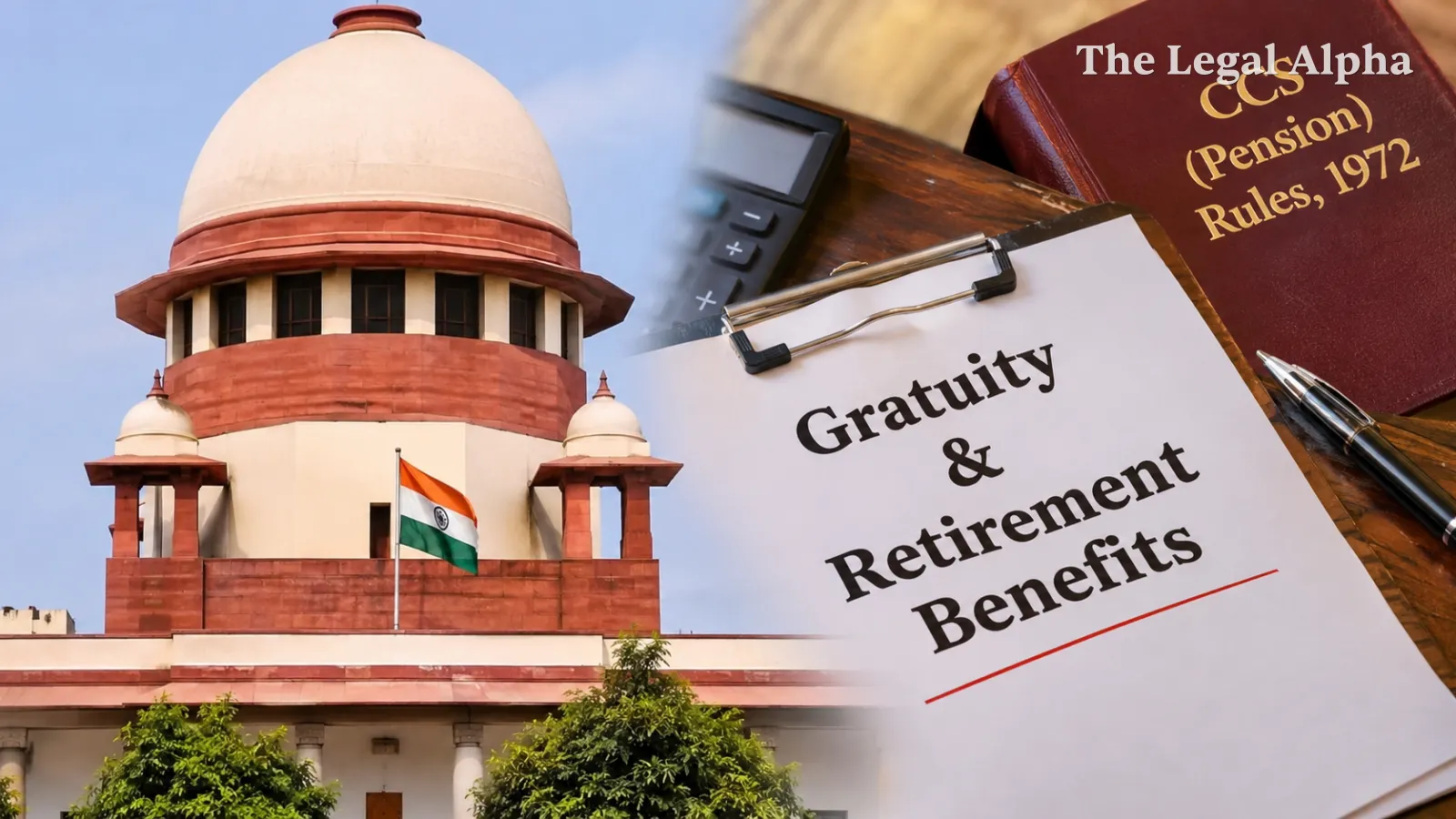
The Supreme Court has clarified that a pending challenge to an employee’s acquittal cannot, by itself, justify withholding retirement gratuity indefinitely when the trial court’s acquittal remains in force and there is no stay on its operation.
In Delhi Development Authority v. Rajender Kumar Sharma & Anr., decided on November 16, 2026, a Bench of Justice Prashant Kumar Mishra and Justice Shree Chandrashekhar dismissed appeals filed by the Delhi Development Authority (DDA) against orders directing the release of gratuity amounting to approximately ₹33.95 lakh to two retired employees, subject to their undertaking to refund the amount with interest if the pending judicial proceedings ultimately go against them.
What Happened?
The dispute arose from a corruption case registered in 2001 against officials of the DDA, Municipal Corporation of Delhi and the Slum and Jhuggi-Jhopri Department.
The prosecution alleged that officials had included fictitious beneficiaries in a survey conducted to identify eligible slum dwellers for relocation and allotment of alternative plots, allegedly in connivance with property dealers.
The two employees, Rajender Kumar Sharma and Satendra Pal, were acquitted by a Special Court in February 2017, although four other accused were convicted. The State subsequently approached the Delhi High Court seeking permission to challenge their acquittal.
Despite the acquittal, the DDA withheld gratuity of ₹18,52,224 payable to Sharma and ₹15,43,113 payable to Pal, citing the pending proceedings.
The employees challenged the withholding of their retirement benefits before the Central Administrative Tribunal (CAT), which directed the DDA to release the amounts with applicable interest, subject to refund undertakings. The Delhi High Court subsequently upheld the Tribunal's decision.
The DDA then approached the Supreme Court.
Area of Law and Sub-topic
Area of Law: Service Law
Sub-topic: Pensionary Benefits, Gratuity and Withholding of Retirement Dues During Judicial Proceedings.
Core Legal Issue
The central question before the Supreme Court was whether an employer could continue withholding an employee's retirement gratuity under Rule 69(1)(c) of the Central Civil Services (Pension) Rules, 1972, merely because the State had initiated proceedings seeking permission to appeal against the employee's acquittal.
The Court also considered whether releasing gratuity subject to an undertaking to refund the amount with interest would adequately protect the employer's financial interests while ensuring that retired employees were not deprived of benefits earned through years of service.
What Did the Supreme Court Decide?
The Supreme Court rejected the DDA's challenge and upheld the orders directing payment of gratuity to both retired employees.
The Bench observed that the criminal trial had already concluded with an acquittal. The mere possibility that an appellate court might subsequently interfere with that decision could not be treated as sufficient grounds to continue withholding the employees' terminal benefits.
The Court emphasised that an acquittal remains operative unless it is set aside by a competent appellate court. The pendency of the State's challenge, particularly in the absence of a stay against the acquittal, did not revive the statutory restriction on payment of gratuity.
The Court also recognised the practical hardship caused by requiring retired employees to wait indefinitely for appellate proceedings to conclude.
It held that the refund undertaking imposed by the CAT and upheld by the Delhi High Court adequately protected the DDA's financial interests.
Accordingly, both appeals filed by the DDA were dismissed.
Key Legal Points
- Acquittal has legal effect: Once a criminal trial concludes in acquittal, the acquittal remains operative unless overturned by an appellate court.
- Pending appeal is not an automatic ground for withholding gratuity: The mere pendency of an application seeking leave to appeal, without a stay on the acquittal, does not justify indefinite withholding of retirement dues.
- Refund undertaking protects public funds: Employers can protect their financial interests through an undertaking requiring employees to return the gratuity with interest if the proceedings ultimately go against them.
- Retirement benefits must remain meaningful: Retired employees should not be compelled to wait indefinitely for appellate proceedings, particularly when the delay is not attributable to them.
- Similar employees should receive consistent treatment: The Supreme Court rejected the DDA's attempt to disregard the relief granted to similarly placed employees under an earlier judicial decision.
Relevant Legal Provisions and Precedents
Rule 69(1)(c), Central Civil Services (Pension) Rules, 1972
The provision restricts payment of gratuity until the conclusion of departmental or judicial proceedings and the issuance of final orders. The Supreme Court clarified its application where the criminal trial has already ended in acquittal, but the State's challenge to that acquittal remains pending.
Section 378, Code of Criminal Procedure, 1973
This provision concerns appeals against acquittals and the requirement of obtaining leave from the appellate court. The State invoked this provision to challenge the employees' acquittal.
Section 419, Bharatiya Nagarik Suraksha Sanhita, 2023
The corresponding provision under the new criminal procedure framework.
Kishan Lal Taneja v. Government of NCT of Delhi (2022)
The Delhi High Court had previously directed the release of gratuity to a co-accused acquitted in the same criminal case, subject to an undertaking to refund the amount if the acquittal was subsequently reversed. The Supreme Court relied on this precedent.
Bikram Chand Rana v. Himachal Pradesh Road Transport Corporation (2026)
The Supreme Court distinguished this decision because it concerned a case where the criminal trial was still pending. The circumstances were materially different from those involving employees who had already been acquitted after trial.
Arguments of the Parties
Delhi Development Authority
The DDA challenged the directions requiring it to release the gratuity. It questioned the reliance on the earlier decision in Kishan Lal Taneja and argued that the pending judicial proceedings justified withholding the amounts under Rule 69(1)(c) of the CCS (Pension) Rules.
It also relied on the Supreme Court's decision in Bikram Chand Rana, seeking to support its position regarding the statutory restriction on payment and the possibility of subsequent recovery.
Retired Employees
The employees sought release of their gratuity on the basis that they had already been acquitted after a full-fledged criminal trial. They relied on the relief granted to a similarly placed co-accused and maintained that the State's pending challenge, without any stay against the acquittal, could not deprive them of their retirement benefits indefinitely.
Their position was accepted by the CAT and the Delhi High Court, subject to the refund undertaking.
Why Does It Matter?
The ruling is significant for retired government employees whose gratuity remains withheld because of prolonged judicial proceedings.
It clarifies the distinction between a pending criminal trial and an appeal against an acquittal. An employer cannot automatically treat both situations alike when determining whether retirement benefits have become payable.
The judgment also addresses the practical consequences of prolonged litigation. Gratuity is an important retirement benefit, and delaying its payment for years can seriously affect employees who have already completed their service.
For government departments and public authorities, the decision highlights the importance of applying pension rules in accordance with the actual procedural status of criminal proceedings.
The refund undertaking provides a practical mechanism to balance the rights of retired employees with the need to safeguard public money.
Legal Takeaway
The Supreme Court has reaffirmed that a retired employee's gratuity cannot be withheld indefinitely merely because the State has challenged an acquittal. Once the trial ends in acquittal and no stay is operating, retirement benefits become payable, subject to appropriate safeguards where necessary. The judgment reinforces the principle that prolonged litigation should not deprive retired employees of the financial benefits earned through decades of service.
Sources
Primary Source: Supreme Court of India, Delhi Development Authority v. Rajender Kumar Sharma & Anr., Civil Appeal Nos. 14204 and 14205 of 2026, 2026 INSC 1213, decided on November 16, 2026.
Read the Supreme Court's original judgment (PDF).
Additional Sources: