Bombay High Court Protects Shooter’s Right to Pursue Sport, Orders Approval of Six Additional Firearms
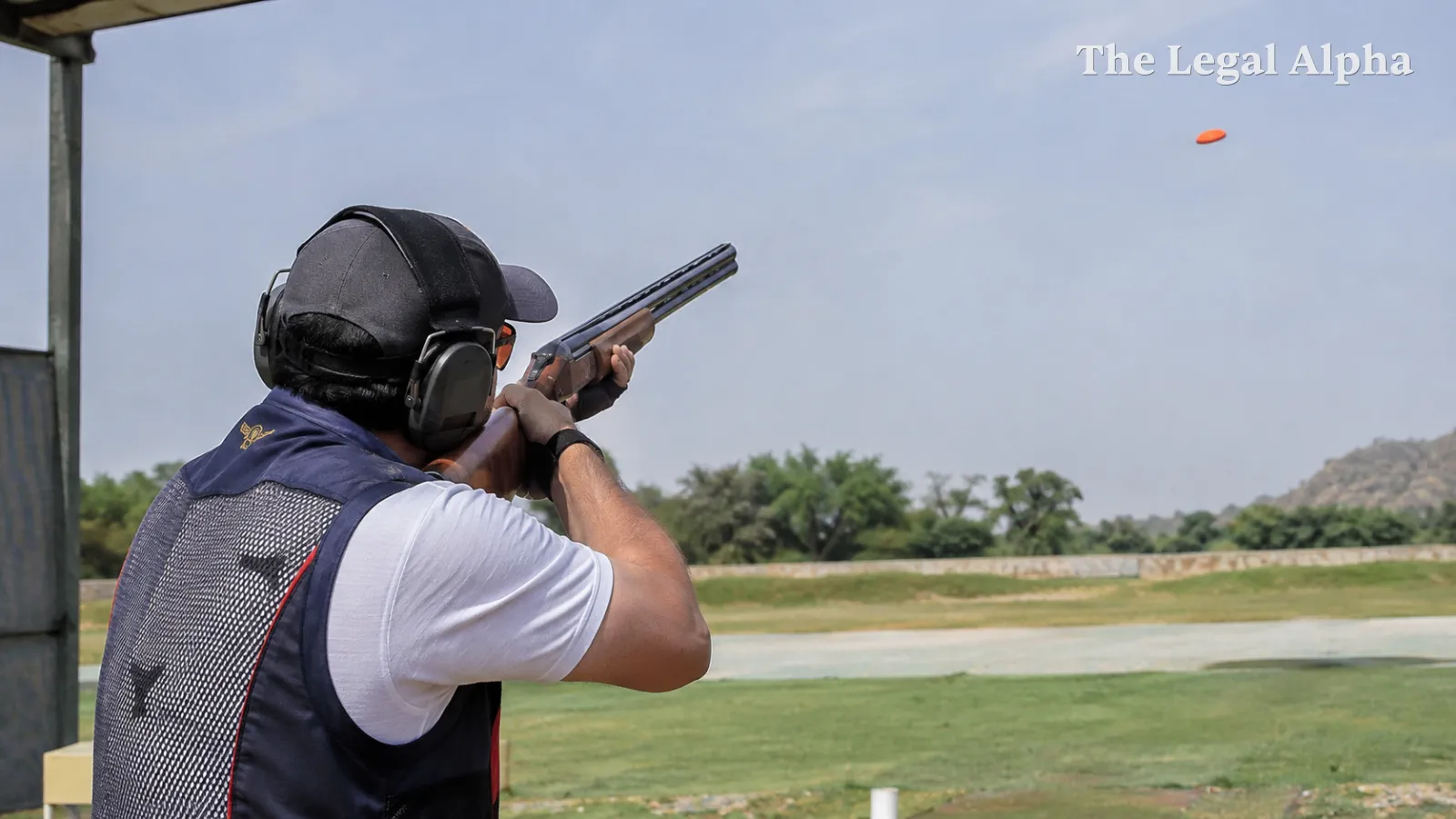
The Bombay High Court has ruled in favour of a national-level shooter whose request for six additional firearms for sporting purposes was rejected by the Maharashtra authorities.
In Hemant Ankush Balwadkar v. State of Maharashtra & Anr., Justice Milind N. Jadhav held that refusing permission to an eligible sportsperson without sufficient justification could amount to an arbitrary restriction on his fundamental right to participate in the sport of his choice.
The Court found that the authorities could not rely merely on the pendency of a criminal case, particularly when the FIR did not attribute any specific role or act of violence to the petitioner.
The judgment was delivered on November 18, 2026, in Writ Petition No. 2180 of 2026.
Legal Topic
Area of Law: Constitutional Law and Criminal Law
Sub-topic: Arms Licensing, Fundamental Rights and Rights of Sportspersons
Core Legal Issue
The central question before the High Court was whether the licensing authorities could refuse a recognised sportsperson permission to acquire additional firearms required for professional shooting practice merely because a criminal case was pending against him.
The Court also examined whether the rejection orders complied with the requirements of the Arms Act, 1959, and whether the authorities had properly considered the petitioner's eligibility under the Central Government's notification dated February 12, 2020.
What Did the Bombay High Court Decide?
The petitioner, Hemant Ankush Balwadkar, is a Pune-based clay pigeon trap shooter recognised by the National Rifle Association of India in two disciplines. He has participated in national and international competitions and already held four firearms under his licence.
Seeking to upgrade his shooting performance, he applied for six additional firearms comprising three non-prohibited bore revolvers or pistols and three rifles. He relied on the Ministry of Home Affairs notification dated February 12, 2020, which permitted eligible sportspersons to possess additional firearms within the prescribed limits.
However, the Commissioner of Police, Pune, rejected his application on January 24, 2025, stating that the additional firearms appeared to be intended for personal use or safety. His subsequent statutory appeal before the State Government was also rejected.
The petitioner challenged these decisions before the High Court, arguing that the authorities had failed to consider his sporting requirements and had relied on a pending FIR in which no specific role was attributed to him.
Justice Milind N. Jadhav found that the original rejection order was an unreasoned and non-speaking order passed without proper application of mind.
The Court further observed that there was no material suggesting that the petitioner had misused his existing firearms or posed any threat to public safety or security.
It also rejected the reliance on the pending criminal case, noting that the FIR did not attribute any role or incident of violence to the petitioner.
Holding that the refusal was arbitrary and interfered with his ability to participate in his chosen sport, the Court quashed both rejection orders.
The High Court allowed the petitioner's application for six additional firearms and directed the Additional Commissioner of Police, Pune, to endorse them on his arms licence within seven days of receiving the application for endorsement along with the Court's order.
Key Legal Points
- Right to participate in sport: The Court recognised that an arbitrary refusal to provide eligible sporting firearms could interfere with a sportsperson's fundamental right to participate in the sport of his choice.
- Pending criminal proceedings: The mere pendency of a criminal case cannot automatically justify action under Section 17 of the Arms Act, 1959.
- Requirement of reasoned orders: Licensing authorities must apply their minds and provide proper reasons when rejecting applications for additional firearms.
- Public safety considerations: The authorities must consider relevant material concerning misuse of firearms or threats to public peace and security rather than rely on unsupported assumptions.
- Sporting eligibility: The petitioner's eligibility under the February 12, 2020, Central Government notification was an important consideration in assessing his request.
Relevant Law
Arms Act, 1959
-
Section 3: Deals with the requirement of a licence for acquisition and possession of firearms and ammunition.
-
Section 13: Governs the grant of licences.
-
Section 14: Specifies grounds on which a licence may be refused.
-
Section 17: Deals with variation, suspension and revocation of licences.
Arms Rules, 2016
- Schedule V: Prescribes the relevant procedural timelines, including disposal of statutory appeals within 60 days and the seven-day period for the endorsement directed in this case.
Ministry of Home Affairs Notification dated February 12, 2020
The notification provides the framework for eligible sportspersons to possess additional firearms within the prescribed limits. The petitioner relied on the provision permitting a maximum of 12 firearms, comprising 10 in the exempted category and two for personal use under Section 3(2) of the Arms Act.
Constitution of India
- Article 21: The right to life and personal liberty, discussed in the context of the earlier Bombay High Court precedent relied upon in the judgment.
Arguments of the Parties
Petitioner's Arguments
The petitioner argued that his existing firearms had become old and obsolete due to prolonged use, affecting his shooting accuracy and performance.
He submitted that the 2020 Central Government notification made him eligible to possess additional firearms for sporting purposes. He further contended that the authorities had rejected his application without adequate reasons and had unfairly relied on a pending criminal case that did not attribute any specific role to him.
He also highlighted that his statutory appeal had not been decided within the prescribed 60-day period under Schedule V of the Arms Rules, 2016.
State's Arguments
The State opposed the petition, maintaining that the notification did not create an automatic or absolute right to obtain additional firearms.
It argued that the petitioner had not sufficiently justified the requirement for six more firearms and that the authorities had considered the relevant police report and the pending criminal proceedings before rejecting his request.
The State also maintained that the offences alleged against the petitioner were serious and could not simply be disregarded.
Why Does It Matter?
The judgment highlights the importance of balancing firearm licensing regulations with the legitimate requirements of recognised sportspersons.
Professional shooting requires regular practice, suitable equipment and the ability to maintain competitive standards. An unreasonable delay or rejection of applications can directly affect an athlete's preparation and participation in national and international competitions.
The ruling also reinforces an important principle of administrative law: licensing authorities cannot exercise statutory powers mechanically or rely on the mere existence of criminal proceedings without examining the actual circumstances of the case.
For sportspersons seeking additional firearms under applicable government notifications, the decision highlights the importance of proper consideration of sporting credentials, eligibility and genuine professional requirements.
However, the judgment does not establish an unconditional right for every sportsperson to acquire additional firearms. Applications remain subject to the applicable statutory requirements and relevant public safety considerations.
Legal Takeaway
The Bombay High Court has made it clear that a pending criminal case, without supporting material showing misuse of firearms or a threat to public safety, cannot automatically justify refusing an eligible sportsperson's request for additional sporting firearms. Licensing authorities must give reasoned decisions and consider the applicant's genuine sporting requirements in accordance with the law.
Sources
Primary Source:
Hemant Ankush Balwadkar v. State of Maharashtra & Anr., Writ Petition No. 2180 of 2026, Bombay High Court, judgment dated November 18, 2026.
Read the Bombay High Court Judgment (PDF).
Additional Source:
Verdictum – Report on the Bombay High Court Decision.