Supreme Court Rejects Jasir Bilal Wani’s Default Bail Plea in Red Fort Blast Case
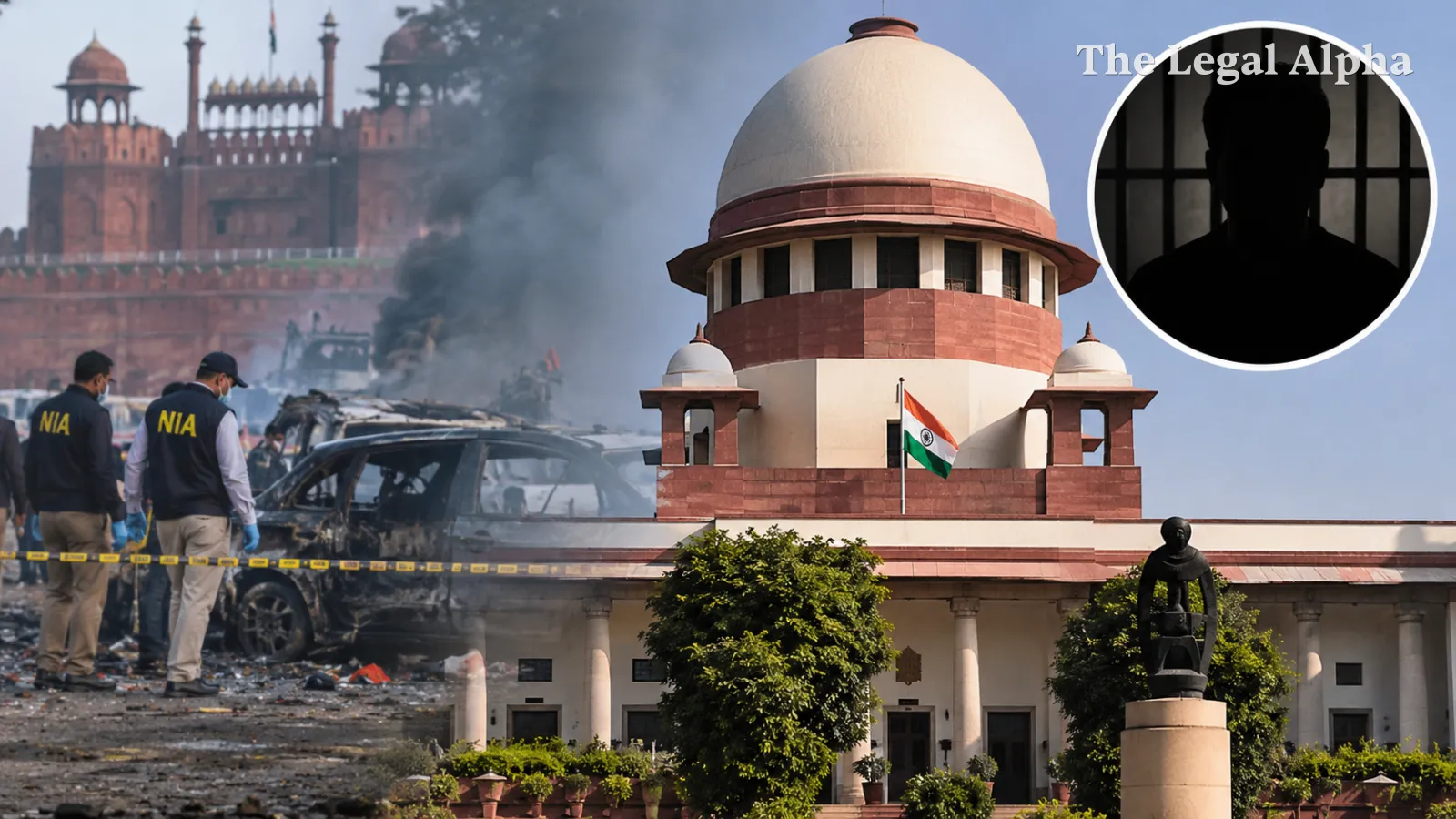
The Supreme Court has refused to grant default bail to Jasir Bilal Wani, an accused in the November 2025 Red Fort blast case, upholding the Delhi High Court’s interpretation of the extended investigation period available under the Unlawful Activities (Prevention) Act (UAPA).
The decision concerns an important question arising from the replacement of the Code of Criminal Procedure (CrPC) by the Bharatiya Nagarik Suraksha Sanhita (BNSS): whether the investigation period for UAPA offences remains 180 days or is reduced to 90 days.
What Happened?
A Bench of Justices Prashant Kumar Mishra and Shree Chandrashekhar dismissed Wani’s challenge to the Delhi High Court judgment dated August 18, 2026.
Wani had sought default bail on the ground that the investigating agency was required to file its chargesheet within 90 days. His argument was based on the replacement of the CrPC by the BNSS and the interpretation of the relevant provisions of the UAPA.
The National Investigation Agency (NIA), however, had obtained extensions of the investigation period, allowing it to investigate for up to 180 days. The chargesheet was subsequently filed on May 14, 2026.
Legal Topic
Area of Law: Criminal Law
Sub-topic: Default Bail, UAPA Investigation Period and Interpretation of Criminal Procedure Laws
Core Legal Issue
The central legal question was whether Section 43D(2) of the UAPA, which refers to Section 167 of the CrPC, should now be interpreted with reference to Section 187 of the BNSS following the repeal of the CrPC.
The issue was significant because the applicable interpretation determines whether an accused facing UAPA charges can claim default bail after 90 days or whether the investigating agency can obtain an extension permitting detention for up to 180 days.
What Did the Supreme Court Decide?
The Supreme Court declined to entertain Wani’s Special Leave Petition (Criminal) No. 22055/2026 and dismissed it.
During the hearing, the Bench questioned whether accepting Wani’s interpretation would effectively mean that Section 43D of the UAPA stopped functioning merely because the CrPC had been repealed.
The Court was not persuaded by the petitioner’s submissions and refused to interfere with the Delhi High Court's decision.
It is important to distinguish the effect of this dismissal from a detailed Supreme Court judgment on the statutory question. The dismissal leaves the High Court's decision undisturbed in this case, but the Supreme Court did not deliver a reasoned judgment setting out a separate interpretation of the UAPA-BNSS relationship.
Key Legal Points
-
Extended investigation period: Section 43D(2)(b) of the UAPA permits the investigation period to be extended up to 180 days, subject to the statutory requirements.
-
CrPC and BNSS relationship: The case concerns whether references to Section 167 of the CrPC in the UAPA should be read as references to the corresponding provision under Section 187 of the BNSS.
-
Default bail: An accused becomes entitled to default bail when the investigating agency fails to file the chargesheet within the applicable statutory period, subject to the relevant legal conditions.
-
Judicial scrutiny of extensions: An extension of the investigation period must satisfy the requirements prescribed under the UAPA, including the necessary report and judicial satisfaction.
-
Supreme Court proceedings: The dismissal of the SLP leaves the Delhi High Court's ruling intact, without constituting a detailed, reasoned Supreme Court ruling on every aspect of the statutory interpretation.
Relevant Law
Unlawful Activities (Prevention) Act, 1967
-
Section 43D(2): Modified application of certain provisions concerning investigation, custody and default bail.
-
Section 43D(2)(b): Provides for extension of the investigation period up to 180 days, subject to statutory conditions.
Bharatiya Nagarik Suraksha Sanhita, 2023
- Section 187: Governs detention during investigation and the statutory framework for default bail.
Code of Criminal Procedure, 1973
- Section 167: The corresponding earlier provision governing detention during investigation and default bail.
General Clauses Act, 1897
- Section 8: Deals with the construction of references to repealed and re-enacted provisions.
National Investigation Agency Act, 2008
- Section 21: Provides the statutory framework for appeals against specified judgments and orders of Special Courts.
Arguments of the Parties
Petitioner – Jasir Bilal Wani
Senior Advocate Warisha Farasat, appearing for Wani, argued that Section 43D of the UAPA specifically incorporates provisions of the CrPC with modifications. She submitted that the reference to Section 167 of the CrPC could not automatically be treated as a reference to Section 187 of the BNSS.
She further argued that the change in criminal procedure law entitled an accused under the UAPA to claim default bail after 90 days rather than the extended 180-day period.
Respondent – National Investigation Agency
The NIA had sought extensions of the investigation period under Section 43D(2) of the UAPA. The extension applications were allowed by the trial court, permitting the investigation period to reach 180 days.
The Delhi High Court accepted the applicability of the extended period by reading the reference to Section 167 of the CrPC in light of Section 187 of the BNSS and Section 8 of the General Clauses Act.
The NIA's position was consequently sustained by the High Court, whose decision the Supreme Court declined to disturb.
Why Does It Matter?
The proceedings address an important transitional issue in Indian criminal law following the introduction of the BNSS in place of the CrPC.
Several special statutes contain references to provisions of the earlier criminal procedure framework. The interpretation of these references becomes significant when the general procedural legislation is repealed and replaced.
For investigating agencies handling cases under the UAPA, the Delhi High Court's interpretation supports the continued availability of the extended investigation period, provided the statutory requirements are fulfilled.
For accused persons, the issue directly affects the timing and availability of default bail, which is an important procedural safeguard against indefinite detention during investigation.
The Supreme Court's dismissal is significant for the parties because the High Court's ruling remains undisturbed. However, the absence of a detailed Supreme Court judgment means the dismissal should not be presented as a comprehensive ruling on every question concerning statutory references from the CrPC to the BNSS.
Legal Takeaway
The Supreme Court has declined to interfere with the Delhi High Court's decision permitting the extended 180-day investigation period under the UAPA in Jasir Bilal Wani's case. The proceedings highlight the importance of interpreting statutory references to the repealed CrPC in the context of the BNSS while preserving the safeguards governing default bail.
Sources
Primary Sources:
Additional Sources: