Supreme Court Protects SASTRA University from Eviction Pending Further Hearing
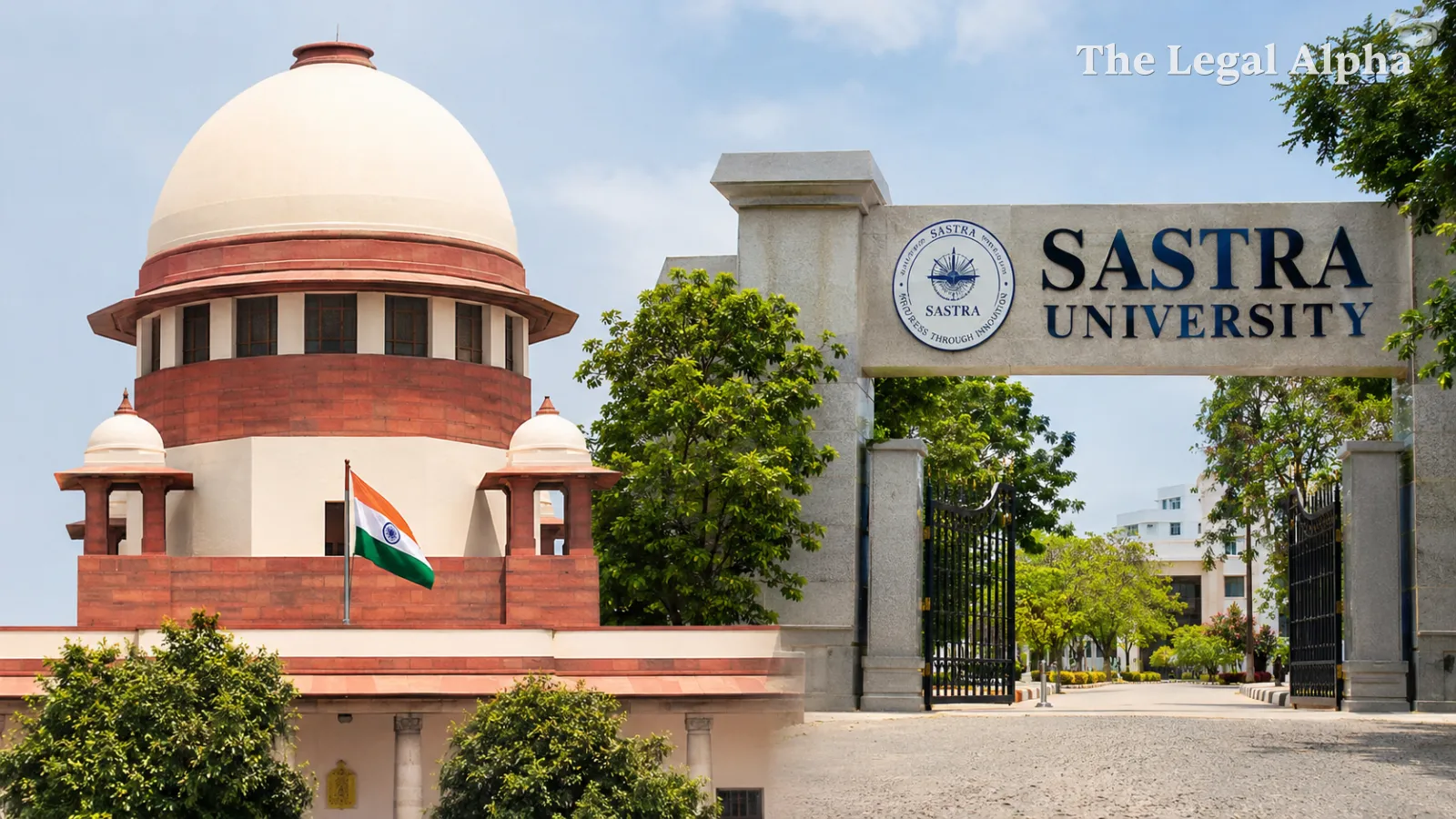
The Supreme Court has intervened in the dispute between SASTRA University and the Tamil Nadu government over land occupied by the university, staying the proposed eviction for the time being. The interim protection keeps the university on the disputed government land while the legal challenge remains under consideration.
The dispute raises important questions about government land, alleged encroachment, the exercise of eviction powers and the legal protections available to institutions contesting such action.
What Happened?
The dispute concerns 31.37 acres of government land at Thirumalaisamudram village in Thanjavur district, Tamil Nadu, currently occupied by SASTRA University as part of its campus.
The land was originally allotted to the Tamil Nadu Prison Department for establishing an open-air jail. The State maintains that the university occupied the property without authorisation. SASTRA, meanwhile, has sought to retain the land by offering alternative parcels of land or monetary compensation.
The dispute has remained under litigation for nearly three decades. On January 9, 2026, the Madras High Court upheld the State government's position and directed the implementation of the eviction notice. SASTRA subsequently approached the Supreme Court.
Legal Topic
Area of Law: Constitutional Law and Administrative Law
Sub-topic: Government Land Encroachment, Eviction Proceedings and Judicial Review
Core Legal Issue
The central legal question is whether the State government can proceed with the eviction of an educational institution occupying government land when the institution has proposed alternative land or financial compensation as a possible resolution.
The proceedings also raise questions about the government's discretion in dealing with public property, the implementation of eviction orders and the extent to which courts can intervene when public-purpose considerations are involved.
What Did the Supreme Court Decide?
On November 23, 2026, a three-judge Bench comprising Chief Justice of India Surya Kant and Justices Joymalya Bagchi and V Mohana continued protection against SASTRA University's eviction.
After the Tamil Nadu government informed the Court that it was unwilling to accept the university's alternative proposals, the Bench issued notice on the university's challenge and made the interim protection against dispossession absolute.
The Court also stayed the Madras High Court's eviction directions and consequential measures that could result in the university losing possession of the disputed property.
The State government has been asked to respond to the university's plea. The Supreme Court has not finally determined the parties' competing claims over the land.
What has been decided: The university cannot be dispossessed of the disputed land while the interim protection remains in force.
What remains pending: The legality of the State's decision, the university's challenge to the eviction and the ultimate resolution of the land dispute.
Key Legal Points
-
The State government maintains that the university occupies 31.37 acres of public land without lawful authorisation.
-
SASTRA University has proposed alternative land parcels and monetary compensation to resolve the dispute.
-
The Supreme Court previously encouraged the State to examine alternative arrangements while protecting the public exchequer.
-
The State's refusal to accept the proposals has moved the dispute towards adjudication on its legal merits.
-
The latest order preserves the university's possession without granting it ownership or permanently regularising its occupation.
Relevant Law
The dispute primarily concerns the legal control and administration of government land.
Relevant legal principles include:
-
Article 14 of the Constitution of India: Government decisions concerning public property must satisfy the requirements of fairness and non-arbitrariness.
-
Article 226 of the Constitution: Provides the High Court with powers of judicial review over government and administrative action.
-
Article 136 of the Constitution: Provides the Supreme Court with discretionary appellate jurisdiction.
-
Principles of Administrative Law: Government decisions involving public land must comply with applicable laws, policies and procedural requirements.
The dispute also involves the State's land-allocation and land-exchange policies. The precise statutory provisions governing the disputed parcel would need to be examined alongside the relevant government orders.
Arguments of the Parties
SASTRA University
The university has sought to avoid eviction by offering alternative parcels of land and monetary compensation. It has maintained that an alternative arrangement could resolve the dispute without requiring the demolition of educational infrastructure.
During the proceedings, the university also expressed willingness to provide financial compensation and alternative land even after the State declined its earlier proposals.
State of Tamil Nadu
The State government has maintained that the university has occupied government property without authorisation and that the land was earmarked for an open-air jail.
The State opposed accepting alternative land, arguing that granting such concessions could create an undesirable precedent for other occupants of government property seeking similar treatment.
Why Does It Matter?
The Supreme Court's intervention highlights the challenge of balancing the protection of government property with the public function performed by educational institutions.
The dispute has implications beyond SASTRA University. Government authorities regularly deal with unauthorised occupation of public land, and the case raises questions about whether alternative arrangements can be considered without undermining established rules governing public property.
The proceedings also demonstrate that interim judicial protection does not automatically confer ownership or legalise an alleged encroachment. The university's continued occupation remains subject to the final outcome of the litigation.
For government authorities, the case reinforces the importance of transparent and legally sustainable decisions when dealing with public land. For educational institutions, it highlights that offering compensation or alternative property does not, by itself, create an enforceable right to retain government land.
Legal Takeaway
The Supreme Court has protected SASTRA University from eviction while its challenge proceeds, but it has not granted the university permanent rights over the disputed land. The final decision will determine the legality of the State's eviction action and the university's claims concerning the proposed alternative arrangements.
Sources
Primary Source:
- Supreme Court of India, Shanmugha Arts, Science, Technology and Research Academy (SASTRA) v. State of Tamil Nadu, SLP (C) Nos. 2359–2360 of 2026, order dated January 15, 2026. Read Supreme Court order.
Additional Sources: