Supreme Court Considers BS-VI-Only Vehicle Policy for Delhi-NCR Amid Rising Air Pollution
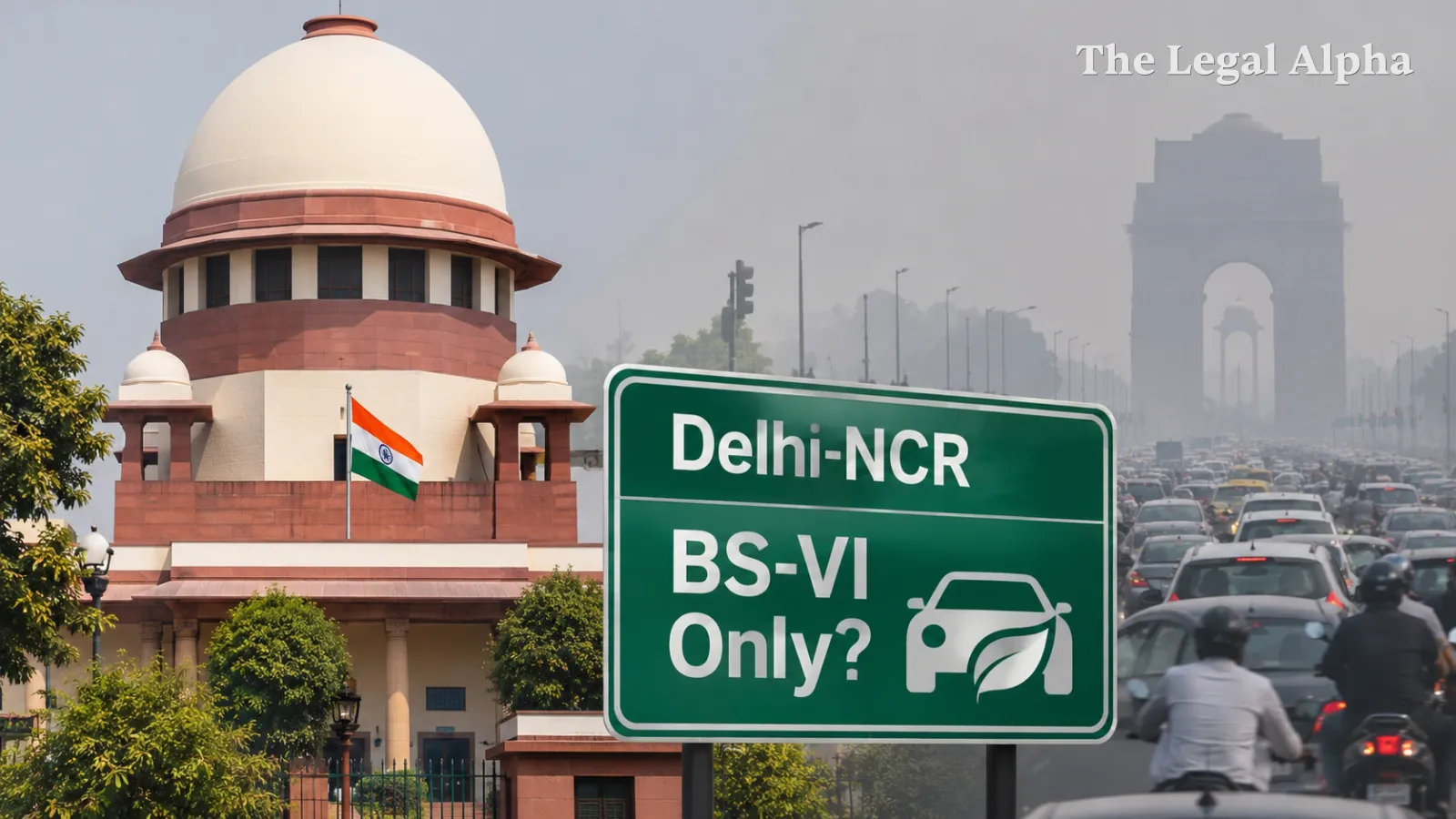
The Supreme Court of India has indicated that it may consider restricting vehicles operating in Delhi, and potentially the wider National Capital Region (NCR), to those complying with Bharat Stage-VI (BS-VI) emission standards. The proposal emerged during proceedings concerning worsening air pollution and the need for stronger measures to control vehicular emissions.
The Court's observations signal a possible shift towards stricter vehicle emission regulations, although no final direction imposing a BS-VI-only requirement across Delhi-NCR has been issued.
A Bench comprising Chief Justice of India Surya Kant and Justices Joymalya Bagchi and V. Mohana made the observation while hearing proceedings concerning vehicular pollution in Delhi-NCR on November 23, 2026.
The Bench indicated that it was considering restricting vehicles that do not meet BS-VI emission standards. The observation reflects the Court's concern that existing measures may not be sufficient to address the region's recurring air quality crisis.
However, the proposal remains under consideration and should not be treated as an operative nationwide or NCR-wide prohibition.
Area of Law: Environmental Law
Sub-topic: Air Pollution Control, Vehicular Emission Standards and Environmental Regulation
The central legal issue concerns the extent to which the Supreme Court can require stricter controls on vehicular movement to protect public health and address deteriorating air quality in Delhi-NCR.
The proceedings also raise questions about coordination between Delhi and neighbouring States, enforcement of existing emission standards, regulation of commercial vehicles and the responsibility of public authorities to implement effective pollution-control measures.
The Bench indicated that it wanted to examine a regime under which only BS-VI-compliant vehicles would be permitted to operate in Delhi, potentially extending the restriction to the wider NCR.
The Court also explored a longer-term proposal to prevent commercial vehicles from entering Delhi altogether.
Under the suggested arrangement, commercial vehicles transporting essential goods could unload their supplies at warehouses established near the city's borders. Smaller battery-operated or other non-polluting vehicles could subsequently transport those goods into the city.
Chief Justice Surya Kant explained that such an arrangement might not be immediately feasible but could be developed over a period of five years.
Importantly, the Court did not issue any binding direction implementing the proposed commercial vehicle restrictions. These observations were suggestions for further consideration.
The Bench also emphasised the participation of Haryana, Punjab and Uttar Pradesh in addressing the regional pollution crisis and called for status reports on measures taken to reduce particulate pollution.
The Supreme Court has been examining Delhi-NCR's air pollution through separate suo motu proceedings addressing different aspects of the environmental crisis.
In its November 6, 2026 order in In Re: Curbing Air Pollution in the National Capital Region, the Court highlighted the increasing contribution of vehicular emissions to pollution.
The Court noted that although incidents of stubble burning had declined, vehicular pollution had emerged as an equally pressing concern.
It directed the Municipal Corporation of Delhi, the Delhi Government, Delhi Police and the governments of Haryana, Rajasthan and Uttar Pradesh to submit detailed responses concerning vehicle regulation, emission compliance and enforcement mechanisms.
The November 23 hearing continued this examination, with particular attention to stricter vehicle restrictions and long-term alternatives for transporting goods into Delhi.
-
Possible BS-VI-only regime: The Supreme Court is considering stricter emission-based restrictions on vehicles operating in Delhi and potentially the wider NCR.
-
Commercial vehicle restrictions: The Bench explored a long-term arrangement to keep commercial vehicles out of Delhi while ensuring uninterrupted supplies of essential commodities.
-
Alternative transportation: Warehousing facilities at Delhi's borders and battery-operated vehicles were suggested as possible alternatives.
-
Inter-State coordination: Haryana, Punjab and Uttar Pradesh were urged to participate actively in controlling regional air pollution.
-
No final prohibition: The Court's observations do not themselves impose a new BS-VI-only restriction. Further consideration and directions remain pending.
The following legal frameworks are relevant to the proceedings:
-
Commission for Air Quality Management in National Capital Region and Adjoining Areas Act, 2021: Provides the statutory framework for coordinating and implementing air pollution control measures across the NCR and adjoining areas.
-
Air (Prevention and Control of Pollution) Act, 1981: Establishes the legal framework for preventing, controlling and reducing air pollution.
-
Environment (Protection) Act, 1986: Provides the Central Government with powers to take measures for environmental protection.
-
Motor Vehicles Act, 1988: Governs motor vehicle regulation, including statutory requirements relating to vehicle operation and compliance.
The CAQM has also issued directions restricting the entry of certain non-BS-VI commercial goods vehicles into Delhi under its existing regulatory framework.
The hearing focused on the need for stronger pollution-control measures and the practical difficulties associated with regulating vehicular movement across Delhi-NCR.
The Court examined the need to balance environmental protection with the uninterrupted availability of essential commodities, including vegetables, fruits and other daily necessities.
The proposal for border warehouses and smaller non-polluting delivery vehicles emerged as a possible solution to this concern.
The available hearing report does not provide a complete account of the individual parties' submissions. Accordingly, no specific arguments have been attributed to them.
The Supreme Court's observations could have significant implications for vehicle owners, transport operators, commercial establishments and residents across Delhi-NCR.
A wider BS-VI-only policy could affect owners of older petrol and diesel vehicles, particularly those travelling into Delhi from neighbouring States. It could also require businesses dependent on conventional goods transportation to reconsider their logistics arrangements.
The proposed border warehousing model presents a potentially important shift in urban supply-chain management. If implemented, it could encourage cleaner last-mile transportation while reducing the movement of polluting commercial vehicles within the capital.
The proceedings also highlight that air pollution cannot be addressed through isolated measures adopted by Delhi alone. Coordinated enforcement and long-term planning involving neighbouring States will be essential.
The Supreme Court is examining whether stricter vehicle emission requirements and structural changes to commercial transportation are necessary to address Delhi-NCR's air pollution crisis. However, its BS-VI-only proposal and commercial vehicle restrictions remain under consideration, rather than being final judicial directions.
Primary Source:
Additional Sources: