Kerala High Court Reviews Fresh Challenge to Disciplinary Inquiry Report by Suspended Sree Sankaracharya University Students
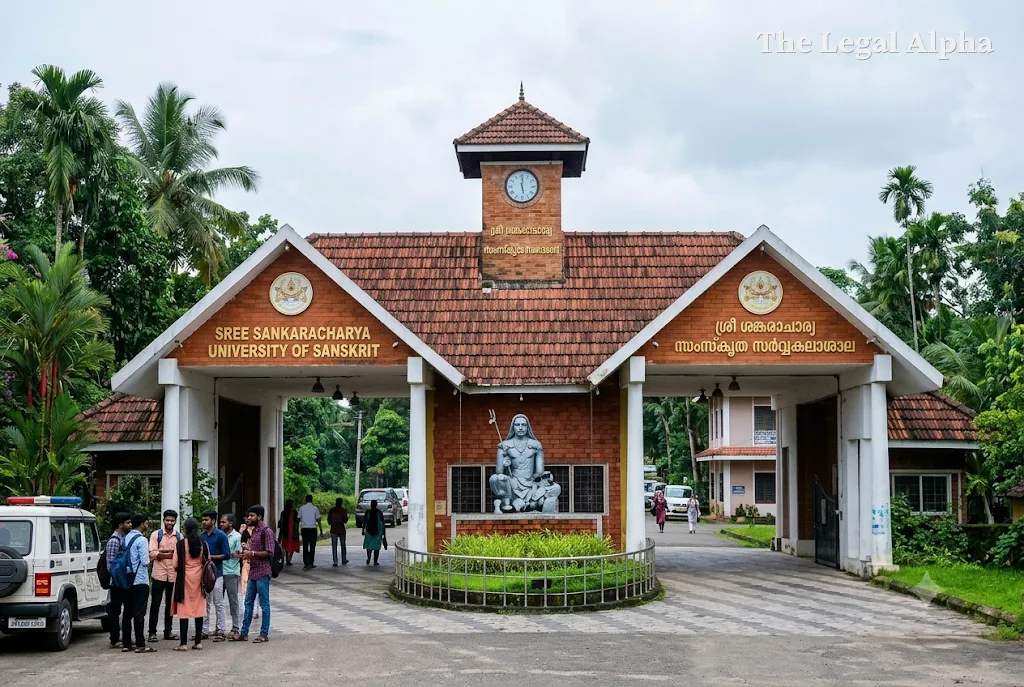
Sixteen suspended students of Sree Sankaracharya University of Sanskrit (SSUS) in Kalady, Ernakulam, have challenged the findings of a university-appointed disciplinary inquiry committee before the Kerala High Court. The dispute stems from campus protests held on August 13, 2026, over student grievances—including drinking water shortages, hostel restrictions, and faculty vacancies—during which Theatre Department scholars staged a street performance outside a Syndicate meeting.
Following allegations by the administration and Vice-Chancellor Ciza Thomas that the protest involved a derogatory mock funeral, physical intimidation, and wrongful confinement, the Syndicate resolved on August 22, 2026, to suspend the 16 students (comprising six PhD scholars, seven postgraduate students, and three undergraduates). Formal suspension orders and an order constituting an inquiry committee were issued on September 1, 2026.
After the committee submitted its report and the university Syndicate moved to impose conditional revocations or extended suspensions based on subsequent developments, the students—led by petitioner Archana P.S. and 15 others—have contested the validity of the inquiry report in their ongoing writ proceedings (W.P.(C) No. 35256 of 2026) before a Single Bench of the High Court. The legal battle has garnered wider attention because it sits at the intersection of student protest rights, campus discipline, and the academic consequences of prolonged interim suspensions.
Legal Topic
Area of Law: Administrative and Constitutional Law
Sub-topic: Higher Education Discipline / Judicial Review of University Inquiry Proceedings
Core Legal Issue
The central legal question before the Kerala High Court is whether the disciplinary inquiry conducted by Sree Sankaracharya University of Sanskrit complied with the principles of natural justice and the university's governing statutes, and whether punitive academic consequences—such as prolonged suspension, conditional reinstatement, and debarment from semester examinations due to resulting attendance shortages—can be sustained on the basis of that inquiry.
In parallel, the court is examining the extent to which judicial review can interfere with internal university disciplinary mechanisms when criminal cases have also been registered over the same campus incident, and how a university must balance institutional discipline against students' right to continue their education.
What Did the Court / Authority Decide?
The challenge to the inquiry report and the underlying suspension orders remains pending before a Single Bench of the Kerala High Court (presided over by Justice P.V. Kunhikrishnan) in W.P.(C) No. 35256 of 2026. Several procedural and interim rulings have already shaped the litigation:
-
Earlier Interim Exam Relief Set Aside: On October 30, 2026, a Single Judge initially passed an interim order permitting the suspended students to remit fees and write semester examinations scheduled from November 4, 2026. However, on November 3, 2026, a Division Bench comprising Justices Anil K. Narendran and Muralee Krishna S. allowed the university's writ appeal (W.A. No. 2276 of 2026), holding that courts cannot issue directions compelling a university to bypass its mandatory minimum attendance and internal assessment regulations without foundational pleadings establishing eligibility.
-
Supreme Court Remand: When the students approached the Supreme Court against the Division Bench's refusal of interim exam relief, the apex court declined to interfere with the order but remitted the main writ petition back to the Kerala High Court Single Bench for expeditious disposal. During those proceedings, the university gave an undertaking to conduct special examinations if the students ultimately succeed in their writ petition.
-
Recent Single Bench Developments: Following the remand, the university informed the High Court via counter-affidavit that its Syndicate decided to revoke the suspension of 12 students provided they tender an unconditional written apology, while extending the suspension of four students—Archana P.S., Shyamjith, Sradha C.P., and Abhijith K.V.—by two months for allegedly entering the campus in violation of suspension terms. The Single Bench questioned the university's insistence on an apology and orally observed that the petitioners should amend their writ petition to formally bring the university's fresh decisions and inquiry outcome under challenge.
Key Legal Points
-
Compliance with Statutory Regulations: In W.A. No. 2276 of 2026, the Kerala High Court Division Bench reaffirmed that a writ of mandamus cannot be issued to compel an educational institution to act contrary to its statutory examination and attendance regulations, even as an interim measure.
-
Pleading Requirements for Interim Relief: Where interim relief practically grants the final relief sought (such as sitting for examinations despite an active suspension), petitioners must establish an exceptionally strong prima facie case backed by explicit pleadings regarding statutory eligibility.
-
Scope of University Inquiry and Natural Justice: In reviewing the disciplinary inquiry report, the Single Bench must evaluate whether the inquiry committee afforded the accused students a fair opportunity to defend themselves and whether the penalties recommended or imposed are proportionate to the established misconduct.
-
Amending Pleadings for Subsequent Events: When a public authority passes fresh administrative orders during the pendency of a writ petition—such as adopting an inquiry report, imposing conditional revocation, or extending a suspension—petitioners are required to amend their writ pleadings so the court can adjudicate the legality of the subsequent orders.
Relevant Law
-
Article 226 of the Constitution of India: Invoked by the students to seek judicial review, a writ of certiorari quashing the university's disciplinary orders, and declarations against prolonged suspension.
-
Sree Sankaracharya University of Sanskrit Act, 1994 & University Statutes/Examination Regulations: Govern the disciplinary powers of the Syndicate and Vice-Chancellor, the constitution of inquiry committees, minimum attendance criteria (75%–80%), and procedures for condoning attendance shortages.
-
Section 5(i) of the Kerala High Court Act, 1958: Governs the maintainability of intra-court writ appeals against interim orders passed by a Single Judge that substantially affect a party's rights.
-
Bharatiya Nyaya Sanhita, 2023 (BNS): Relevant criminal provisions invoked in the two First Information Reports (FIRs) registered at Kalady Police Station concerning the August 13, 2026 campus incident.
-
Judicial Precedents Cited in the Litigation: IES College of Engineering v. Anas P.M. (2023) and Dr. Antony Thomas v. V.M. Muhammed Rafique (2017) (relied upon by the Division Bench regarding campus discipline and the consequences of suspension on attendance).
Arguments of the Parties
Petitioners (Suspended Students)
The students contended that the August 13, 2026 street play was a peaceful, artistic protest highlighting neglected infrastructure and faculty shortages, not a personal attack or act of violence against the Vice-Chancellor. Challenging the inquiry report and disciplinary action, they argued that the allegations were fabricated to suppress campus dissent, that their inability to meet attendance norms was a direct result of the university barring them from campus during a prolonged inquiry, and that demanding an unconditional apology as a precondition for revoking suspensions violates their dignity and constitutional rights.
Respondents (Sree Sankaracharya University of Sanskrit, Syndicate, and Vice-Chancellor)
The university submitted that maintaining academic discipline is paramount and cannot be compromised. According to the administration, the protest escalated into a premeditated political agitation involving physical assault, wrongful confinement of the Vice-Chancellor for over 45 minutes, and serious criminal offences. Regarding the students' academic status, the university maintained that none of the eligible undergraduate or postgraduate petitioners met mandatory attendance thresholds (ranging between 31.82% and 65.33%) or applied for condonation within the prescribed deadline, while six petitioners were doctoral scholars outside the scope of the semester exam notification.
Why Does It Matter?
This dispute highlights a recurring legal tension across Indian universities: how to prevent interim suspensions from turning into irreversible academic penalties before guilt is conclusively established. When disciplinary inquiries stretch over months, students barred from classrooms automatically fall short of mandatory attendance requirements, effectively losing an academic year even if they later clear their names.
At the same time, the litigation underscores that constitutional courts remain cautious about overriding statutory academic standards through interim orders. By securing the university's undertaking to hold special examinations if the students prevail, the courts have attempted to preserve the students' academic remedies without dismantling university examination rules mid-session. How the Kerala High Court scrutinizes the inquiry report and the university's conditional apology requirement will provide important guidance on procedural fairness and proportionality in student disciplinary proceedings.
Legal Takeaway
While universities possess statutory authority to enforce campus discipline and require strict adherence to attendance rules, their disciplinary inquiries and subsequent penalties remain subject to judicial review for fairness and proportionality. Students facing prolonged suspension must ensure their writ pleadings directly address statutory eligibility and formally challenge final inquiry findings to preserve their right to academic remedies such as special examinations.
Sources
Primary Source:
-
High Court of Kerala Order/Judgment in Sree Sankaracharya University of Sanskrit & Ors. v. Archana P.S. & Ors., W.A. No. 2276 of 2026 (Neutral Citation:
2026:KER:83945, decided November 3, 2026) and ongoing proceedings in W.P.(C) No. 35256 of 2026.
Additional Sources:
-
Supreme Court of India remand proceedings in the SSUS students' special leave petition (November 2026).
-
Contemporary legal and news reporting from LiveLaw, The News Minute, Onmanorama, and The Times of India (November 2026).