Judicial Process Versus Street Mobilisation: Harish Salve Questions Political March to the Supreme Court
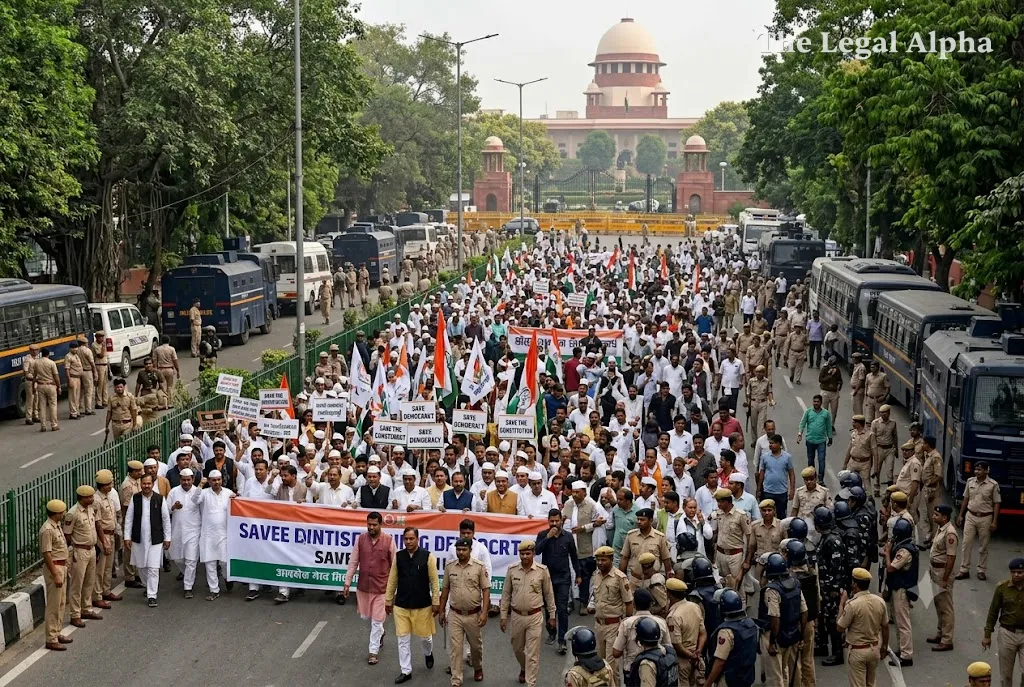
Senior Advocate and former Solicitor General of India Harish Salve raised strong objections against the INDIA bloc’s planned protest march toward the Supreme Court and its attempt to seek an administrative audience with the Chief Justice of India. The political alliance organised the march in connection with grievances surrounding the Chief Election Commissioner and broader protest restrictions in New Delhi.
The controversy follows reports that political leaders sought an appointment with the Chief Justice of India, which was declined. Salve criticised the move as an attempt to deploy political pressure against an independent constitutional court rather than adhering to established judicial procedures for filing and arguing petitions before assigned benches.
Legal Topic
Area of Law: Constitutional Law
Sub-topic: Judicial Independence / Procedural Due Process and Public Demonstrations
Core Legal Issue
The core legal question centres on the constitutional boundary separating judicial adjudication from political lobbying. Specifically, it addresses whether litigants and political entities can seek direct administrative or collective audience with the Chief Justice of India to influence ongoing institutional controversies, or whether constitutional decorum requires grievance redressal strictly through formal judicial filings before roster-allocated benches.
A secondary question involves reconciling the fundamental freedom of peaceful assembly under Article 19(1)(b) with statutory police regulations governing public order in high-security administrative zones.
What Did the Court / Authority Decide?
The Supreme Court did not entertain private meetings with political delegations, reaffirming that the court functions through formal judicial proceedings rather than administrative delegations.
In related judicial proceedings concerning ongoing demonstrations in the capital, the Supreme Court issued directions balancing civil liberties with public order. The Court directed law enforcement authorities to act proportionately, instructing that arbitrary or excessive barricading be removed while clarifying that protests must remain within statutory police guidelines. The substantive legal challenges concerning administrative decisions remain pending before their respective assigned benches.
Key Legal Points
-
The Chief Justice of India acts as the master of the roster who assigns matters to appropriate benches, but does not entertain extra-judicial administrative audiences to address matters meant for judicial adjudication.
-
The constitutional right to peaceful assembly under Article 19(1)(b) remains subject to reasonable restrictions under Article 19(3) and local police regulations.
-
State law enforcement measures aimed at managing public protests must adhere to the principle of proportionality and avoid unnecessary disruption to ordinary citizens.
-
Attempts to mobilize public demonstrations directly against or toward the seat of the apex court risk compromising the institutional decorum and independence essential to the judicial function.
Relevant Law
-
Constitution of India: Article 19(1)(a) (Freedom of Speech and Expression)
-
Constitution of India: Article 19(1)(b) read with Article 19(3) (Right to Assemble Peacefully and Reasonable Restrictions)
-
Constitution of India: Article 32 (Remedies for Enforcement of Fundamental Rights)
-
Supreme Court Rules, 2013 (Governing the institution, listing, and hearing of petitions before designated benches)
-
Delhi Police Act, 1978 (Regulatory powers regarding public assemblies and procession routes)
Arguments of the Parties
Opposition Alliance Position The opposition parties contended that institutional grievances concerning election oversight and administrative curbs on public dissent demand urgent constitutional attention. They maintained that public representatives possess the right to approach constitutional heads and peacefully register public dissatisfaction when democratic accountability is at stake.
Institutional / Counter Position Critics and legal commentators, including Salve, submitted that the judiciary cannot be treated as an arena for political campaigning or street agitation. They argued that when formal writ petitions have already been instituted, parties must present their arguments inside the courtroom before assigned benches instead of attempting to exert institutional pressure outside court gates.
Why Does It Matter?
This development highlights the growing tension between judicial neutrality and political battles in constitutional democracies. When political parties attempt to blur the line between formal litigation and public demonstrations targeting the judiciary, it risks eroding institutional trust and challenging courtroom decorum.
The episode reiterates a crucial procedural standard for all litigants: constitutional courts operate under rigid statutory rules and roster systems. Seeking informal or political access to the head of the judiciary undermines institutional safeguards designed to ensure impartial, transparent dispute resolution.
Legal Takeaway
Constitutional courts address grievances exclusively through formal judicial filings heard by assigned benches in open court. The right to protest does not extend to pressuring the judiciary, and fundamental liberties must operate strictly within procedural law and reasonable statutory limits.
Sources
-
Primary Source: Supreme Court of India Procedural Norms & Official Statement/Interview by Senior Advocate Harish Salve (IANS interview, October 2026).
-
Additional Sources: Court proceedings and reporting on National Capital protest management guidelines; Supreme Court Rules, 2013.