Allahabad High Court Urges Law Commission to Rethink POCSO Act Framework for Consensual Teenage Relationships
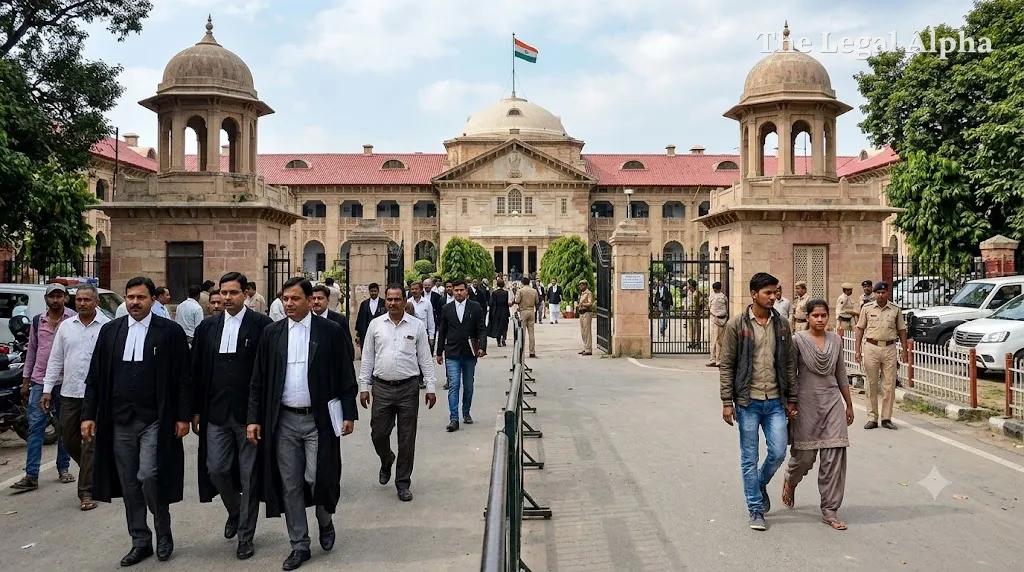
The Allahabad High Court called upon the Law Commission of India to recommend legislative amendments to the Protection of Children from Sexual Offences (POCSO) Act, 2012, highlighting the disconnect between the statute’s rigid mandates and Indian social realities.
The observations arose during a habeas corpus proceeding involving a young couple who had eloped, executed an affidavit declaring their marriage, and subsequently had a child together. While the prosecution maintained that the young woman was a minor and had placed her in a state protection home (Bal Griha), medical age determination tests indicated that she was approximately 18 years old. A Division Bench comprising Justice Atul Sreedharan and Justice Achal Sachdev permitted the woman to reside with her partner after she expressed her desire to do so. In its verdict, the Bench underscored that widespread illiteracy and prevailing socio-economic conditions often result in genuine romantic relationships being dragged into severe statutory criminal proceedings.
Legal Topic
-
Area of Law: Criminal Law / Child Protection Law
-
Sub-topic: POCSO Act / Statutory Rape & Consensual Adolescent Relationships
Core Legal Issue
The core question before the High Court was whether the young woman was subjected to unlawful detention in a state protection home, and whether her custody could be handed over in accordance with her stated preference based on statutory age determination rules.
At an institutional level, the court confronted the broader systemic question of how the criminal justice system should treat consensual, non-exploitative relationships between adolescents under a strict-liability statutory framework that recognizes no threshold of consent below the age of 18.
What Did the Court Decide?
-
Habeas Corpus Allowed: Noting the absence of standard school or municipal birth certificates and relying on an ossification test that determined the woman's age to be around 18 years under Section 94(2) of the Juvenile Justice Act, the High Court held her to be an adult and allowed her to leave with the petitioner.
-
Reference to Law Commission: The Bench directed the Law Commission of India to examine the working of the POCSO Act and recommend reforms that account for ground-level realities, particularly proposing alternatives such as judicial sentencing discretion and community service in exceptional cases involving consensual adolescent couples.
-
Independence of Trial Proceedings: The court explicitly clarified that its factual findings in the habeas corpus petition would not bind or influence the Special Court conducting the pending trial under the POCSO Act, directing the trial court to decide the charges strictly on the evidence produced before it.
Key Legal Points
-
Disregard of Socio-Economic Realities: The Bench observed that while enacting the POCSO Act, the legislature appears not to have adequately considered India's socio-economic conditions, where large sections of the population are illiterate or semi-literate and unaware of complex statutory obligations or legal consent thresholds.
-
Need for Sentencing Flexibility: The court emphasized the necessity of equipping judges with statutory discretion in sentencing, rather than subjecting non-coercive adolescent unions to automatic, lengthy mandatory minimum prison sentences.
-
Exploration of Alternative Punishments: The High Court recommended that lawmakers consider non-custodial options, such as community service, for unique situations involving young couples rather than treating them on par with predatory offenders.
-
Standard of Age Determination: In the absence of primary documentary records under Section 94 of the Juvenile Justice Act, medical ossification reports remain determinative for establishing majority in detention disputes.
Relevant Law
-
Protection of Children from Sexual Offences (POCSO) Act, 2012: Section 2(d) (defining a child as anyone under 18 years), along with sections governing penetrative sexual assault and mandatory sentencing provisions.
-
Juvenile Justice (Care and Protection of Children) Act, 2015: Section 94 (procedure for determining age through municipal records, school certificates, or ossification tests).
-
Constitution of India: Article 226 (powers of the High Court to issue writs of Habeas Corpus).
Arguments of the Parties
Petitioner
The petitioner argued that the couple had voluntarily eloped and entered into a marriage, as evidenced by a joint affidavit. It was submitted that their relationship was completely consensual, had resulted in the birth of a child, and that keeping the young woman confined at a Bal Griha amounted to unlawful detention.
Respondent / State
Appearing for the State and the young woman's father, counsel submitted that according to the father's records, the girl was a minor born on July 25, 2010. Consequently, the State contended that her custody in a protective home was lawful and that allegations of statutory sexual offences could not be waived by private arrangement or alleged consent.
Why Does It Matter?
This ruling adds strong judicial momentum to the growing debate across Indian high courts regarding the criminalization of adolescent romance. The POCSO Act was primarily drafted to punish predatory sexual abuse against children, but statutory strict liability often ensnares young couples, leading to long pre-trial incarcerations, broken families, and institutionalization of young mothers.
By petitioning the Law Commission to explore alternative penalties like community service and sentencing discretion, the Allahabad High Court has reinforced calls for a legislative carve-out—similar to "close-in-age" exceptions recognized in several foreign jurisdictions—that protects vulnerable minors without destroying young families.
Legal Takeaway
The Allahabad High Court affirmed that medical age testing prevails when statutory birth records are missing, permitting an adult woman to choose her residence. More broadly, the court underscored that the POCSO framework urgently requires legislative amendments allowing sentencing discretion so that adolescent romantic relationships are not mechanically penalized with the harsh mandates meant for predatory offenders.
Sources
Primary Source:
-
Rakesh Yadav @ Pappu And Another v. State of U.P. And 4 Others, Habeas Corpus Writ Petition, High Court of Judicature at Allahabad (Bench comprising Justice Atul Sreedharan and Justice Achal Sachdev, Neutral Citation: 2026 LiveLaw (AB) 821).
Additional Sources:
-
Indian Express Legal Report (October 2026).
-
LiveLaw News Coverage on HC Reference to Law Commission (October 2026).