Government Employees Facing Criminal Trials Cannot Claim Travel Allowance, CAT Ahmedabad Rules
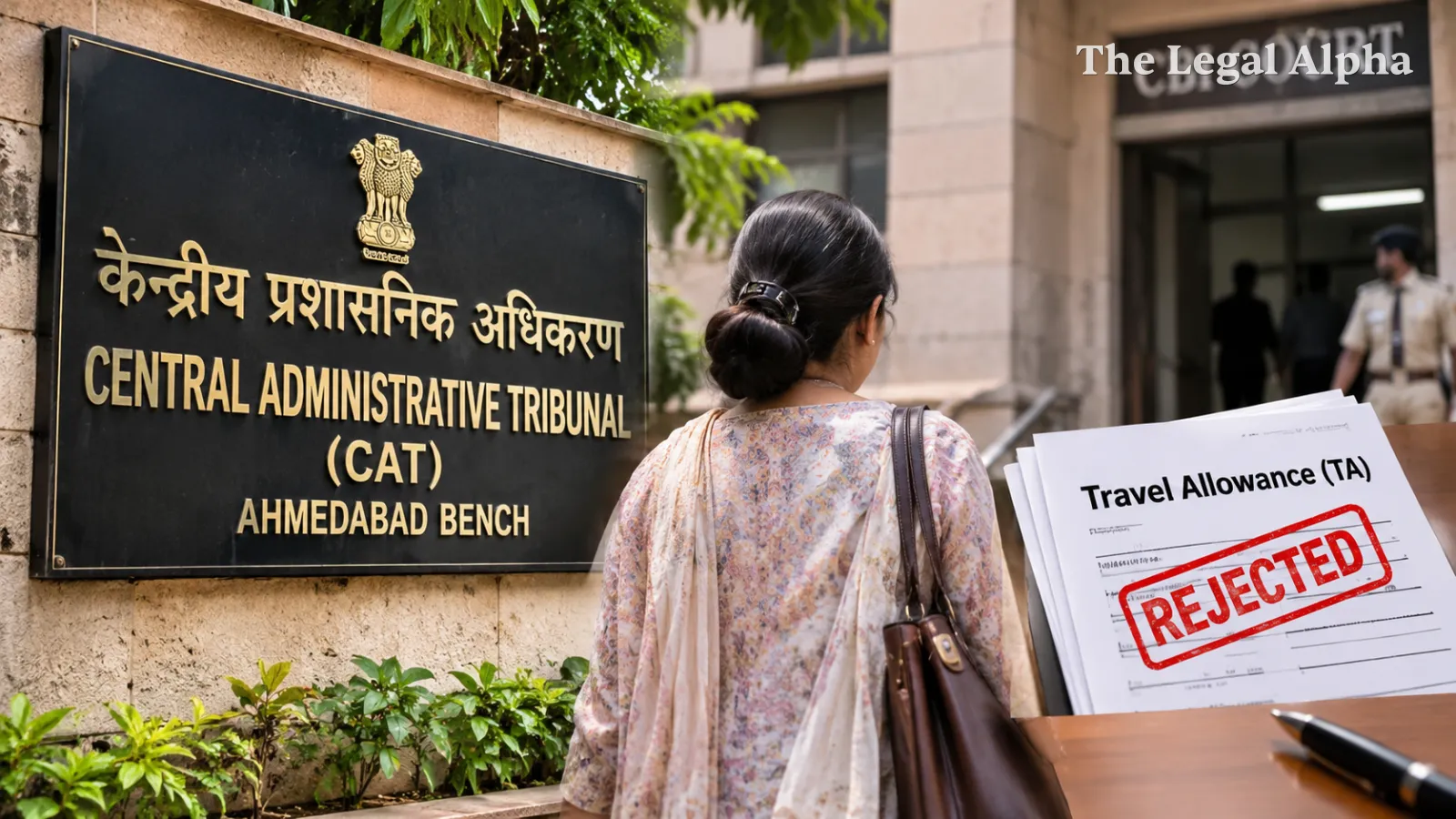
The Central Administrative Tribunal (CAT), Ahmedabad Bench, has ruled that government employees facing criminal prosecution as accused cannot claim travelling allowance (TA) from the government for attending court hearings, even when the criminal proceedings arise from matters connected with their official duties.
The ruling came in a case involving a Transmission Executive posted at All India Radio (AIR), Bhuj, who had sought reimbursement of travel expenses incurred while attending CBI court proceedings in Ahmedabad in a corruption case.
The employee argued that the criminal proceedings originated from events connected with her official responsibilities and that the time spent attending court should be treated as duty.
Legal Topic
Area of Law: Service Law and Administrative Law
Sub-topic: Government Employees' Travelling Allowance, Service Benefits and Criminal Proceedings
Core Legal Issue
The central question before the tribunal was whether a government employee who has been charge-sheeted and is facing a criminal trial as an accused can claim travelling allowance for attending court proceedings under government rules governing official travel and court appearances.
The tribunal also examined whether the employee's subsequent acquittal could create an entitlement to travel reimbursement that was not available under the applicable service rules.
What Did the Tribunal Decide?
In its order dated October 1, 2026, in Ashlesha M Mehta v. All India Radio, Original Application No. 365 of 2019, the CAT Ahmedabad Bench, comprising Judicial Member Jayesh V. Bhairavia and Administrative Member Sanjiv Kumar, dismissed the employee's application.
The tribunal held that the relevant government instructions did not provide a general entitlement to travelling allowance for an employee attending a criminal trial in the capacity of an accused.
It also rejected the argument that the employee's eventual acquittal could retrospectively establish her right to reimbursement.
The tribunal further clarified that an administrative authority can correct an earlier decision if it discovers that a financial or service benefit was granted through an incorrect interpretation of the governing rules.
Key Legal Points
-
Accused and witness are different: Government employees attending court as accused cannot claim the same travel benefits available to employees summoned as witnesses.
-
Acquittal does not create retrospective entitlement: Subsequent acquittal does not automatically establish a right to travelling allowance.
-
Administrative errors can be corrected: An employee cannot claim a permanent entitlement merely because the department initially granted an unauthorised benefit.
-
Natural justice must be respected: Withdrawal of benefits carrying adverse civil consequences must follow a fair decision-making process.
-
Official connection is not sufficient: The fact that criminal proceedings arise from official duties does not automatically convert attendance as an accused into official duty.
Relevant Law
Fundamental and Supplementary Rules (FR/SR)
-
SR 153-A: Government instructions concerning travelling allowance for government servants undertaking journeys in connection with police or Special Police Establishment inquiries.
-
SR 154: Government instructions dealing with court appearances by government employees summoned to give evidence concerning matters connected with their official duties.
-
Section 19, Administrative Tribunals Act, 1985: Provides the mechanism through which the employee approached the tribunal seeking relief.
Important Judicial Precedent
- Mohinder Singh Gill v. Chief Election Commissioner (1978) 1 SCC 405 – The Supreme Court's decision concerning the requirement that administrative orders must stand on the reasons recorded in the order itself.
Arguments of the Parties
Applicant's Arguments
The employee argued that the criminal proceedings originated from a complaint made by an AIR official concerning events during her official service.
She maintained that the department had initially examined her request and sanctioned travelling allowance through specific orders in 2018. According to her, the subsequent withdrawal of these benefits was arbitrary and contrary to the principles of natural justice.
She also relied on her acquittal in the CBI case and argued that the travel period should be treated as duty.
Respondents' Arguments
The All India Radio authorities contended that the original approval was based on an incorrect interpretation of SR 153-A and SR 154.
They argued that the relevant provisions covered government employees attending police inquiries or appearing before courts as witnesses, not employees who had already been charge-sheeted and were facing criminal trials as accused.
The department further maintained that an earlier administrative mistake could not create a legally enforceable right to continue receiving benefits contrary to the applicable rules.
Why Does It Matter?
The ruling clarifies an important distinction in government service law: attending court because an employee has been summoned to provide official evidence is legally different from attending court to defend oneself against criminal charges.
For government departments, the decision reinforces the importance of applying service rules correctly before approving financial benefits. An earlier administrative approval does not necessarily prevent authorities from correcting an error discovered later.
For government employees, the ruling highlights that even an eventual acquittal does not automatically entitle them to reimbursement of travel expenses incurred while facing criminal prosecution.
The decision also underlines that the connection between alleged conduct and official duties, by itself, cannot replace the specific eligibility requirements prescribed under service rules.
Legal Takeaway
Government employees facing criminal trials as accused cannot claim travelling allowance merely because the proceedings arose from their official duties or ultimately ended in acquittal. Eligibility must be established under the applicable service rules, and an earlier erroneous administrative approval cannot independently create such a right.
Sources
Primary Source: Ashlesha M Mehta v. All India Radio, OA No. 120/365/2019, Central Administrative Tribunal, Ahmedabad Bench, decided on October 1, 2026.
Read the CAT judgmentAdditional Sources: