Election Commission Relaxes Verification Norms for Maharashtra Electoral Roll Revision, Permitting Alternative Documentation
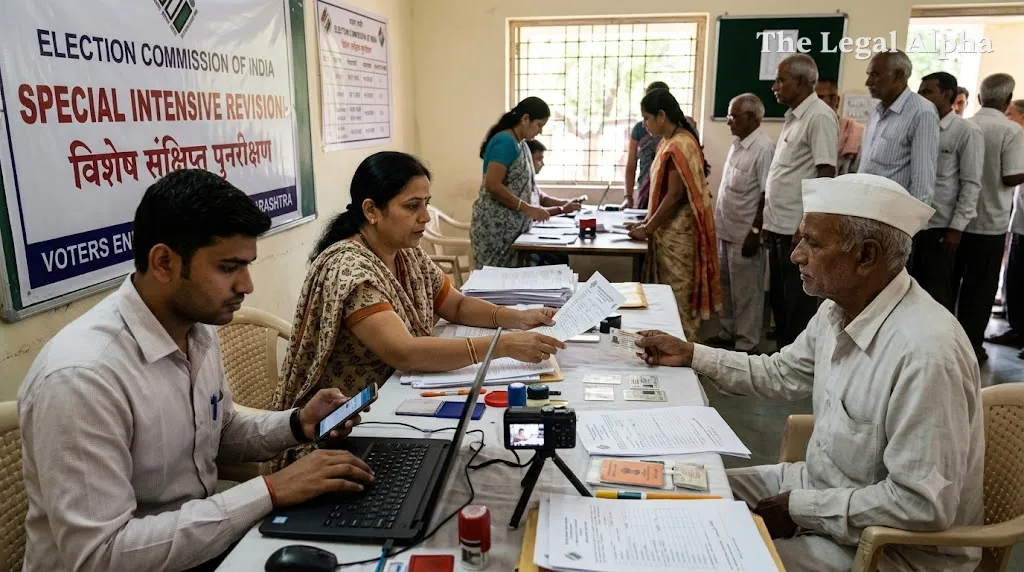
The Election Commission of India approved a proposal submitted by the Maharashtra Chief Electoral Officer to accept alternative supporting documents from electors issued Special Intensive Revision notices.
State electoral authorities had flagged discrepancies and unmapped entries across draft rolls, issuing notices to roughly 1.22 crore voters. Under earlier verification procedures, electors were required to furnish specific documents from a rigid schedule to establish residency, age, or identity. Following representations and administrative review, the Commission permitted local Electoral Registration Officers to accept other credible evidence. To operationalise the shift, the Booth Level Officer mobile application has been updated with an option enabling field officials to upload valid alternative records.
Legal Topic
Area of Law: Election Law / Constitutional Law
Sub-topic: Electoral Roll Preparation and Voter Registration Procedures
Core Legal Issue
The principal issue is whether statutory authorities conducting summary or intensive revisions of electoral rolls can insist upon an exhaustive list of documentary proof, or whether procedural fairness requires an inclusive evidentiary standard to prevent the arbitrary disenfranchisement of genuine electors.
At stake is the balance between administrative scrutiny aimed at cleansing electoral rolls of duplicate or fictitious entries, and ensuring that legitimate voters are not excluded merely because they lack particular government documents when other credible proof is available.
What Did the Authority Decide?
The Election Commission granted formal approval to broaden document acceptability across Maharashtra during the Special Intensive Revision exercise:
-
Electoral Registration Officers are authorised to evaluate alternative credible proof tendered by electors whose records show logical or demographic discrepancies, rather than insisting strictly on the previously prescribed document list.
-
The digital verification architecture was modified, adding an "other" field to the Booth Level Officer mobile application to upload non-standard supporting evidence directly from field visits.
-
Electors are relieved from mandatory physical attendance at formal registry hearings, allowing documentation to be routed via local field functionaries or digital portals.
-
Deadlines for processing claims and objections were aligned with ongoing revision schedules, with dedicated facilitation camps organised at polling stations before final roll publication.
Key Legal Points
-
Evidentiary Flexibility in Franchise Protection: Administrative checklists for electoral verification cannot operate as an exhaustive bar against genuine citizens who possess alternate credible evidence establishing eligibility.
-
Procedural Fairness in Roll Deletions: Natural justice requires that statutory authorities examine the substance of an elector's qualification rather than rejecting applications solely on strict technical defects.
-
Technology Adapted to Substantive Rights: Digital registry portals and administrative mobile applications must accommodate discretionary verification by field officers rather than restricting uploads to closed parameter fields.
-
Discretion of Electoral Registration Officers: Under statutory election rules, registration officers possess quasi-judicial discretion to assess the probative value of collateral evidence submitted to resolve identity and age discrepancies.
Relevant Law
-
Constitution of India: Article 324 (superintendence, direction, and control of elections vested in the Election Commission) and Article 326 (adult suffrage as the foundation of registration on electoral rolls).
-
Representation of the People Act, 1950: Section 21 (preparation and revision of electoral rolls), Section 22 (correction of entries in electoral rolls), and Section 23 (inclusion of names in electoral rolls).
-
Registration of Electors Rules, 1960: Rule 10 (publication of draft rolls), Rule 12 (period for lodging claims and objections), and Rule 21A (procedure for deletion or correction of entries).
Arguments and Administrative Positions
Chief Electoral Officer, Maharashtra
The state election authority submitted that standard document lists created severe practical bottlenecks for millions of voters flagged during automated data-matching. Rigid document categories risked improper disenfranchisement of genuine electors, particularly in rural and semi-urban constituencies where individuals may rely on collateral family records or local certifications rather than formal birth certificates.
Election Commission of India
The Commission maintained that maintaining roll integrity requires rigorous verification to weed out duplicate or deceased entries. However, the regulatory body conceded that evidentiary schedules must remain indicative rather than exhaustive, affirming that Electoral Registration Officers possess the discretion to accept any credible documentation that reasonably establishes identity, relationship, or age.
Why Does It Matter?
This procedural relaxation directly affects over 1.2 crore registered voters across Maharashtra facing scrutiny over draft roll discrepancies. By clarifying that prescribed document lists are illustrative rather than exhaustive, the Commission has set an important administrative standard that safeguards voter enfranchisement against mechanical, algorithmic flagging.
The move also provides vital operational clarity to thousands of Booth Level Officers and Electoral Registration Officers handling summary revisions across the country. It reduces litigation risks before high courts concerning arbitrary disenfranchisement and establishes that administrative convenience cannot override an elector's fundamental statutory entitlement to remain on the voter rolls.
Legal Takeaway
Statutory lists of identity and age proof used during electoral roll revisions are illustrative guidelines, not an exhaustive legal bar. Registration authorities are required to consider any convincing collateral evidence to resolve discrepancies and protect an eligible citizen's right to vote.
Sources
Primary Source:
Official Directions and Administrative Approval issued by the Election Commission of India to the Chief Electoral Officer, Maharashtra regarding document acceptability during the Special Intensive Revision (SIR) 2026.
Additional Sources:
-
The Representation of the People Act, 1950 and the Registration of Electors Rules, 1960.
-
Press announcements and official notifications released by the Office of the Chief Electoral Officer, Maharashtra.
-
Public reporting and administrative updates published by The Times of India, Pune Edition (October 2026).