Delhi High Court Issues Summons in Kangana Ranaut’s Personality Rights Suit Over AI Deepfakes and Misattributed Quotes
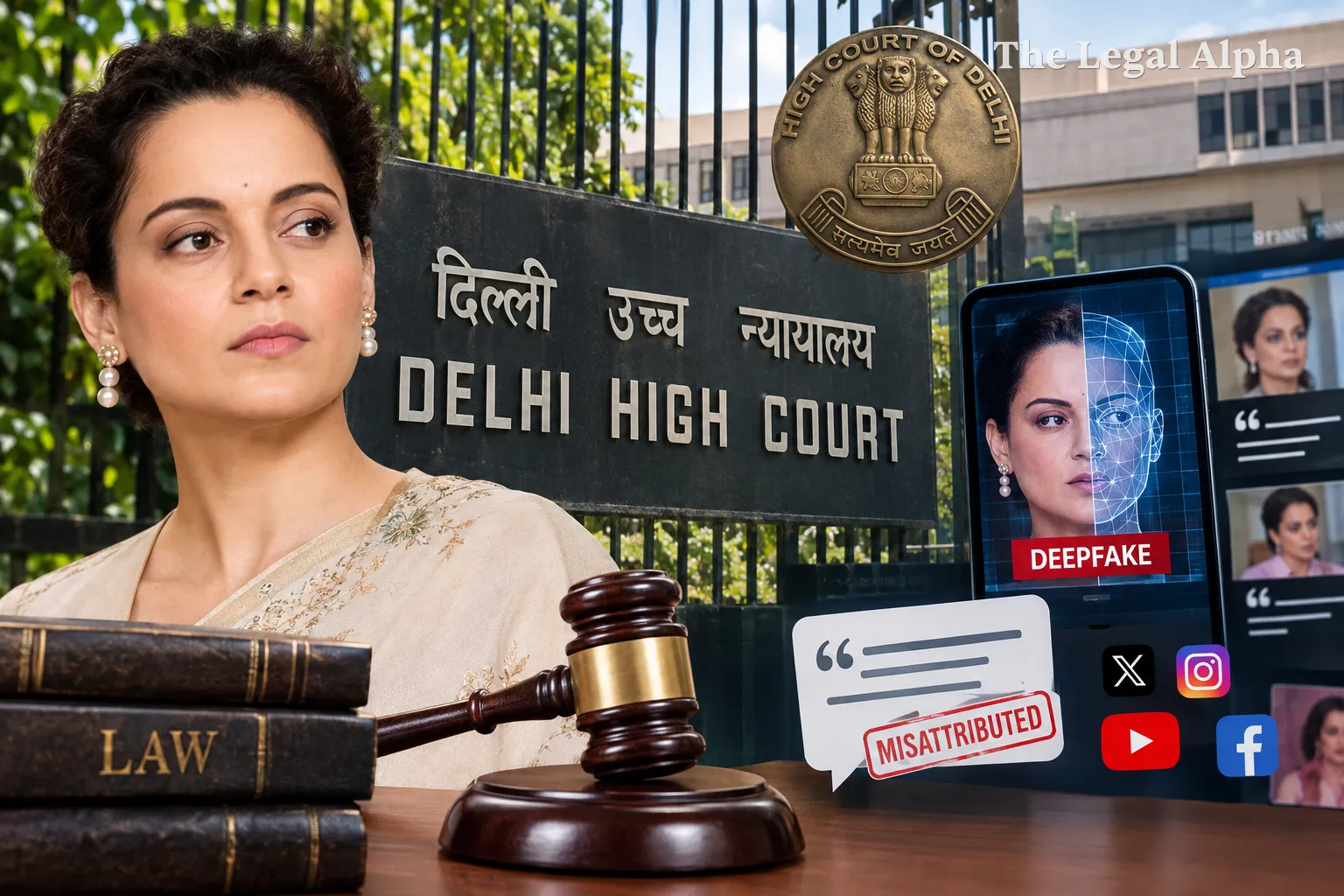
Actor and Member of Parliament Kangana Ranaut has approached the Delhi High Court seeking comprehensive protection of her personality and publicity rights. The civil suit targets the unauthorised commercial exploitation of her identity, particularly the circulation of artificial intelligence-generated deepfakes, sexually explicit synthetic media, and fabricated quotes falsely attributed to her across digital platforms.
Presiding over the suit titled Kangana Ranaut v. Meta Platforms & Ors., Justice Vikas Mahajan issued summons to the named defendants and issued notice on Ranaut’s application seeking an interim injunction. While taking cognisance of the grievance, the bench asked the plaintiff to furnish specific particulars regarding the remaining defendants against whom active takedown directions are sought before substantive interim restraint orders are entered.
Legal Topic
-
Area of Law: Intellectual Property Law / Media and Information Technology Law
-
Sub-topic: Personality and Publicity Rights / AI-Generated Deepfakes and Digital Impersonation
Core Legal Issue
The primary legal question before the High Court is whether the unauthorised creation and dissemination of AI-generated synthetic media—specifically sexually suggestive deepfakes and fabricated statements—constitutes an actionable violation of a public figure's common law personality and publicity rights, alongside an infringement of the fundamental right to privacy and dignity.
A secondary issue concerns the procedural standards governing takedown reliefs: how plaintiffs must specify digital URLs and intermediary defendants when balancing immediate injunctive protection against legitimate satire, memes, or online commentary.
What Did the Court / Authority Decide?
-
Issued Summons and Notice: The High Court issued formal summons in the main civil suit and issued notice on the interim relief application under Order XXXIX Rules 1 and 2 of the Code of Civil Procedure.
-
Directions on Defendant Particulars: Justice Mahajan directed Ranaut’s counsel to file an amended memo of parties, identifying precisely which defendants continue to host infringing material, noting that several entities had already voluntarily taken down disputed content after receiving advance service.
-
Interim Injunction Held in Abeyance: The court deferred passing a sweeping interim dynamic injunction until the clarified array of parties and specific URLs are formally placed on record.
-
Listing: The matter has been listed for further hearing on February 3, 2027.
Key Legal Points
-
Protection of Personality Attributes: Indian courts recognise an individual’s proprietary right to control the commercial exploitation and digital replication of their name, image, likeness, voice, and persona.
-
Delineation Between Satire and Unlawful Impersonation: While reviewing the material, the court distinguished between protected satirical memes and actionable violations involving defamatory, obscene, or AI-generated misattributions.
-
Procedural Precision for Intermediary Injunctions: Prior to granting ex-parte or omnibus takedown orders against social media platforms, courts require clear identification of non-compliant defendants and distinct offending uniform resource locators (URLs).
-
Harm of Generative AI Deepfakes: The creation of non-consensual synthetic media crosses the boundary of fair comment when it generates fabricated compromising imagery or falsely attributes statements to public figures.
Relevant Law
-
The Code of Civil Procedure, 1908: Section 9 (civil jurisdiction) and Order XXXIX Rules 1 and 2 (grant of temporary injunctions).
-
The Information Technology Act, 2000 & Intermediary Guidelines (2021): Section 79 (safe harbour parameters) and Rule 3 (due diligence obligations for removing impersonation and obscene content).
-
The Constitution of India: Article 21 (right to privacy and personal dignity as affirmed in K.S. Puttaswamy v. Union of India).
-
Judicial Precedents: Anil Kapoor v. Simply Life India & Ors. (restraining unauthorised AI cloning of celebrity personas) and Amitabh Bachchan v. Rajat Negi & Ors. (safeguarding celebrity publicity rights).
Arguments of the Parties
Petitioner / Applicant Counsel appearing for Ranaut argued that third parties were actively exploiting her celebrity status without authorisation by deploying generative AI tools to create sexually explicit imagery and false quotes. The counsel submitted that fact-checking mechanisms confirmed these digital assets were synthetic fabrications designed to malign her public standing and commercially exploit her persona. Counsel clarified that while satirical commentary or memes were circulating, interim injunctive relief was strictly targeted at non-consensual obscene fabrications and deceptive misattributions.
Respondent / Intermediaries Counsel representing digital platforms and intermediaries submitted that advance notices had already resulted in the voluntary takedown of several flagged links. They contended that blanket injunctions should not be issued without providing specific, actionable URLs and that legitimate public discourse or artistic expressions should remain unaffected.
Why Does It Matter?
This suit reflects a sharp escalation in celebrity litigation confronting generative artificial intelligence. As deepfake technology becomes increasingly accessible, the Delhi High Court has emerged as the central forum shaping India's jurisprudence on digital identity rights.
The matter underlines the practical friction between rapid algorithmic content generation and existing intermediary liability frameworks. By demanding precise particulars before issuing dynamic takedown orders, the court strikes a crucial balance: protecting individual dignity and publicity assets against deceptive AI cloning without encouraging overly broad censorship that could chill public political commentary or legitimate satire.
Legal Takeaway
Celebrities and public figures can invoke common law personality rights and privacy protections to halt the non-consensual deployment of AI deepfakes and fabricated quotes. However, to obtain enforceable interim takedown orders against intermediaries, plaintiffs must furnish specific web links and clearly delineate between harmful digital impersonation and protected satire.
Sources
-
Primary Source: Delhi High Court proceedings in Kangana Ranaut v. Meta Platforms & Ors. (Coram: Justice Vikas Mahajan, October 2026).
-
Additional Sources: Delhi High Court judicial precedents on personality rights (Anil Kapoor v. Simply Life India; Amitabh Bachchan v. Rajat Negi); Information Technology (Intermediary Guidelines and Digital Media Ethics Code) Rules, 2021.