Delhi High Court Disposes Doctors’ Plea Against Sunny Deol’s Film ‘Suryaa’ After Producers Agree to Fiction Disclaimer
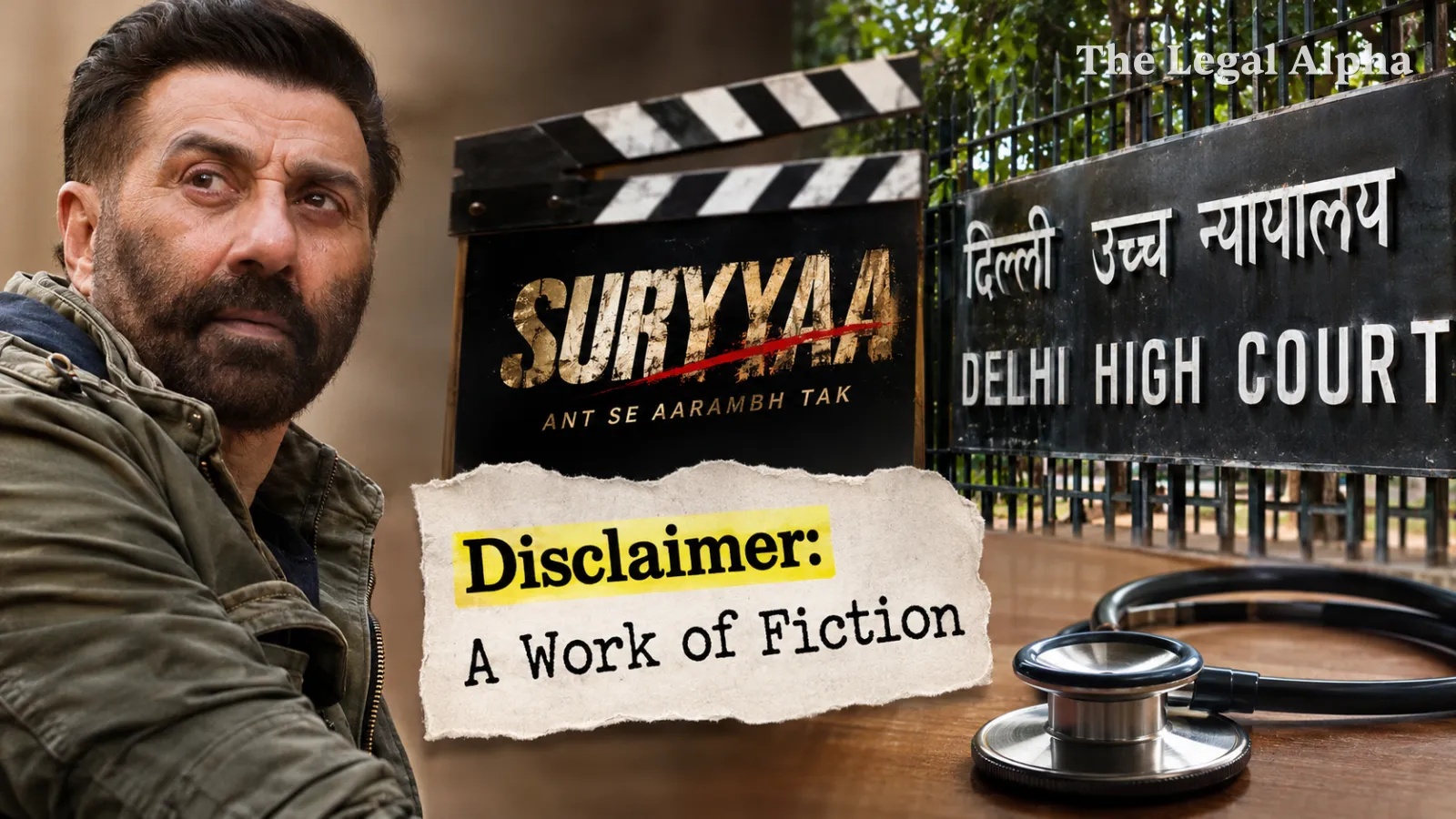
The Delhi High Court has disposed of a petition filed by practising doctors challenging the promotional content of Sunny Deol-starrer Suryaa: Ant Se Aarambh Tak. The producers have agreed to include a disclaimer in both the film and its trailer clarifying that the story is fictional and adapted from the Malayalam film Joseph.
The order was passed on November 17, 2026, by Justice Amit Mahajan in Dr. Nishant Soni & Ors. v. Union of India & Ors., W.P.(C) 16253/2026.
The petitioners had raised concerns that the film's promotional material portrayed doctors in a defamatory manner and could encourage hostility and violence against healthcare professionals. The controversy has brought attention to the balance between creative freedom and the protection of professional reputation.
Legal Topic
Area of Law: Constitutional Law and Media & Entertainment Law
Sub-topic: Freedom of Expression, Defamation and Film Content Regulation
Core Legal Issue
The central legal issue was whether the promotional material of a film, allegedly presenting fictional events as inspired by real incidents, could justify judicial intervention on grounds of defamation, public apprehension and potential hostility towards healthcare professionals.
The proceedings also raised questions about the responsibility of film producers to distinguish fictional storytelling from factual representations, particularly when the subject matter concerns sensitive professions and public institutions.
What Did the Delhi High Court Decide?
Justice Amit Mahajan disposed of the petition after recording the undertaking given on behalf of the film's producers.
Senior Advocate Rajiv Nayar, appearing for the producers, informed the Court that Suryaa is a remake of the Malayalam film Joseph. He submitted that the original film had not been banned by the authorities and had received national and international recognition.
The producers further agreed to place an appropriate disclaimer in the trailer as well as the film, making clear that the story is fictional and adapted from Joseph.
The Court considered this undertaking sufficient to dispose of the petition without issuing further directions.
The Union Government also informed the Court that permission had not been granted to the film at that stage.
Importantly, the Court disposed of the matter specifically on the basis of the concerns raised by the petitioners and the undertaking furnished by the producers. It did not deliver a final finding that the film was defamatory or that its content encouraged violence.
Key Legal Points
- Disclaimer undertaking: The producers agreed to clarify that the film is fictional and adapted from the Malayalam film Joseph.
- Judicial intervention: The Court considered the producers' undertaking sufficient and found no requirement to pass additional orders.
- Professional reputation: The petition highlighted concerns about the portrayal of doctors and its possible impact on the safety of healthcare workers.
- Creative expression: The proceedings brought attention to the competing concerns surrounding cinematic storytelling and the potential consequences of portraying professional groups negatively.
- Limited scope of disposal: The petition was disposed of based on the undertaking, without a final adjudication of the allegations concerning defamation or incitement.
Relevant Law
Constitution of India
-
Article 19(1)(a): Guarantees freedom of speech and expression, which includes artistic and cinematic expression.
-
Article 19(2): Permits reasonable restrictions on freedom of speech and expression on specified constitutional grounds, including defamation and public order.
Cinematograph Act, 1952
- Section 5B: Provides the statutory grounds governing certification of films for public exhibition.
The Court's November 17 order primarily records the producers' undertaking. It does not establish a new legal interpretation of these statutory or constitutional provisions.
Arguments of the Parties
Petitioners – Practising Doctors
The doctors argued that the film's promotional material portrayed the medical profession in a defamatory manner.
They expressed concern that negative representations of doctors could aggravate existing hostility towards healthcare professionals, who already face attacks from disgruntled patients' relatives.
They also raised concerns about their representations to the relevant authorities remaining unaddressed.
Respondents – Film Producers
Represented by Senior Advocate Rajiv Nayar, the producers submitted that Suryaa was an adaptation of the Malayalam film Joseph, which had not been prohibited by the authorities.
They maintained that the apprehensions raised by the petitioners were misplaced and agreed to include an appropriate disclaimer in the trailer and the film.
Union of India
The Union Government informed the Court that permission had not been granted to the film at that stage.
Why Does It Matter?
The development highlights an important issue concerning the relationship between artistic freedom and the potential real-world consequences of cinematic portrayals.
Films frequently explore controversial subjects, including corruption, institutional failures and professional misconduct. However, when fictional narratives are presented in ways that audiences may interpret as factual accounts, disputes concerning reputation and public perception can arise.
The Delhi High Court's approach in this case demonstrates how an undertaking from the concerned producers can address the immediate apprehensions raised before the Court without requiring a broader order restricting the film.
For filmmakers and production houses, the proceedings also underline the importance of clear disclaimers, particularly when adapting stories involving sensitive professional or social issues.
At the same time, the order should not be understood as a general ruling that disclaimers automatically resolve every legal challenge involving potentially defamatory cinematic content.
Legal Takeaway
The Delhi High Court disposed of the doctors' petition after the producers undertook to identify Suryaa as a fictional adaptation of the Malayalam film Joseph through disclaimers in both the trailer and the film. The decision is a case-specific disposal based on that undertaking, rather than a final judicial determination on the allegations of defamation or incitement.
Sources
Primary Source:
- Delhi High Court order dated November 17, 2026, in Dr. Nishant Soni & Ors. v. Union of India & Ors., W.P.(C) 16253/2026. Read the Court Order (PDF).
Additional Sources: