Delhi HC Stays FSSAI Order Banning 'Energy Drink' Labels for PepsiCo and Monster
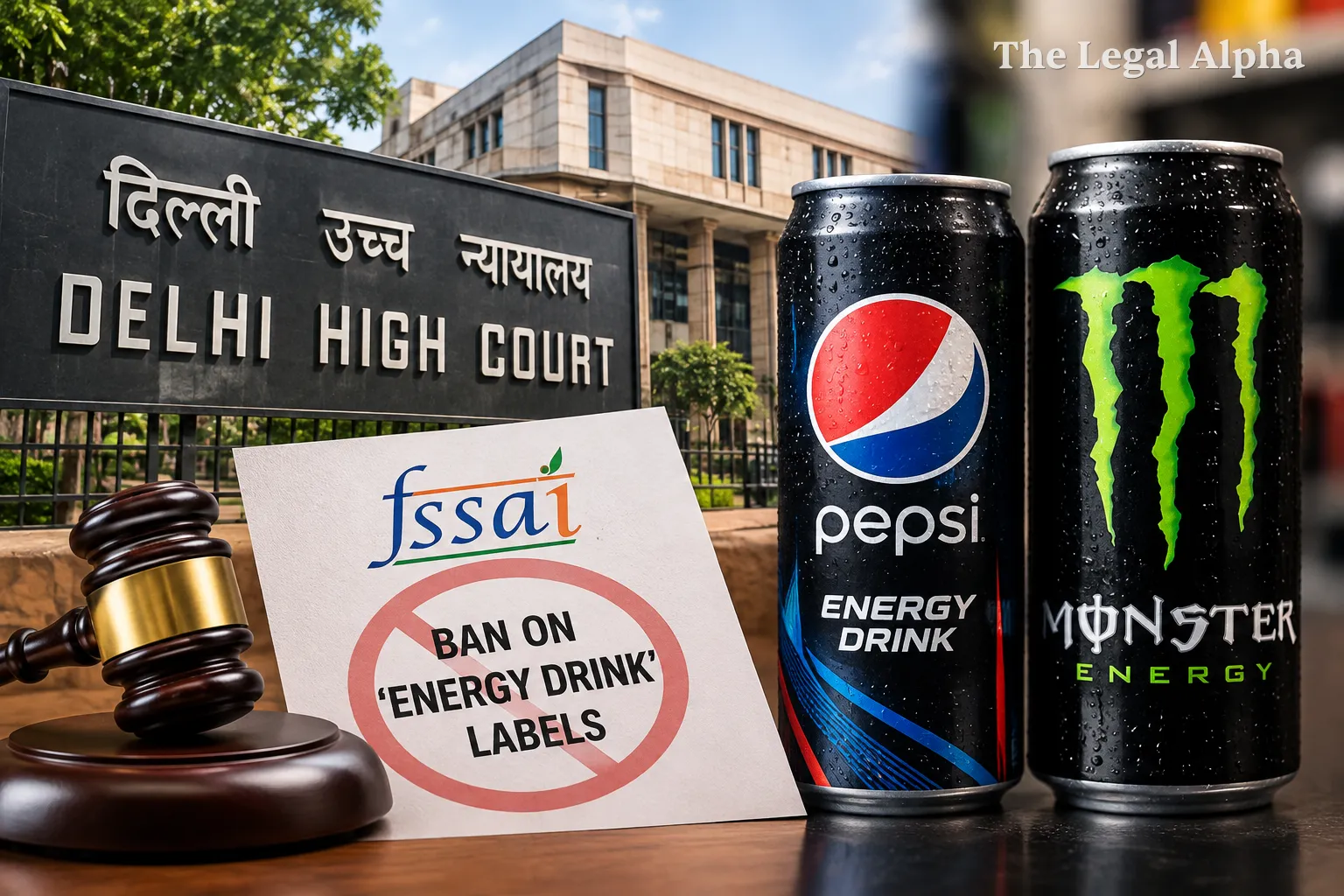
Case Record: PepsiCo India Holdings Pvt. Ltd. v. FSSAI & Ors. [W.P.(C) 14669/2026] & Monster Energy India Pvt. Ltd. v. FSSAI & Ors. [W.P.(C) 14670/2026]
Court: High Court of Delhi at New Delhi
Bench: Justice Amit Mahajan
Date of Pronouncement: October 06, 2026 | Reported: October 07, 2026 (LiveLawBiz ID: 553479)
Subject: Food Safety & Standards Act, 2006 | Labelling Regulations & Natural Justice
Category
Judgements / Regulatory & Food Safety Law
The Food Safety and Standards Authority of India (FSSAI) recently issued administrative orders and coercive directives instructing major beverage manufacturers—including PepsiCo India Holdings Pvt. Ltd. (makers of Sting and Rockstar) and Monster Energy India Pvt. Ltd. (makers of Monster Energy)—to immediately remove and discontinue the descriptor 'Energy Drink' from their product cans, packaging, and commercial labels.
Under Regulation 2.10.6 of the Food Safety and Standards (Food Products Standards and Food Additives) Regulations, 2011, such beverages are classified under the statutory nomenclature of 'Caffeinated Beverages'. Taking the stance that the term 'Energy Drink' is misleading because caffeine provides only a stimulant effect rather than true nutritional energy or stamina, FSSAI ordered beverage giants to re-label their products strictly as 'Caffeinated Beverages'. Crucially, the food safety regulator issued these orders without issuing prior show-cause notices or providing an opportunity of personal hearing, and called upon state food safety authorities to seize and confiscate existing market stock bearing the 'Energy Drink' label.
Facing catastrophic supply-chain disruption and the potential destruction of crores of rupees worth of manufactured inventory already distributed to retailers across the country, PepsiCo India Holdings Pvt. Ltd. and Monster Energy India Pvt. Ltd. approached the High Court of Delhi by filing separate writ petitions under Article 226 of the Constitution [W.P.(C) 14669/2026 and W.P.(C) 14670/2026]. The manufacturers challenged the FSSAI directives as arbitrary, violative of the principles of natural justice, and an impermissible interference with established trade descriptions.
Legal Topic
Food Safety, Regulatory Compliance & Administrative Law – Food Safety and Standards Act, 2006 (FSS Act); Food Safety and Standards (Food Products Standards and Food Additives) Regulations, 2011 (Regulation 2.10.6: Caffeinated Beverages); Food Safety and Standards (Packaging and Labelling) Regulations; Principles of Natural Justice (Audi Alteram Partem); Legality of Executive Directives Passed Without Show-Cause Notice; Commercial Free Speech and Permissible Trade Descriptors; Article 226 Supervisory Review.
Core Legal Issue
Whether the Food Safety and Standards Authority of India (FSSAI) can lawfully mandate the immediate deletion of the widely used commercial descriptor 'Energy Drink' and direct seizure of existing product inventories without issuing a show-cause notice or affording a reasonable opportunity of hearing to affected food business operators.
What Did the Court / Authority Decide?
The High Court of Delhi at New Delhi, through a Single Judge Bench comprising Justice Amit Mahajan, granted substantial interim relief by staying the coercive operation of the impugned FSSAI directives against both PepsiCo India Holdings Pvt. Ltd. [W.P.(C) 14669/2026] and Monster Energy India Pvt. Ltd. [W.P.(C) 14670/2026].
Justice Amit Mahajan held that the impugned orders issued by the FSSAI were passed in blatant violation of the principles of natural justice, as the statutory regulator failed to issue any show-cause notice or afford a personal hearing to the beverage manufacturers before altering their long-standing labeling authorizations. Balancing the commercial equities with regulatory objectives, the High Court permitted PepsiCo and Monster Energy to sell and liquidate their entire existing stocks and inventories bearing the 'Energy Drink' label across the country without fear of seizure or penal action. However, the Court directed that pending final adjudication, the manufacturers shall not produce fresh batches bearing the disputed descriptor. The High Court issued formal notice to FSSAI and the Union of India, directing them to file counter-affidavits, and tagged the matters with connected petitions, including earlier proceedings involving Red Bull.
Key Legal Points
- Violation of Natural Justice Vitiates Regulatory Directives: Justice Amit Mahajan observed that administrative and regulatory directives issued by statutory authorities like FSSAI without issuing a show-cause notice or giving affected parties an opportunity of hearing suffer from a fundamental breach of natural justice.
- Protection of Existing Market Inventories: The High Court protected the manufacturers from arbitrary commercial forfeiture by permitting the sale and distribution of all pre-existing stocks bearing the 'Energy Drink' label, preventing immediate supply-chain collapse.
- Prohibition on Fresh Manufacture Pending Hearing: Balancing consumer protection and regulatory oversight, the Bench restrained the companies from producing fresh batches bearing the 'Energy Drink' descriptor until the court formally determines the validity of the labeling regulations.
- Parity with Precedent: The High Court followed the judicial trajectory set in late September 2026 in Red Bull India Pvt. Ltd. v. FSSAI, ensuring regulatory consistency and parity across competing beverage manufacturers in the Indian market.
- Substantive Classification Left for Final Adjudication: The Court clarified that whether the descriptor 'Energy Drink' violates the Caffeinated Beverage standards under Regulation 2.10.6 will be examined comprehensively after the Union Government and FSSAI place their detailed counter-affidavits on record.
Relevant Law
- Food Safety and Standards Act, 2006 (FSS Act): The parent statute governing food safety, formulation of standards, and powers of food safety officers to inspect and seize non-compliant food articles.
- Regulation 2.10.6, Food Safety and Standards (Food Products Standards and Food Additives) Regulations, 2011: Prescribes specific standards for 'Caffeinated Beverages', regulating minimum and maximum permissible levels of caffeine (145 mg/l to 320 mg/l), taurine, inositol, and B-vitamins.
- Food Safety and Standards (Packaging and Labelling) Regulations, 2011 / (Labelling and Display) Regulations, 2020: Governs mandatory declarations, product descriptions, nutritional information, and prohibitions against misleading claims.
- Article 19(1)(g) & Article 226, Constitution of India: Constitutional protection guaranteeing the right to carry on lawful trade and business, enforceable through writ petitions against arbitrary executive action.
- Canara Bank v. Debasis Das (2003) 4 SCC 557: Supreme Court benchmark ruling establishing that even administrative orders carrying civil consequences must adhere to the principles of natural justice.
Arguments of the Parties
- Contentions of the Petitioners (PepsiCo India & Monster Energy):
- Represented by Senior Advocate Sandeep Sethi (for PepsiCo) and Advocate Udayan Jain (for Monster Energy), the companies submitted that 'Energy Drink' is an internationally acknowledged trade term and descriptor recognized under Codex Alimentarius and global food safety systems.
- Counsel proved that their beverages strictly comply with all compositional and safety standards prescribed for Caffeinated Beverages under Regulation 2.10.6.
- It was argued that FSSAI's sudden orders were issued without a show-cause notice, without scientific consultation, and in gross violation of natural justice.
- The petitioners contended that immediate enforcement and threat of seizures would cause irreparable financial injury running into hundreds of crores of rupees by paralyzing distribution networks.
- Contentions of the Respondents (FSSAI & Union of India):
- Represented by Central Government Standing Counsel (CGSC) Avshreya Pratap Singh Rudy and Counsel Suransh Chaudhary, the respondents argued that the term 'Energy Drink' is misleading to consumers.
- The Revenue and regulatory counsel submitted that the Indian regulations recognize only 'Caffeinated Beverages', and using 'Energy Drink' misleadingly implies that the product is a nutritional source of energy or physical stamina.
- The regulator maintained that its directions were necessary in the larger public interest to protect consumers from misleading health perceptions.
Why Does It Matter?
The Indian energy drink market has expanded into a multi-billion dollar category, driven by mass brands like PepsiCo’s Sting and premium brands like Monster Energy and Red Bull. The battle between beverage makers and the food safety regulator represents a classic clash between global commercial trade branding and domestic consumer protection regulations. While FSSAI’s intent is to prevent youth and consumers from confusing caffeine-induced alertness with true nutritional energy, doing so via abrupt executive fiats without regulatory consultation threatens enormous economic disruption.
Justice Amit Mahajan’s ruling provides essential administrative discipline and commercial equilibrium. By calling out FSSAI's failure to adhere to basic natural justice, the Delhi High Court sends a stern reminder that statutory regulators cannot bypass procedural fairness. The decision protects hundreds of crores in existing consumer supply chains from being arbitrarily seized, while maintaining regulatory oversight by halting fresh production of disputed labels until the court settles the substantive question of law.
Legal Takeaway
Statutory regulators cannot issue coercive packaging and labeling directives or order the seizure of manufactured consumer goods without first complying with the principles of natural justice through proper show-cause notices and hearings. While regulatory bodies possess the authority to ensure accurate consumer labeling under the Food Safety and Standards Act, abrupt orders altering settled trade descriptors cannot be enforced retrospectively against existing stock. Pending final judicial determination of food standards, courts will protect existing inventories from arbitrary forfeiture while regulating fresh manufacturing.
Sources (Primary & Additional)
- Primary Judicial Order: High Court of Delhi at New Delhi, PepsiCo India Holdings Pvt. Ltd. v. Food Safety and Standards Authority of India (FSSAI) & Ors. [W.P.(C) 14669/2026] and Monster Energy India Pvt. Ltd. v. FSSAI & Ors. [W.P.(C) 14670/2026], Orders dated October 06, 2026, per Justice Amit Mahajan. Delhi High Court Official Case Information Portal.
- Authoritative Legal Reporting (LiveLawBiz): Riya Rathore, \"Delhi High Court Stays FSSAI Orders Forcing PepsiCo, Monster Energy To Drop 'Energy Drink' Label\" (Article ID: 553479, Published on October 07, 2026). LiveLawBiz Article.
- Corporate & Beverage Legal Intelligence (Bar & Bench): Legal Correspondent Desk, \"Delhi High Court says PepsiCo, Monster can sell existing stocks of 'energy drinks' but can't make more\" (Published on October 06-07, 2026). Bar & Bench Report.