Delhi District Courts Face Backlog of Over 3 Lakh Cases; Lieutenant Governor Directs Overhaul of Prosecution and Trial Infrastructure
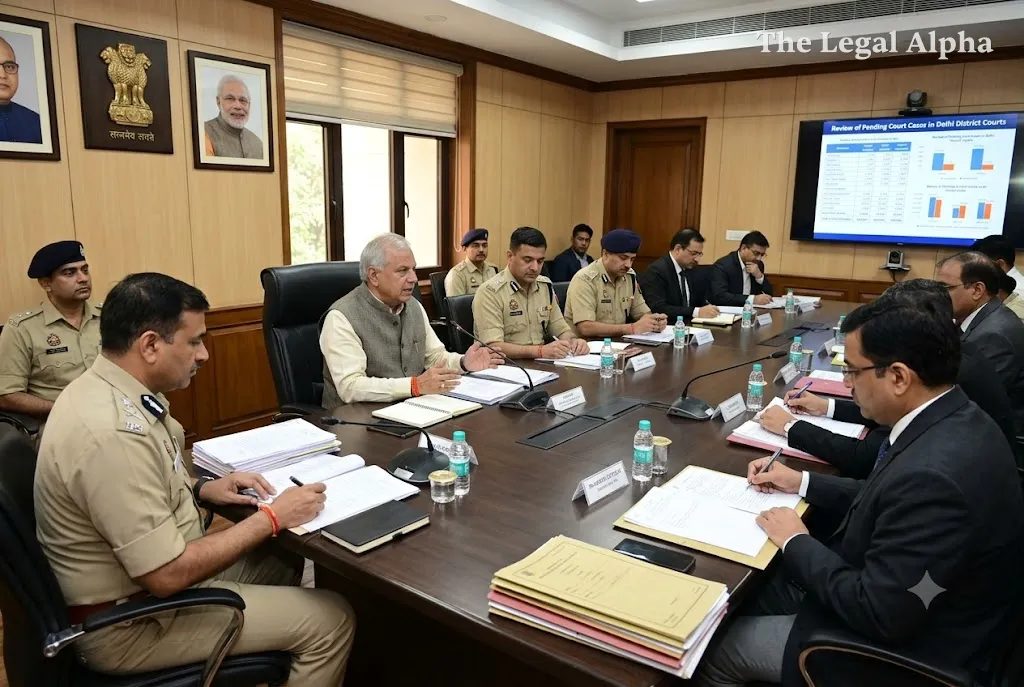
Delhi Lieutenant Governor Taranjit Singh Sandhu has directed an immediate administrative and procedural overhaul across Delhi’s criminal justice machinery after official data revealed that over 3.02 lakh trial cases remain pending in the capital’s district courts.
During a high-level review meeting with top legal, home, and police administration officials, the Lieutenant Governor flagged severe prosecutorial vacancies and physical courtroom shortages. With magistrate courts bearing the heaviest load, the administration ordered strict adherence to trial timelines mandated under the newly enforced criminal procedure code, close coordination among investigators and forensic experts, and institutional accountability for investigative lapses leading to acquittals.
Legal Topic
Area of Law: Criminal Law and Administration of Justice
Sub-topic: Prosecutorial Reforms, Trial Management, and Judicial Infrastructure under BNSS
Core Legal Issue
The core issue concerns the administrative failure to match prosecution personnel and trial court capacity with statutory trial deadlines, resulting in widespread systemic delays and severe docket congestion.
The review addressed whether the executive branch can operationalize the expedited procedural mandates of the Bharatiya Nagarik Suraksha Sanhita (BNSS), 2023, while prosecutors remain overburdened by thousands of cases per officer and critical trial court infrastructure remains unexpanded.
What Did the Authority Decide?
The Lieutenant Governor issued a series of administrative directions aimed at restructuring the Directorate of Prosecution and clearing bottlenecks across trial courts:
-
Enforcing Statutory Timelines: Directing trial prosecutors and law enforcement agencies to strictly comply with the procedural timelines prescribed under the BNSS, curtail routine adjournments, and ensure prompt appearance of witnesses.
-
Addressing Personnel Deficits: Undertaking to directly pursue delayed prosecution recruitments with the Union Public Service Commission (UPSC) and the Public Works Department (PWD) to fast-track appointments and courtroom infrastructure development.
-
Investigative & Charge-Sheet Scrutiny: Ordering enhanced scrutiny of police charge-sheets and forensic evidentiary trails before submission to courts to minimize technical defects.
-
Accountability for Prosecutorial Failures: Directing systemic reviews of acquittal judgements to identify whether acquittals were caused by lapses in police investigation or prosecutorial negligence, with consequential corrective action.
-
Prioritisation of Vulnerable Litigants: Instructing prosecutors to prioritize pending trials involving offenses against women and children and ensure active communication with victims.
Key Legal Points
-
Caseload Imbalance in Subordinate Courts: Out of the 3,02,477 pending trial cases recorded as of September 30, 2026, magistrate courts account for 2,54,597 cases, while sessions courts account for 47,880.
-
Severe Prosecutor Workload: Public prosecutors in sessions courts manage an average of 309 pending cases each, whereas Assistant Public Prosecutors in magistrate courts shoulder an average caseload of 2,021 cases each, rising above 3,000 cases per prosecutor in districts like Rohini.
-
Directorate Restructuring under BNSS: Recruitment rules are being framed for 40 newly created posts of Deputy Director and Assistant Director of Prosecution under the provisions of the BNSS, alongside the deputation of 32 Additional Public Prosecutors.
-
Auditing Acquittals: Executive monitoring revealed that a standing committee assessing investigative and prosecutorial errors has reviewed 64,210 criminal acquittals across 34 review sessions since August 2014.
Relevant Law
-
Bharatiya Nagarik Suraksha Sanhita (BNSS), 2023: Specifically, Section 18 and Section 20 governing the establishment, hierarchy, and functions of the Directorate of Prosecution, as well as provisions governing mandatory time-bound trial procedures, electronic summons, and framing of charges.
-
Constitution of India, Article 21: The fundamental right to a speedy, fair, and open trial, which encompasses the state's constitutional obligation to provide adequate judicial infrastructure and timely trials.
Arguments and Administrative Positions
Directorate of Prosecution and Law Department
The prosecution directorate submitted that structural deficits—most notably severe delays in UPSC recruitment cycles, shortages of dedicated prosecutor chambers, insufficient physical courtrooms, and cramped record storage—impede the swift disposal of matters. Officials pointed out that individual prosecutors in high-volume districts manage unsustainable caseloads that make preparation for daily trial calls extremely difficult.
The Lieutenant Governor’s Review Bench
The Lieutenant Governor emphasized that "justice delayed cannot become justice denied," stating that structural handicaps cannot excuse unmonitored adjournments, careless evidence handling, or preventable trial postponements. The executive position highlighted that statutory timelines under India's new criminal code are binding mandates requiring immediate technical modernization, inter-agency coordination with forensic laboratories, and institutional accountability for flawed investigations.
Why Does It Matter?
The staggering pendency figures underscore that introducing modern procedural codes like the BNSS cannot speed up trials without substantial investments in personnel and physical courtroom infrastructure. When an individual magistrate prosecutor is expected to handle over 2,000 active trial matters, the constitutional guarantee of a speedy trial is compromised, prolonging detention periods for undertrial prisoners and denying timely closure to crime victims.
Furthermore, establishing systemic audits of trial court acquittals introduces concrete administrative scrutiny over how police investigating officers gather evidence and how prosecutors present it. If implemented effectively across metropolitan districts, structured oversight and regularized forensic coordination could significantly curb procedural lapses and witness weariness.
Legal Takeaway
Statutory procedural timelines are only as effective as the prosecutorial and judicial machinery tasked with enforcing them. The Lieutenant Governor's directives confirm that tackling subordinate court pendency requires filling prosecutorial vacancies, expanding basic court infrastructure, and holding trial agencies accountable for preventable trial delays.
Sources
Primary Source:
-
Official Review Meeting Minutes & Administrative Directives on Court Pendency, Office of the Lieutenant Governor of Delhi (Chaired by LG Taranjit Singh Sandhu, October 2026).
Additional Sources:
-
High-Level Review of District Court Pendency and Directorate of Prosecution Data (as of September 30, 2026).
-
Directorate of Prosecution & Department of Law, Justice and Legislative Affairs, Government of NCT of Delhi.