Supreme Court Reserves Verdict on Karnataka’s Law Validating 2011 KPSC Appointments
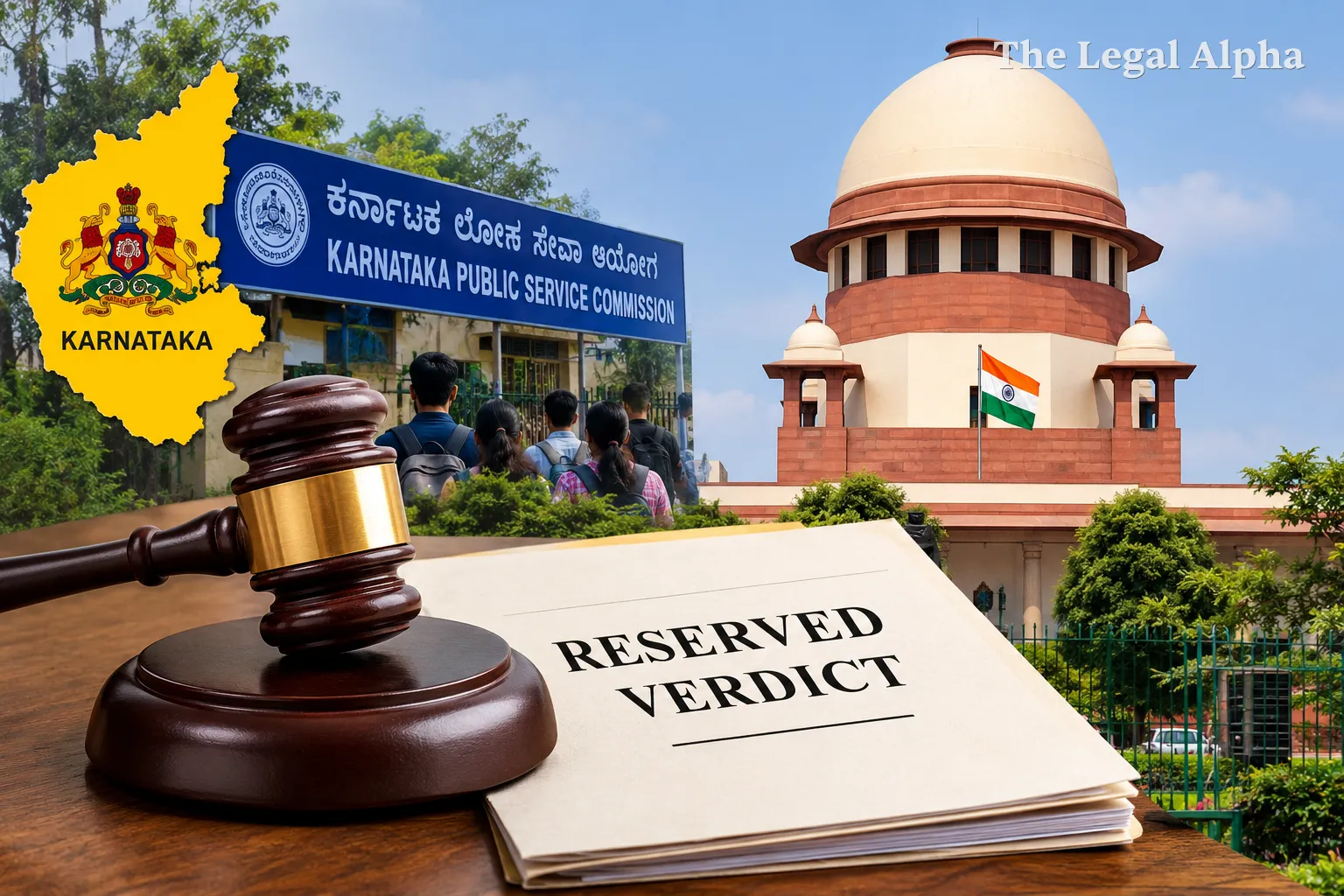
The Supreme Court has reserved its judgment on petitions challenging a Karnataka High Court ruling that upheld the state’s legislative validation of the controversial 2011 Karnataka Public Service Commission (KPSC) recruitment. The dispute centers on 362 Gazetted Probationer posts that were marred by allegations of widespread corruption, mark tampering, and procedural irregularities during the viva-voce stage.
A bench comprising Justices J.B. Pardiwala and K. Vinod Chandran heard arguments in a Special Leave Petition brought by unsuccessful candidates who contend that the state legislature bypassed judicial findings of fraud by enacting a retrospective validating law. The bench has granted the parties until October 26 to submit supplementary affidavits and written notes before delivering its final determination.
Legal Topic
-
Area of Law: Constitutional Law & Administrative Law
-
Sub-topic: Legislative Overruling / Public Employment & Recruitment Fraud
Core Legal Issue
The fundamental legal question before the Supreme Court is whether a state legislature can enact a validation statute to revive a public recruitment process that executive inquiries and courts previously found to be tainted by systemic fraud and corruption.
Under constitutional doctrine, while a legislature has the competence to cure defects in an existing law with retrospective effect to alter the basis of a judgment, it cannot directly overrule or nullify judicial determinations without removing the underlying defect. The Court must decide whether the Karnataka statute cures a statutory flaw or impermissibly encroaches upon judicial powers to shield tainted appointments from judicial scrutiny.
What Did the Court Decide?
The Supreme Court has formally concluded oral arguments and reserved its verdict.
No final determination on the constitutional validity of the statute has been pronounced yet. However, the bench directed the petitioners and the Karnataka government to submit detailed affidavits outlining complete factual and procedural specifics by October 26. It also permitted proposed intervenors to place concise written notes on record.
Key Legal Points
-
Limits of Validating Statutes: A legislature can retrospectively alter the legal foundation of a judicial ruling, but it cannot exercise direct judicial power to overturn binding court findings regarding recruitment corruption.
-
Separation of Powers: The challenge tests whether legislative action encroached upon the judiciary’s constitutional mandate under Articles 141 and 142 to review tainted selections.
-
Integrity of Public Selection: The Supreme Court examined whether appointments rooted in proven systemic manipulation violate the equality and fairness guarantees in Articles 14 and 16 of the Constitution of India.
-
Status of Pending Affidavits: The final ruling remains pending post-submission of parties' records and arguments due by October 26.
Relevant Law
-
Karnataka Civil Services (Validation of Selection and Appointment of 2011 Batch Gazetted Probationers) Act, 2022: The state enactment challenged for retrospectively legitimizing the cancelled 2011 selection list.
-
Articles 14 and 16 of the Constitution of India: Constitutional guarantees ensuring equality before the law and equal opportunity in public employment.
-
Articles 245 and 246 of the Constitution of India: Provisions defining the scope and constitutional limits of legislative competence.
-
Relevant Precedents: Pradeep Kumar Biswas v. Indian Institute of Chemical Biology and Medical Council of India v. State of Kerala (governing the limits of legislative validation vs. impermissible legislative overruling of judicial orders).
Arguments of the Parties
Petitioners
Counsel for the petitioners submitted that the entire 2011 recruitment process was hopelessly contaminated by fraud, noting that criminal investigations had established bribery and manipulation, leading to identical marks being awarded to hundreds of candidates. They argued that the 2022 Validation Act was a colourable exercise of legislative power intended solely to nullify earlier judicial decisions and regularize an intrinsically flawed process, thereby violating Articles 14 and 16.
State of Karnataka & Beneficiaries
The State government and selected candidates contended that the legislature acted well within its constitutional authority to resolve years of administrative uncertainty. They submitted that the Validation Act removed the legal impediments that previously led to executive withdrawal, asserting that not all 362 candidates were implicated in misconduct and that innocent, successful aspirants deserved finality and service protection after years of limbo.
Why Does It Matter?
This case directly tests the constitutional limits of state legislatures attempting to validate public employment selections plagued by administrative wrongdoing. Public recruitment controversies frequently prompt state governments to pass retrospective validation acts to avoid mass terminations or administrative deadlocks.
A definitive ruling from the Supreme Court will clarify the boundary between legitimate curative legislation and unconstitutional legislative overreach. The outcome will set an important precedent for government employers, civil services aspirants, and state recruitment bodies across India regarding whether political or legislative compromises can override judicial findings of corruption in competitive examinations.
Legal Takeaway
Legislatures have the power to cure statutory defects retrospectively, but they cannot pass validation laws that merely bypass judicial findings of fraud in public recruitments. The Supreme Court's forthcoming decision will establish whether retrospective state legislation can shield tainted administrative selection processes from constitutional scrutiny.
Sources
-
Primary Source: Supreme Court of India, Special Leave Petition (Civil) proceedings challenging Karnataka High Court orders concerning the Karnataka Civil Services (Validation of Selection and Appointment of 2011 Batch Gazetted Probationers) Act, 2022 (Record of Proceedings before Bench of Justices J.B. Pardiwala & K. Vinod Chandran, reserved October 2026).
-
Additional Sources: Karnataka Act No. 14 of 2022 (Official Gazette Notification); Supreme Court record in State of Karnataka v. Santhosh Kumar C. (2026 INSC 276).