Calcutta High Court Declines to Quash Criminal Proceedings Over Alleged Religious Concealment and Deceitful Marriage
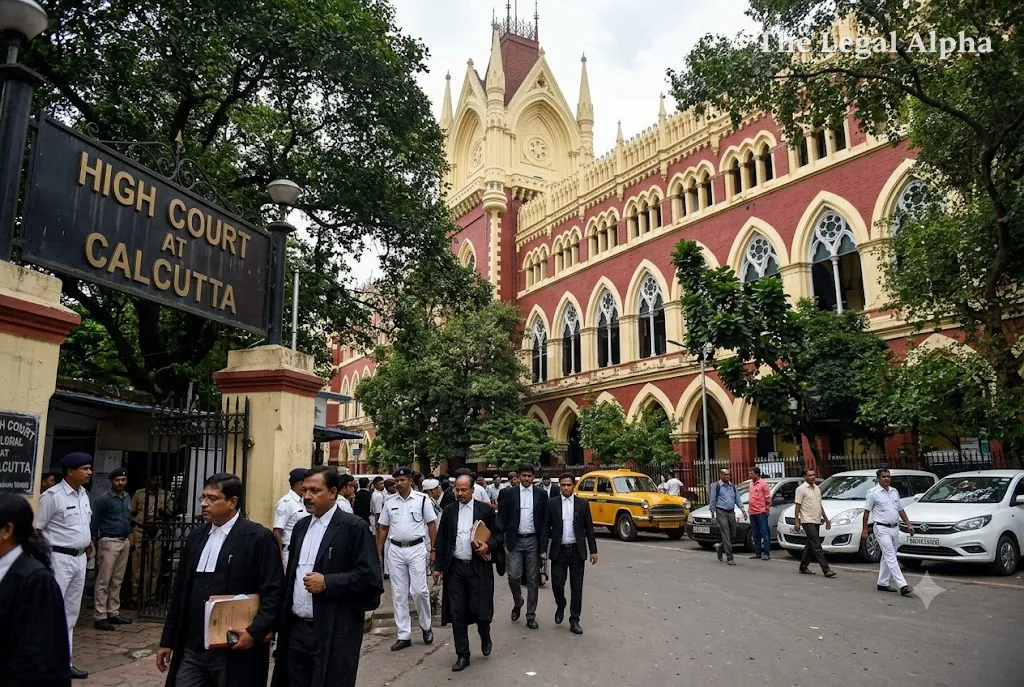
The Calcutta High Court dismissed a criminal revisional petition filed by a West Bengal police constable, Md. Rafikul Islam, and his family members seeking to quash criminal proceedings pending against them. The case originated from a complaint filed by a woman alleging that the petitioner falsely represented himself as a Hindu bachelor named "Rajib Sarkar," persuaded her into an intimate relationship, performed a simulated wedding ceremony at a temple in Digha, and cohabited with her.
According to the complaint, she subsequently discovered that he was a married Muslim man with children. Upon confronting him, she was allegedly subjected to severe physical assault, wrongful confinement, non-consensual intercourse, and a forced miscarriage at his ancestral home in Murshidabad. Following a directive by the Additional Chief Judicial Magistrate at Barrackpore under Section 156(3) of the Code of Criminal Procedure, an FIR was registered at Nimta Police Station. The accused moved the High Court under Section 482 of the CrPC to terminate the prosecution, but the High Court refused to scuttle the trial.
Legal Topic
Area of Law: Criminal Law / Criminal Procedure
Sub-topic: Inherent Powers to Quash FIRs / Consent Obtained by Deception
Core Legal Issue
The primary issue before the High Court was whether criminal proceedings alleging impersonation, deceitful inducement into a physical relationship, and marital cruelty could be quashed under Section 482 of the CrPC by relying on disputed factual claims, conflicting defenses, or the outcome of a prior departmental inquiry.
A related legal question was whether the court at the pre-trial stage could determine the validity of the complainant's consent and whether terminology such as "love jihad" has any recognition or bearing under Indian criminal jurisprudence.
What Did the Court Decide?
Justice Ajay Kumar Gupta dismissed the revisional petition, refusing to interfere with the pending proceedings before the Additional Chief Judicial Magistrate, Barrackpore.
The Court held that the inherent power of the High Court under Section 482 of the CrPC is discretionary and must be exercised sparingly, strictly within the boundaries settled by the Supreme Court. The Bench observed that evaluating contradictory factual defenses—including whether the complainant knew the petitioner's real identity, whether the relationship was genuinely consensual, and how much weight should be assigned to findings from an internal police disciplinary proceeding—would amount to conducting a mini-trial at the threshold stage.
Addressing the discourse around the controversy, the Court noted that the term "love jihad" has no legal definition under Indian law. As a result, courts cannot decide cases on colloquial or political labels and must evaluate the charges strictly under the codified statutory framework of the Indian Penal Code. The trial court was left to determine the veracity of the evidence without influence from the High Court's dismissal.
Key Legal Points
-
No Mini-Trial Under Section 482: Inherent powers cannot be invoked to evaluate contested factual narratives or assess the defense's evidence before a full trial has commenced.
-
Consent and Misrepresentation of Identity: Allegations that consent for a physical relationship was procured by deliberately concealing marital status and religious identity disclose prima facie offenses that require evidentiary scrutiny.
-
Absence of Legal Definition for Colloquial Terms: The phrase "love jihad" carries no legal status or statutory definition under Indian criminal law; proceedings must be governed strictly by statutory provisions of the penal code.
-
Independent Nature of Criminal Prosecutions: Dropping charges or arriving at a different conclusion in an administrative or departmental inquiry does not automatically invalidate a criminal prosecution arising out of the same underlying incident.
Relevant Law
-
Section 482, Code of Criminal Procedure, 1973 (CrPC): Inherent powers of the High Court to prevent abuse of the process of any court or to secure the ends of justice.
-
Section 156(3), CrPC: Magistrate's power to order an investigation by the police into cognizable offenses.
-
Sections 416 and 419, Indian Penal Code, 1860 (IPC): Cheating by personation and punishment for cheating by personation.
-
Sections 420, 498A, 313, 323, 506, and 120B, IPC: Offenses relating to cheating, cruelty by husband or relatives of husband, causing miscarriage without woman's consent, voluntarily causing hurt, criminal intimidation, and criminal conspiracy.
-
Supreme Court Precedent: Neeharika Infrastructure Pvt. Ltd. v. State of Maharashtra, establishing caution and restraint in quashing investigations and prosecutions.
Arguments of the Parties
Petitioners
Senior counsel appearing for Md. Rafikul Islam and his relatives argued that the FIR was an afterthought and a malicious attempt to ruin his life and police career. They submitted that both parties were consenting adults who engaged in a voluntary relationship, which could not constitute an offense under Section 376 or related penal provisions. The defense further contended that no valid marriage existed, rendering Section 498A inapplicable, and asserted that a departmental inquiry had already cleared the petitioner of allegations regarding impersonation and assault, making the continuation of criminal proceedings an abuse of process.
Respondent / State and Complainant
The State and the de facto complainant submitted that the petitioner systematically concealed his true name, marital status, and religion by posing as a bachelor named "Rajib Sarkar." They argued that her consent was obtained under a fraudulent misconception of fact, invalidating voluntary agreement. It was also contended that specific allegations existed regarding wrongful confinement, physical cruelty, and forced miscarriage inflicted by the accused and his family, which clearly made out a prima facie case necessitating a trial.
Why Does It Matter?
The ruling reiterates the institutional boundaries of High Courts when invoked under Section 482 of the CrPC. By declining to weigh rival factual assertions, the Calcutta High Court reaffirmed that where allegations establish a prima facie case involving personal deception, physical violence, and assault, courts will not shut down proceedings early merely because the accused claims consent or relies on parallel departmental proceedings.
The decision also provides clarity regarding public nomenclature and judicial scrutiny. By observing that "love jihad" remains an undefined socio-political phrase rather than a legal category, the Court underscored that the judiciary will evaluate allegations of deceitful interfaith relationships strictly through established criminal offenses such as cheating by personation, fraudulent concealment, and assault.
Legal Takeaway
Allegations of religious concealment and fraudulent identity used to secure physical intimacy or marriage cannot be bypassed at the preliminary stage under Section 482 of the CrPC. Inherent powers do not authorize High Courts to conduct a mini-trial, and claims of consent must be tested against evidence during a full trial.
Sources
Primary Source:
Judgment of the Calcutta High Court in Md. Rafikul Islam & Ors. v. The State of West Bengal & Anr. (Neutral Citation: 2026:CHC-AS:1890, CRR No. 3501 of 2022, decided by Justice Ajay Kumar Gupta).
Additional Sources:
Records from the Court of the Additional Chief Judicial Magistrate, Barrackpore, in connection with Nimta P.S. Case No. 885/2021.