Delhi Court Finds Sharjeel Imam Breached Interim Bail Terms Over Media Interaction but Declines Revocation Ahead of Scheduled Surrender
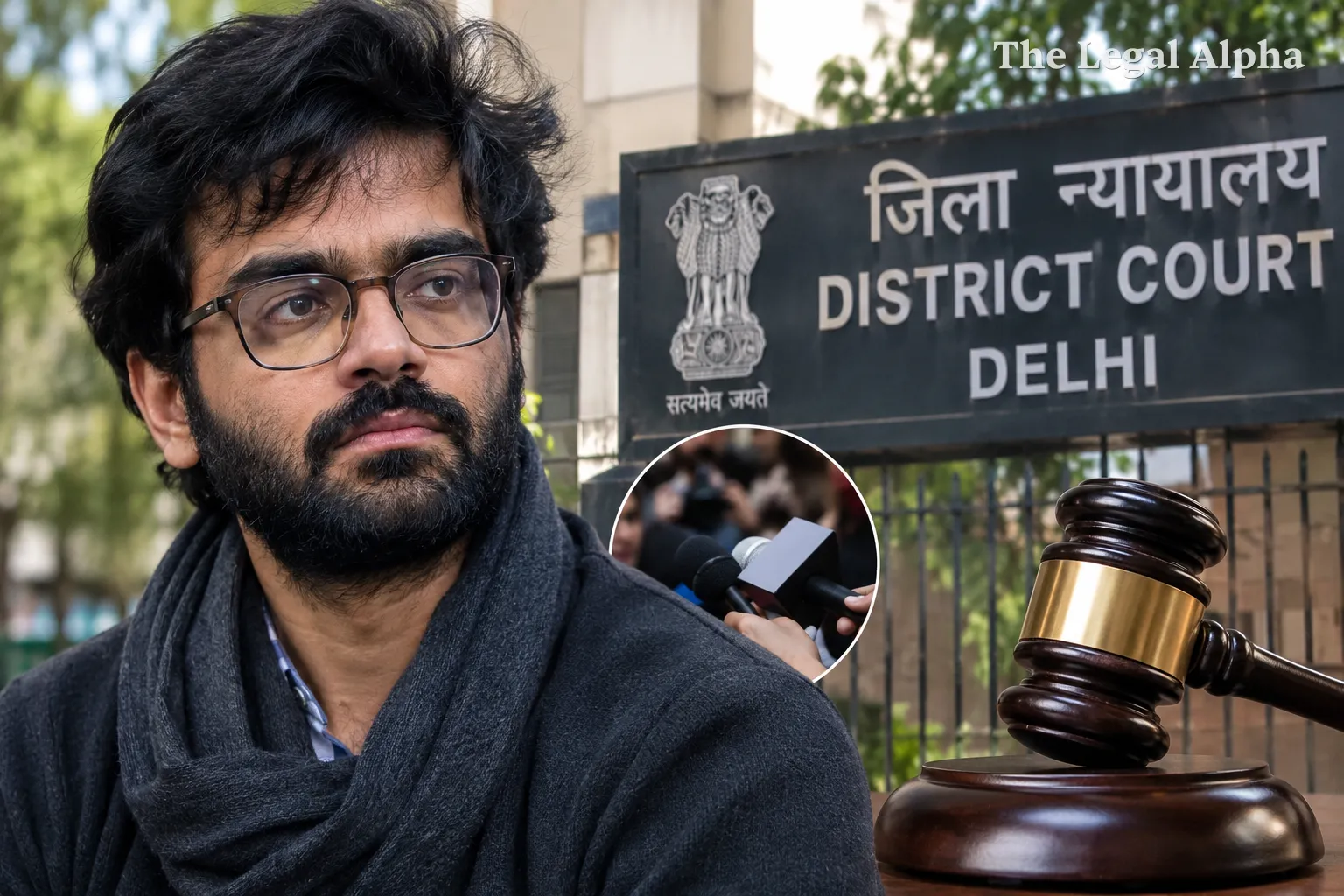
A Delhi court ruled that student activist Sharjeel Imam breached the conditions attached to his temporary release in the 2020 Delhi riots larger conspiracy case after video material showed him present during a media interaction. The Delhi Police approached the court seeking immediate cancellation of his interim relief, arguing that he had abused the concession granted to him. Additional Sessions Judge Sameer Bajpai of the Karkardooma Courts noted the breach but refrained from passing an order cancelling the bail, as Imam was already slated to surrender back to judicial custody later the same day upon the expiry of his release term.
Legal Topic
Area of Law: Criminal Procedure & Anti-Terror Law
Sub-topic: Bail Compliance / Revocation of Interim Bail under Special Statutes
Core Legal Issue
The primary legal issue before the court was whether an undertrial granted limited interim relief on humanitarian grounds forfeits that liberty by breaching specific restrictive covenants—namely, a total ban on engaging with the press or social media—and whether a formal revocation order is warranted when the interim bail duration is already lapsing on the date of hearing.
What Did the Court / Authority Decide?
Additional Sessions Judge Sameer Bajpai held that Imam had apparently flouted the express conditions set down in the interim bail order by coming into contact with media personnel.
The court reviewed digital footage circulating online that placed Imam in the room while a journalist interviewed his brother. Despite establishing the infraction, the court declined to issue an order revoking the interim bail because the seven-day period was expiring that very evening and Imam was already bound to surrender before prison authorities.
Key Legal Points
-
Conditional bail orders impose strict, binding obligations on undertrials, particularly where courts grant relief for narrow, compassionate purposes such as family ceremonies.
-
The presence of an accused in an environment where press interviews are actively conducted constitutes contact with the media, breaching negative covenants against media engagement.
-
Courts retain wide discretion under procedural criminal law to assess whether an established violation justifies an immediate revocation order, taking practical circumstances—such as an imminent scheduled surrender—into account.
-
Judicial tolerance for deviations from bail undertakings is especially low in cases involving special security statutes such as the Unlawful Activities (Prevention) Act.
Relevant Law
-
Code of Criminal Procedure, 1973 (CrPC) / Bharatiya Nagarik Suraksha Sanhita, 2023 (BNSS): Provisions governing bail conditions and the court's power to cancel bail upon breach of undertakings.
-
Unlawful Activities (Prevention) Act, 1967 (UAPA): Substantive charges under which FIR 59/2020 was registered regarding the larger conspiracy behind the 2020 northeast Delhi riots.
-
Indian Penal Code, 1860 (IPC): Allied penal provisions invoked in the underlying conspiracy proceedings.
Arguments of the Parties
Delhi Police / Prosecution
The prosecution argued that Imam had directly misused the court's indulgence. State counsel presented video recordings from YouTube and social media platforms showing Imam in close proximity to press personnel while an interview was being filmed. The State contended that this conduct constituted a direct violation of the conditions barring him from communicating with the media and interacting with persons outside his immediate circle of family and friends, warranting immediate revocation of his liberty.
The Defence
Imam had secured seven days of interim bail strictly to attend his cousin's wedding functions. While the defence acknowledged the restrictive parameters imposed by the court, the circumstances around the footage reflected family settings where external recordings occurred, rather than an intentional press briefing organized by the accused. Furthermore, as the temporary period was set to conclude on October 10, the relief had effectively run its course without abscondence.
Why Does It Matter?
The decision underscores the legal risk that undertrials face when restrictive conditions are attached to temporary liberty. Courts routinely impose restrictions on speech, media engagement, and public commentary when granting humanitarian bail in politically charged or sensitive criminal trials.
By finding a breach simply because the accused was seated in the same room where press activity unfolded, the ruling illustrates that courts interpret non-contact restrictions strictly against the beneficiary of the order. At the same time, it reflects a pragmatic judicial approach: where the tenure of release has effectively expired and the accused is returning to custody, courts may decline to invoke formal cancellation mechanisms that would have no practical consequence.
Legal Takeaway
Strict negative covenants in interim bail orders—such as prohibitions on press or social media interaction—are interpreted strictly, and passive presence during media engagements can be construed as a violation. However, courts balance technical non-compliance against practical utility when determining whether an immediate formal revocation of bail is necessary.
Sources
Primary Source:
-
Order of the Court of Additional Sessions Judge Sameer Bajpai, Karkardooma Courts, Delhi, in the matter arising out of FIR 59/2020 (Crime Branch/Special Cell), dated October 10, 2026.
Additional Sources:
-
Court proceedings and legal reports covering the State's interim bail cancellation plea in the 2020 Delhi Riots larger conspiracy trial.