Beneficial Laws Cannot Remain on Paper: Supreme Court Demands Nationwide Awareness Campaign for Motor Accident Interim Relief Scheme
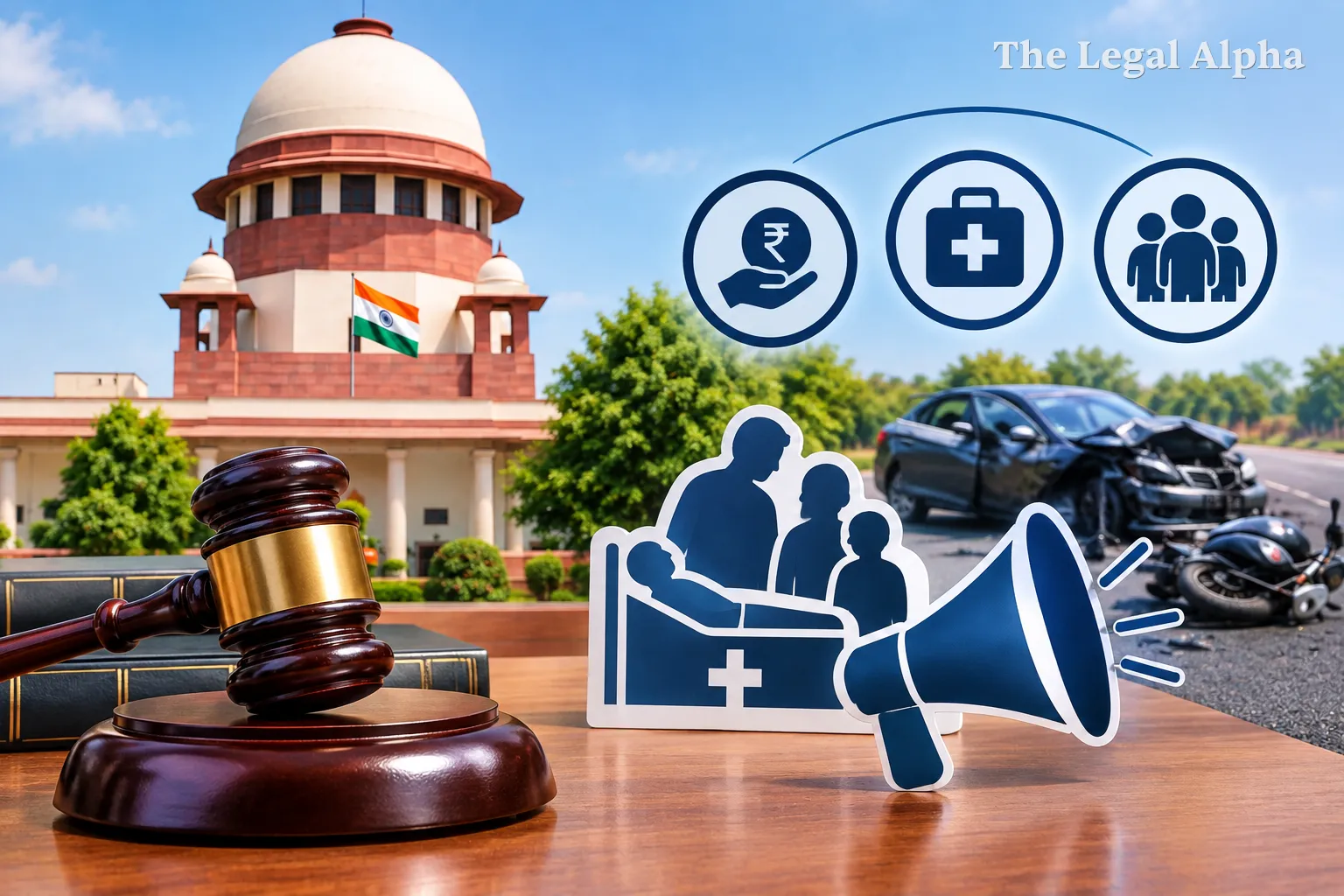
The Supreme Court of India expressed strong dissatisfaction with the quiet rollout of the Compensation to Victims (Interim Relief) Scheme, 2026, remarking that a beneficial law serves little purpose if the common citizen remains unaware of its existence. While hearing continuing proceedings in a long-standing public interest litigation on road safety, a Bench comprising Justice J.B. Pardiwala and Justice K.V. Viswanathan pulled up the Union Government for failing to publicise the statutory scheme.
During the hearing, the court discovered that neither the general public nor the court-appointed Amicus Curiae had been apprised of the newly framed rules, which offer interim financial support to road accident victims. Characterising the measure as an "unannounced law," the apex court directed the Union Ministry of Road Transport and Highways to publish the scheme immediately in the Official Gazette and formulate a comprehensive strategy to ensure widespread public awareness and seamless operational execution across every state and Motor Accidents Claims Tribunal.
Legal Topic
Area of Law: Motor Vehicles and Tort Law
Sub-topic: Motor Accident Compensation / Statutory Interim Relief and Implementation
Core Legal Issue
The primary legal question before the Supreme Court was whether a social welfare scheme framed under subordinate legislation can be deemed legally and practically effective when it has been introduced without publication in the Official Gazette and without an accessible implementation framework.
Beyond administrative notification, the court addressed the broader obligation of the executive in welfare jurisprudence: whether the State fulfills its statutory mandate simply by drafting a compensation framework on paper, or whether it bears an enforceable duty to proactively publicise and operationalise beneficial provisions so that entitled citizens can actually invoke them.
What Did the Court Decide?
The Supreme Court held that statutory relief schemes aimed at vulnerable citizens cannot function in secrecy or administrative isolation. The Bench issued a series of peremptory directions to the Central Government:
-
Mandatory Gazette Publication: The Centre was directed to notify the Compensation to Victims (Interim Relief) Scheme, 2026, in the Official Gazette without further delay to satisfy the statutory requirements of legal effect.
-
Nationwide Publicity Campaign: The Union must orchestrate a nationwide awareness drive across print, digital, and grassroots channels so that accident victims, their legal heirs, police departments, and Claims Tribunals are made conscious of the mechanism.
-
Submission of an Implementation Roadmap: The Union Government must present a concrete plan on the next date of hearing, illustrating how the digital application portal will function, how claims will be processed, and how state administrations will enforce the scheme.
-
Clarification on Uninsured Vehicles: The court sought clear instructions from the government on whether the current draft scheme covers accidents caused by uninsured vehicles or whether additional safeguards must be introduced.
While the court issued notice in related contempt petitions regarding past non-compliance with road-safety directions, it refrained from making any adverse finding of contempt at this stage, treating the exercise as a continuing supervisory effort.
Key Legal Points
-
Promulgation Precedes Enforcement: Delegated legislation that confers socio-economic benefits requires proper publication and gazetting; without public notice, statutory rights remain largely theoretical.
-
The Concept of "Unannounced Law": The court observed that rolling out welfare measures without grassroots publicity creates an information vacuum, defeating the legislative intent of prompt interim relief.
-
Administrative Accountability in PILs: In ongoing institutional public interest litigations, the Supreme Court continues to exercise dynamic regulatory oversight to compel executive agencies to comply with statutory mandates.
-
Equitable Coverage in Accident Compensation: The Bench underlined that administrative schemes framed under motor vehicle laws must not leave victims of hit-and-run or uninsured vehicles without immediate recourse.
Relevant Law
-
Motor Vehicles Act, 1988 (as amended in 2019):
-
Section 164A: Empowers the Central Government to formulate schemes providing interim relief to claimants pending final adjudication of compensation.
-
Section 164: Mandates payment of fixed compensation in cases of death or grievous hurt on a no-fault liability basis.
-
Section 212: Governs the publication, notification, and laying of rules and schemes framed under the Act before Parliament.
-
-
Judicial Precedent: Continuing directions under S. Rajaseekaran v. Union of India (2014 & 2018) regarding national road safety enforcement and victim rehabilitation.
Arguments of the Parties
Petitioner / Applicant
The applicant appearing in person, alongside submissions highlighted by the Amicus Curiae, contended that the Central Government had delayed the establishment of the statutory interim relief framework required by the amended Motor Vehicles Act. It was submitted that accident victims continue to endure catastrophic financial stress during the initial weeks following a collision, with tribunals and police authorities having no operational mechanism or intimation regarding the release of interim funds.
Respondent / Union of India
Appearing for the Central Government, Additional Solicitor General Vikramjit Banerjee submitted that the Ministry of Road Transport and Highways had already finalized the Compensation to Victims (Interim Relief) Scheme, 2026. Under the formulated scheme, provision has been made for interim relief amounting to Rs. 2 lakh in fatal accident cases and Rs. 1 lakh for grievous injuries. The ASG stated that the framework had been circulated to state governments and that an online claims portal was in development, assuring the Bench that formal gazette publication and wider outreach would be accomplished swiftly.
Why Does It Matter?
Road accidents in India push thousands of families into immediate destitution every year, often because the traditional compensation process before Motor Accidents Claims Tribunals takes years to conclude. While the statutory creation of an interim compensation mechanism of Rs. 2 lakh for death and Rs. 1 lakh for severe injury provides critical emergency support, its utility is entirely dependent on claimant awareness.
By confronting executive opacity, the Supreme Court's intervention ensures that state transport departments, local police stations, hospitals, and legal services authorities are compelled to treat victim notification as an affirmative administrative duty. Furthermore, scrutinising the scheme's treatment of accidents involving uninsured vehicles closes a crucial loophole, ensuring that the poorest victims are not excluded from emergency recovery.
Legal Takeaway
A statutory benefit exists only to the extent that an ordinary citizen knows how to claim it. The Supreme Court has reaffirmed that executive agencies cannot discharge legislative mandates through silent administrative rollouts; effective gazette publication and broad public education are indispensable preconditions for beneficial law enforcement.
Sources
Primary Source:
-
Supreme Court of India: S. Rajaseekaran v. Union of India & Ors., Writ Petition (Civil) No. 295 of 2012, Record of Proceedings dated October 16, 2026 (Bench of Justice J.B. Pardiwala and Justice K.V. Viswanathan).
Additional Sources:
-
Motor Vehicles (Amendment) Act, 2019, Sections 164, 164A, and 212.
-
Compensation to Victims (Interim Relief) Scheme, 2026, Ministry of Road Transport and Highways (MoRTH).