Bank Manager’s Request Cannot Curtail Travel Liberty Over Unpaid Debt: Madras High Court
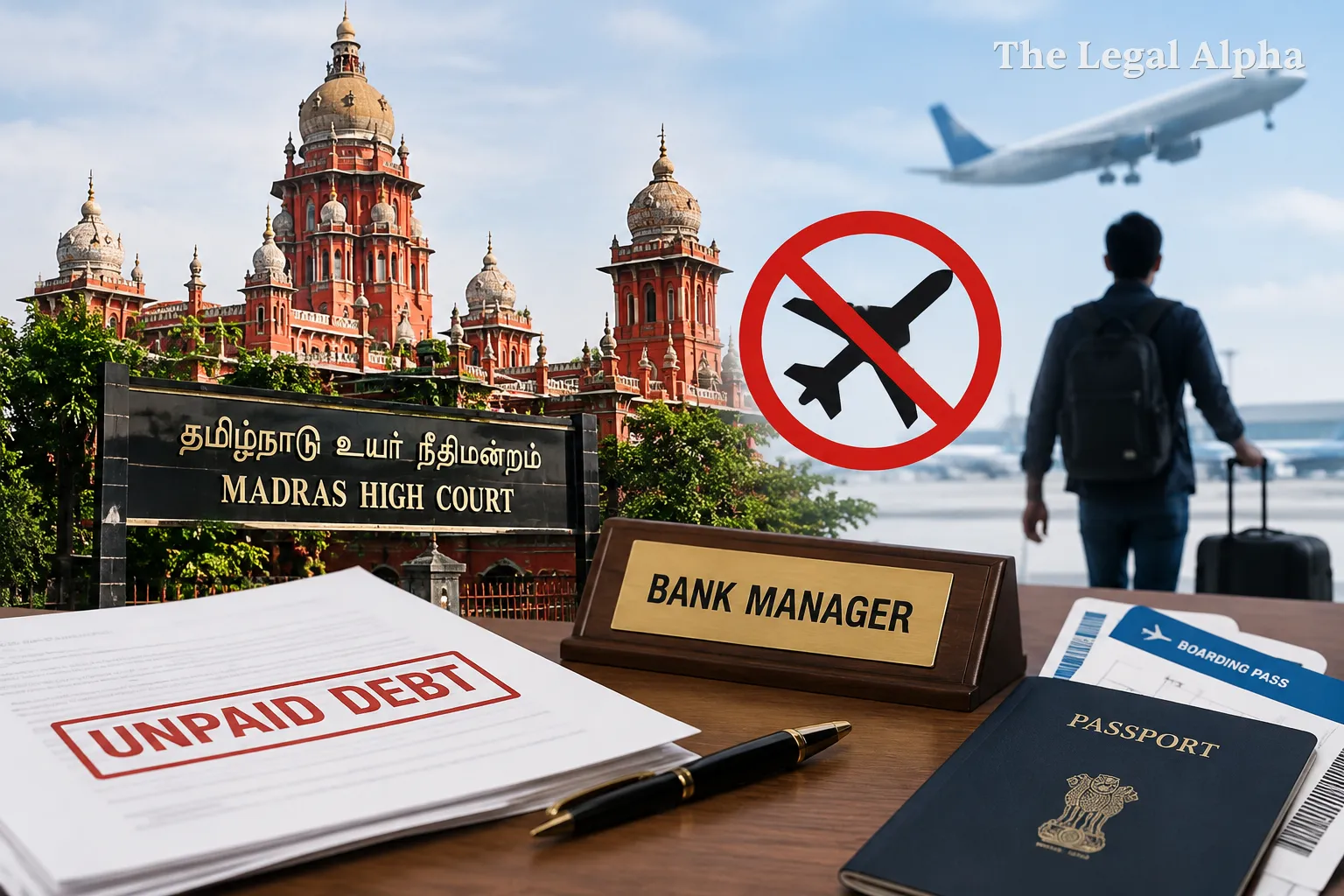
The Madras High Court dismissed a review petition filed by the Bank of Baroda seeking to restore a Look Out Circular (LOC) issued against a loan guarantor. The circular had prevented the borrower from traveling overseas solely on the grounds of outstanding commercial credit, despite no criminal complaints or allegations of fraud being filed.
Justice V. Lakshminarayanan held that an informal communication from a branch manager to immigration authorities cannot substitute for statutory law to circumscribe a citizen’s personal liberty. Emphasizing that taking a loan does not surrender one's fundamental protections, the bench refused to permit coercive travel bans as civil recovery mechanisms.
3. Legal Topic
Area of Law: Constitutional Law & Banking Law
Sub-topic: Fundamental Rights / Recovery of Debts & Look Out Circulars (LOC)
4. Core Legal Issue
Can public sector banks restrict an individual's constitutionally protected right to travel abroad via Look Out Circulars merely to enforce civil debt recovery, in the complete absence of criminal proceedings or statutory authority?
The Court had to resolve whether an administrative letter authored by a bank official qualifies as "procedure established by law" under Article 21, and whether commercial default alone empowers lenders to restrain a borrower’s physical movement across international borders.
5. What Did the Court / Authority Decide?
-
Dismissal of Review: The High Court dismissed the Bank of Baroda's review application, affirming its earlier decision dated August 24, 2026, which quashed the LOC issued against the guarantor, Kondepati Ganga Prasad.
-
Rejection of Coercive Restraints: The bench held that commercial recovery must run through established statutory mechanisms (such as civil suits or debt recovery tribunals) rather than executive travel blocks.
-
The "Catch-22" Finding: The Court observed that preventing a debtor from traveling abroad to earn income creates an illogical impasse, noting that trapping an individual within domestic borders directly hampers their capacity to generate funds and repay the lender.
-
Finality: Finding no error apparent on the face of the record, the Court closed the review without costs, leaving the guarantor free to travel abroad.
6. Key Legal Points
-
Letters Are Not Legislation: Under Article 21 of the Constitution, deprivation of personal liberty must be backed by validly enacted legislation. A requisition letter issued by a bank manager carries no legislative character and cannot operate as law.
-
Civil Debt vs. Criminal Liability: A financial default is a contractual matter concerning assets and liabilities; it does not confer a lien over an individual's physical freedom unless tainted by cognizable penal offences such as fraud or diversion.
-
Protection from Creditor Overreach: The Court cautioned that legitimizing bank-issued travel bans without statutory backing would establish a hazardous precedent, effectively leaving borrowers at the mercy of private creditors and finance companies.
-
Sanctity of Article 21: The fundamental right to travel abroad, settled since the Supreme Court's landmark ruling in Maneka Gandhi, cannot be suspended through informal administrative arrangements between lenders and immigration desks.
7. Relevant Law
-
Constitution of India: Article 21 (Protection of life and personal liberty, including the right to travel abroad).
-
Passports Act, 1967: The primary statutory framework governing the impounding of passports and restrictions on international travel.
-
Ministry of Home Affairs Office Memoranda: Guidelines regulating the invocation and issuance of Look Out Circulars by law enforcement and statutory agencies.
-
Precedents: Maneka Gandhi v. Union of India (1978); Satwant Singh Sawhney v. D. Ramarathnam, APO New Delhi (1967); Kharak Singh v. State of U.P. (1962).
8. Arguments of the Parties
Petitioner (Kondepati Ganga Prasad / Guarantor)
The guarantor argued that he intended to travel abroad to pursue livelihood opportunities and generate income to repay the outstanding debt. He contended that restricting his exit through an LOC violated his fundamental liberty under Article 21, especially when the bank had not initiated any criminal prosecution or lodged complaints alleging fraud before any investigative agency.
Respondent (Bank of Baroda)
The bank submitted that the guarantor should be restrained from leaving Indian jurisdiction until the entire loan liability was fully cleared. The lender maintained that permitting default-linked debtors to leave the country would imperil debt recovery and undermine the financial interests of public sector banking institutions.
9. Why Does It Matter?
This ruling strikes a crucial blow against the creeping practice of public sector lenders deploying immigration restrictions as routine debt-collection tactics. By reiterating that personal liberty cannot be treated as collateral, the High Court firmly demarcates civil breach from criminal evasion.
The decision provides strong guidance to lower courts and tribunals dealing with boilerplate LOC requests. If commercial banks were allowed to unilaterally restrict cross-border travel without establishing fraud or invoking statutory penal procedures, non-banking financial companies and private moneylenders could claim similar extraordinary powers. The judgment preserves the constitutional boundary ensuring that economic disputes are adjudicated through civil debt recovery channels rather than administrative confinement.
10. Legal Takeaway
A commercial loan binds a borrower's property, not their fundamental constitutional rights. In the absence of statutory authority or formal criminal charges, a bank cannot use Look Out Circulars to restrict an individual's right to travel abroad for mere loan recovery.
Sources
Primary Source:
Madras High Court Order in Bank of Baroda v. Kondepati Ganga Prasad & Ors. (Review Application No. 12 of 2026 in W.P. Crl. No. 1951 of 2026), coram: Justice V. Lakshminarayanan.
Additional Sources:
-
Supreme Court of India, Maneka Gandhi v. Union of India (1978 1 SCC 248).
-
High Court of Delhi, Preet Kaur & Anr. v. Bureau of Immigration & Ors. (W.P.(C) 7093/2022).