Transparency Panel Invokes Coercive Powers Against Punjab Police Officer Over Repeated Non-Appearance and Withheld Records
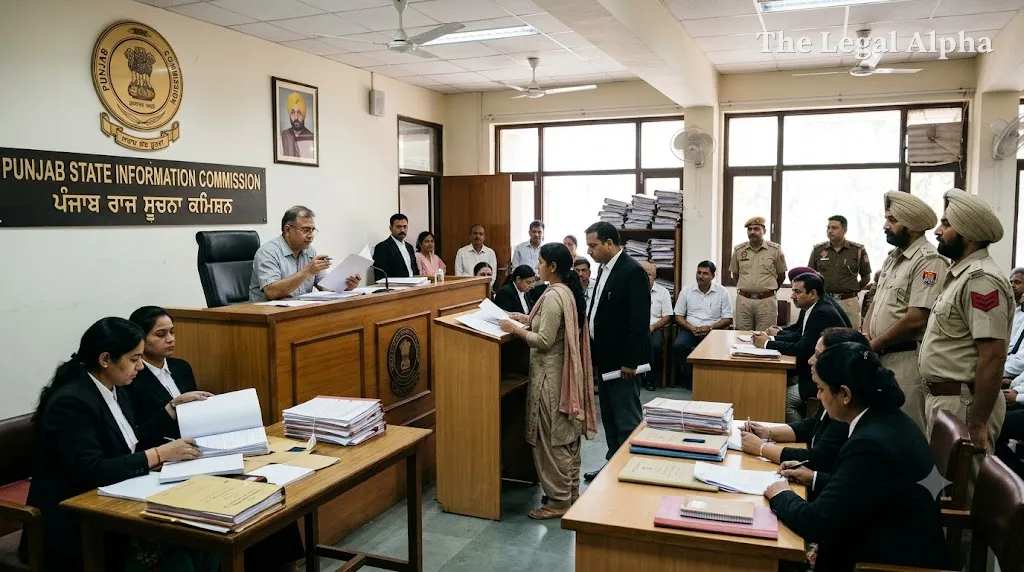
The Punjab State Information Commission initiated coercive measures against Jitender Kumar, the Station House Officer (SHO) of Daba Police Station in Ludhiana, after he failed to appear across three consecutive statutory hearings. The proceedings arise from an unanswered Right to Information (RTI) application originally filed in June 2025 seeking official police records.
The regulatory panel issued bailable warrants against the officer and directed Ludhiana Commissioner of Police Swapan Sharma to personally ensure service of the process. The directive mandates that the SHO be produced at the next hearing alongside the requested documentation. The matter gained procedural urgency following the death of the original appellant, whose daughter has moved to continue the legal pursuit as her legal representative.
Legal Topic
Area of Law: Administrative Law / Information Law
Sub-topic: Transparency Compliance, Public Authority Accountability, and Execution of Civil Court Powers by Quasi-Judicial Tribunals
Core Legal Issue
The controversy turns on the scope and enforcement of an Information Commission's powers under the Right to Information Act, 2005, when a designated Public Information Officer (PIO) systematically disregards formal summons, fails to answer statutory penalty notices, and withholds documents without legal exemption.
At a broader level, the proceedings address the question of whether procedural defaults and deliberate avoidance of quasi-judicial oversight by law enforcement officials warrant the invocation of coercive mechanisms—specifically, bailable warrants enforceable through senior police leadership—to preserve citizens' statutory entitlement to official records.
What Did the Court / Authority Decide?
The Commission found that the SHO exhibited continuous non-compliance by ignoring multiple hearing dates and failing to reply to a formal show-cause notice issued under Section 20(1) of the RTI Act on June 17, 2026.
Consequently, the Commission ordered the following:
-
Issuance of Coercive Process: Exercised powers under Section 18(3)(a) of the RTI Act to issue bailable warrants to compel the SHO’s physical presence.
-
Execution Directive: Ordered the Commissioner of Police, Ludhiana, to supervise the service of the warrants and ensure the officer appears with the records requested in the June 11, 2025 RTI application.
-
Substitution of Legal Heir: Permitted the deceased appellant's daughter, Rattan Kaur Mann, to prosecute the proceedings upon placing on record a valid legal heir certificate and authorization letter.
-
Contempt and Administrative Warning: Cautioned that a subsequent default would result in formal adverse recommendations sent directly to the Director General of Police (DGP), Punjab, for departmental sanctions under service rules.
The proceedings stand adjourned to November 25, 2026, for production of the records and return of the warrant.
Key Legal Points
-
Vesting of Civil Court Powers: Under Section 18(3) of the RTI Act, Information Commissions enjoy the procedural powers of a Civil Court trying a suit under the Code of Civil Procedure, 1908 (CPC), specifically regarding the summoning and enforcing the attendance of persons.
-
Strict Penalty Framework: Section 20 of the Act creates personal liability for PIOs who, without reasonable cause, fail to furnish information within prescribed timelines or evade regulatory inquiry.
-
Hierarchy in Warrant Execution: Directing the jurisdictional Commissioner of Police to execute warrants against a subordinate SHO reinforces administrative hierarchy to prevent intra-departmental shielding of defaulting officers.
-
Survivability of RTI Appeals: The right to pursue disclosure of public information does not automatically extinguish upon an applicant's demise, permitting legitimate legal heirs to substitute themselves upon establishing locus standi.
Relevant Law
-
Section 18(3)(a), Right to Information Act, 2005: Empowers the Commission to summon and enforce the attendance of persons and compel them to give oral or written evidence on oath and to produce documents.
-
Section 20(1), Right to Information Act, 2005: Provides for the imposition of financial penalties on Public Information Officers who persistently fail to provide information or refuse to receive applications.
-
Order XVI, Code of Civil Procedure, 1908 (CPC): Prescribes the procedural mechanism for issuing bailable and non-bailable warrants when a summoned witness or party fails to appear before a forum exercising civil powers.
Arguments of the Parties
For the Appellant / Applicant: The appellant's daughter, Rattan Kaur Mann, submitted before the panel that the requested police records had been withheld since June 2025 without lawful justification. She maintained that her mother's passing should not derail the transparency process, seeking formal leave to continue the appeal to obtain the documentation.
For the Respondent / Public Authority: The SHO (Daba Police Station) submitted no legal defense or counter-affidavit on record. The officer neither filed a response to the Commission's Section 20(1) show-cause notice nor tendered an explanation or medical ground for failing to appear across three consecutive listings.
Why Does It Matter?
Quasi-judicial tribunals like Information Commissions frequently face institutional resistance from enforcement bodies, where local police officials may treat transparency notices as secondary to internal departmental duties. By issuing bailable warrants rather than routine administrative reminders, the Punjab State Information Commission reaffirmed that public authorities cannot treat statutory appearance notices as discretionary.
Moreover, the direction commanding the city's police commissioner to execute the warrant highlights an important compliance dynamic: administrative leadership is legally bound to assist quasi-judicial bodies in disciplining subordinate officers. The recognition of a legal heir's right to pursue an RTI appeal also sets an important consumer-facing precedent, preventing state instrumentalities from using protracted delays to outlast applicants.
Legal Takeaway
Statutory bodies constituted under the RTI Act possess civil court powers to compel attendance, and public officials who repeatedly ignore regulatory summons face personal legal liability, including warrants and disciplinary referrals. Furthermore, a citizen's pursuit of public transparency survives their death, enabling legal heirs to step in and compel compliance.
Sources
-
Primary Source: Order of the Punjab State Information Commission in Appeal Proceedings relating to RTI Application dated June 11, 2025; Show-Cause Notice issued under Section 20(1) dated June 17, 2026.
-
Additional Sources: Section 18(3) and Section 20 of the Right to Information Act, 2005; Proceedings before the Punjab State Information Commission (Hearing of October 2026, next scheduled listing November 25, 2026).