Telangana High Court Blocks NIMS’s Late Bid to Undo 1,569-Day Service Benefit Order for Former Deputy Registrar
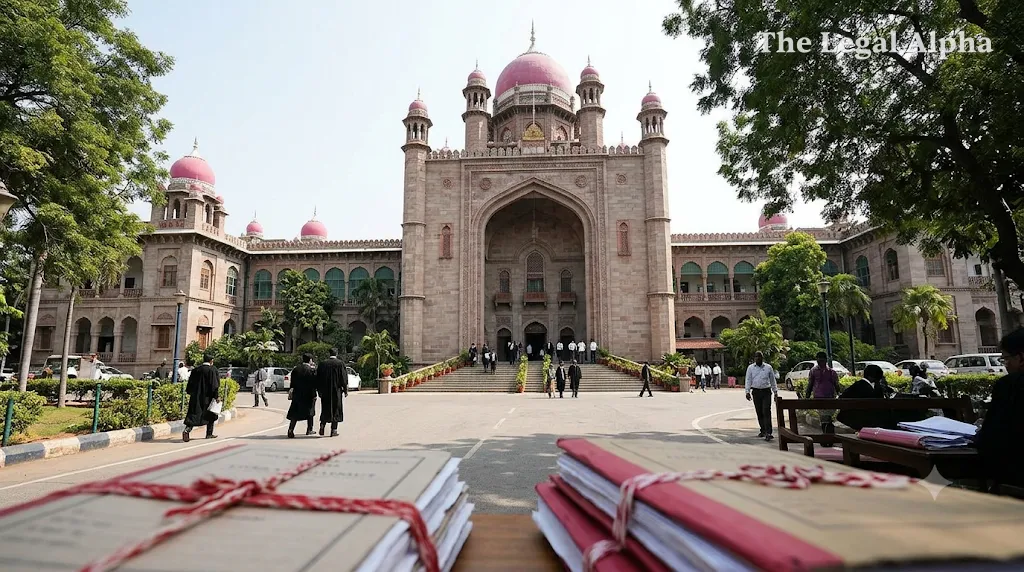
The Telangana High Court has dismissed a writ appeal filed by the Nizam’s Institute of Medical Sciences (NIMS), confirming an earlier directive that grants full service and monetary benefits to its former Deputy Registrar, K. Vinodhar.
A division bench comprising Acting Chief Justice P. Sam Koshy and Justice Narsing Rao Nandikonda upheld a single judge’s decision refusing to recall a November 2023 judgment in Vinodhar’s favor. The underlying dispute spans over two decades and centers on 1,569 days—between June 12, 2002, and September 27, 2006—when Vinodhar remained out of service following an order of compulsory retirement before being reinstated. NIMS had sought to reopen the case by alleging that Vinodhar suppressed the dismissal of a prior writ petition, but the division bench ruled that the institution missed its procedural window to raise that claim.
Legal Topic
Area of Law: Service Law / Administrative Law
Sub-topic: Procedural Finality, Recall of Orders, and Treatment of Intervening Service Period (Dies Non)
Core Legal Issue
The division bench was tasked with deciding whether a litigant can file a recall application—and subsequently an intra-court appeal—to set aside a final judgment on the ground of alleged fraud or suppression of facts, when those exact facts were already on record and could have been raised during earlier review proceedings.
Specifically, the court examined the procedural boundaries between a review petition and a recall petition, and whether failing to challenge an earlier order dismissing a review application bars a party from reopening the dispute through a fresh recall plea.
What Did the Court Decide?
On November 5, 2026, the division bench dismissed Writ Appeal No. 572 of 2026 and affirmed the single judge’s April 24, 2026 order in IA No. 1 of 2026, which had rejected NIMS’s recall application.
The court’s decision leaves the single judge’s original November 10, 2023 ruling fully intact. Under that judgment:
-
NIMS’s earlier administrative orders treating the 1,569-day gap as dies non (a break in service that does not count toward pay or pension) and as a substantive punishment remain quashed.
-
The entire period from June 12, 2002, to September 27, 2006, must be treated as "on duty" for all purposes.
-
NIMS is required to extend all consequential monetary benefits to Vinodhar, including notional increments, revised pay fixation, updated pensionary benefits, and accumulated arrears.
The bench made no order as to costs and closed all pending miscellaneous applications. Nothing remains pending in this appeal, as the review order had already attained finality.
Key Legal Points
-
Finality of Unchallenged Review Orders: Once a review petition is dismissed and that order goes unchallenged, the matter attains finality. A party cannot circumvent procedural bars by filing a subsequent recall application on grounds that were already available during the review stage.
-
Overlapping Scope of Review and Recall: Review and recall jurisdictions rest on closely related procedural principles; litigants are not permitted to pursue successive rounds of litigation to re-argue points they neglected to raise earlier.
-
Standard for Proving Fraud on the Court: While established precedents hold that an order obtained through fraud is a nullity, allegations of fraud and suppression must be specifically pleaded and strictly proved.
-
Bar Against Approbate and Reprobate: The bench noted the settled legal principle that a party—or an employee accepting conditional reinstatement—cannot accept the favorable part of an order while simultaneously repudiating its unfavorable conditions, though procedural finality ultimately barred NIMS from reopening the merits here.
Relevant Law
-
Clause 15 of the Letters Patent: Governs the maintainability of an intra-court writ appeal before a division bench against orders passed by a single judge.
-
Articles 14 and 16 of the Constitution of India: Invoked in the underlying service dispute challenging arbitrary administrative action and denial of equal treatment in public employment.
-
Order 47 Rule 9 of the Code of Civil Procedure, 1908: Referenced via precedent regarding the statutory bar against entertaining a second review application.
-
Key Precedents Cited: S.P. Chengalvaraya Naidu v. Jagannath and A.V. Papayyasastry v. Government of A.P. (on fraud vitiating judicial proceedings); R.N. Gosain v. Yashpal Dhir (on the doctrine against approbating and reprobating); and Vipin Kumar v. Jaydeep (on the impermissibility of using recall petitions to bypass bars on successive reviews).
Arguments of the Parties
Appellants (NIMS) Represented by Senior Counsel Prabhakar Sripada and Standing Counsel K. Prabhakar Reddy, NIMS contended that Vinodhar committed fraud on the court by failing to disclose that he had previously filed Writ Petition No. 42430 of 2016 on the same grievance, which was dismissed as withdrawn without liberty on November 27, 2018. NIMS argued that Vinodhar had voluntarily accepted reinstatement in September 2006 on the explicit condition that the intervening period be treated as a substantive punishment, and that he could not challenge a 2002 penalty or a 2008 dies non order after a 17-year delay.
Respondent (K. Vinodhar) Represented by advocate D. Goverdhana Chary, Vinodhar maintained that treating over four years of service as dies non without issuing a separate notice or hearing violated principles of natural justice and service rules, especially after the Executive Board itself noted procedural flaws in his original compulsory retirement. Relying on Chief Commissioner, Land Administration v. P. Govind Reddy, his counsel argued that fraud cannot be inferred from mere suspicion and that NIMS had ample opportunity to raise its objections during the main writ hearing and the subsequent review petition.
Why Does It Matter?
For public institutions, statutory bodies, and government employers, this judgment serves as a strict procedural warning against piecemeal litigation. Even when an employer believes it has strong substantive defenses—such as an employee’s prior acceptance of conditional reinstatement or a failure to disclose earlier withdrawn petitions—those arguments must be raised promptly at the earliest available stage.
By reinforcing that recall applications cannot be used as a backdoor second review, the Telangana High Court has strengthened the doctrine of finality in service jurisprudence. Once an institution withdraws a writ appeal to pursue a review, fails to raise key objections in that review, and allows the dismissal of the review to stand unchallenged, courts will not rescue the institution years later through a recall plea.
Legal Takeaway
Litigants cannot use a recall application to revive defenses—even serious allegations of suppression of facts—that were available during earlier writ or review proceedings. Once a review order goes unchallenged, the underlying judgment attains finality and must be complied with.
Sources
Primary Source:
Judgment of the High Court for the State of Telangana at Hyderabad in Nizam’s Institute of Medical Sciences and Another v. K. Vinodhar and Another, Writ Appeal No. 572 of 2026 (decided on November 5, 2026, by Acting Chief Justice P. Sam Koshy and Justice Narsing Rao Nandikonda).
Additional Sources:
-
Order of the Single Judge, Telangana High Court, in IA No. 1 of 2026 in WP No. 21197 of 2019 (dated April 24, 2026) and main order in WP No. 21197 of 2019 (dated November 10, 2023).
-
Legal Republic, "Telangana HC refuses NIMS bid to recall 1,569-day duty order: fraud was never raised in review" (November 6, 2026).