Supreme Court Signals Sabarimala Nine-Judge Bench Ruling Before December 18 Winter Recess
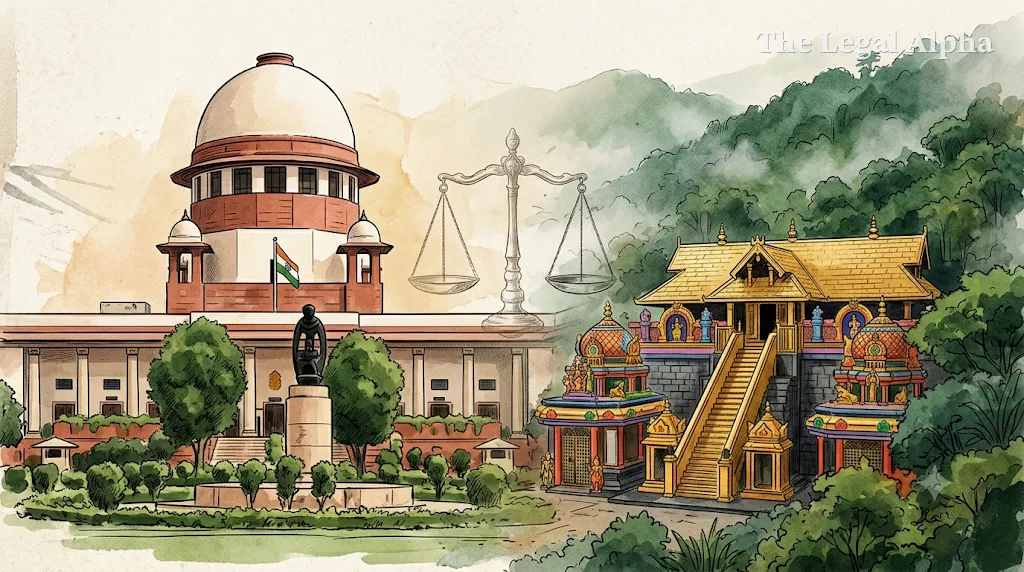
The Supreme Court of India has indicated that a nine-judge Constitution Bench is expected to pronounce its long-awaited judgment in the Sabarimala reference case before the Court breaks for its winter vacation on December 18, 2026.
Justice B.V. Nagarathna, who sits on the nine-judge Bench led by Chief Justice of India Surya Kant, dropped this procedural hint on November 25, 2026. The remark came up while the Court was hearing separate petitions concerning the Knanaya Catholic community and a High Court decision regarding the expulsion of members who marry outside the community.
The Sabarimala reference—officially titled Kantaru Rajeevaru v. Indian Young Lawyers Association—centers on seven broad constitutional questions governing the boundaries of religious freedom in India. The Bench, which also includes Justices M.M. Sundresh, Ahsanuddin Amanullah, Aravind Kumar, Augustine George Masih, Prasanna B. Varale, R. Mahadevan, and Joymalya Bagchi, had reserved its verdict on May 14, 2026, following 16 days of oral arguments. Because the ruling will redefine how Indian courts evaluate religious customs against fundamental rights, the timeline for its delivery is a major development for constitutional law and dozens of pending religious rights disputes.
Legal Topic
Area of Law: Constitutional Law Sub-topic: Freedom of Religion / Fundamental Rights / Judicial Review
Core Legal Issue
The nine-judge Bench is not merely revisiting the specific dispute over women's entry into Kerala's Sabarimala Temple; rather, it is answering seven overarching constitutional questions referred to it in November 2019. At the heart of the reference is how to reconcile the right to religious freedom and denominational autonomy with the Constitution's guarantees of individual equality and dignity.
Specifically, the Court must clarify the interplay between an individual's freedom of conscience under Article 25 and a religious denomination's right to manage its own affairs under Article 26, and whether both are subordinate to other fundamental rights like the right to equality under Article 14. The Bench is also tasked with defining the scope of "morality" under Articles 25 and 26, determining the extent to which courts can review or invalidate essential religious practices, and deciding whether third parties who do not belong to a faith can challenge its internal customs through public interest litigation.
What Did the Court / Authority Decide?
No final ruling has been issued yet. The immediate development is a judicial indication regarding the expected timeline for the final verdict.
-
What is decided: Nothing on the merits of the reference has been pronounced. The Bench concluded 16 days of hearings and reserved its judgment on May 14, 2026.
-
Important observation: During an unrelated hearing on November 25, 2026, Justice B.V. Nagarathna indicated that the nine-judge Bench aims to deliver its judgment before the Supreme Court closes for its Christmas recess on December 18, 2026.
-
What is still pending: The authoritative pronouncement on all seven constitutional questions remains pending. Once this larger Bench lays down the legal framework, the original review petitions against the 2018 Sabarimala judgment—along with roughly 66 tagged petitions involving other religious practices—will be decided in accordance with the new precedent.
Key Legal Points
-
Scope of Articles 25 and 26: The ruling will establish whether the freedom to practice religion (Article 25) and the autonomy of religious denominations (Article 26) operate independently or must yield to other Part III fundamental rights, particularly equality (Article 14) and personal liberty (Article 21).
-
Meaning of Constitutional Morality: The Court will clarify whether the word "morality" restricting religious freedom in Articles 25 and 26 refers to traditional societal morality or "constitutional morality" anchored in equality and non-discrimination.
-
Judicial Review and Essential Religious Practices: The Bench is examining the limits of judicial intervention in matters of faith, including whether secular courts are equipped to determine what constitutes an "essential religious practice".
-
Standing in Public Interest Litigation: The judgment is expected to settle whether individuals or organizations outside a religious denomination have the legal standing (locus standi) to challenge that community's religious customs via Public Interest Litigation (PIL).
Relevant Law
-
Constitution of India, Article 25: Guarantees freedom of conscience and the right to freely profess, practice, and propagate religion, subject to public order, morality, health, and other fundamental rights.
-
Constitution of India, Article 26: Grants every religious denomination the right to establish religious institutions and manage its own affairs in matters of religion, subject to public order, morality, and health.
-
Constitution of India, Articles 14, 15, 17, and 21: Fundamental rights guaranteeing equality before the law, prohibition of discrimination, abolition of untouchability, and protection of life and personal liberty.
-
Kerala Hindu Places of Public Worship (Authorisation of Entry) Rules, 1965 (Rule 3(b)): The rule struck down in 2018 that previously permitted religious denominations to exclude women from public temples based on custom.
-
Indian Young Lawyers Association v. State of Kerala (2018): The 4:1 Constitution Bench ruling that lifted the ban on women aged 10 to 50 entering the Sabarimala Temple.
-
Kantaru Rajeevaru v. Indian Young Lawyers Association (2019): The 3:2 review order that kept the review petitions pending and referred seven broader questions of religious freedom to a larger Bench.
Arguments of the Parties
Review Petitioners and Religious Denominations
The parties seeking reconsideration of the 2018 Sabarimala verdict—including temple authorities and representatives of various religious groups—contended that religious beliefs and customs cannot be judged on a purely secular yardstick. They submitted that the "essential religious practices" test is unworkable and forces judges to act as theologians. They further argued that Article 26 protects denominational autonomy from external interference, that internal religious customs cannot be invalidated simply by importing Article 14 equality standards, and that non-believers should not be permitted to use PILs to dismantle a faith's traditions.
Respondents and Supporting Intervenors
The respondents defending the 2018 judgment and petitioners in tagged gender-justice cases argued that the Constitution envisions social reform and places individual dignity above discriminatory customs. They submitted that no religious practice can claim immunity from Part III of the Constitution if it perpetuates exclusion, undermines bodily autonomy, or violates the right to equality. According to their submissions, denominational rights under Article 26 cannot overpower the fundamental rights of individual worshippers under Article 25(1).
Why Does It Matter?
The upcoming ruling extends far beyond a single temple in Kerala. Over 60 tagged petitions are currently awaiting the outcome of this reference. These include constitutional challenges regarding the entry of Muslim women into mosques and dargahs, the entry of Parsi women who marry outside their faith into Fire Temples, the practice of female genital mutilation in the Dawoodi Bohra community, and religious excommunication practices.
By restating the legal framework governing Articles 25 and 26, the nine-judge Bench will establish the binding constitutional test for all future disputes where religious autonomy collides with individual civil rights in India. It will also guide how courts handle PILs filed against community customs, potentially reshaping access to constitutional remedies in personal law and religious matters.
Legal Takeaway
The Supreme Court is expected to deliver its landmark nine-judge Bench verdict on the scope of religious freedom before December 18, 2026. The decision will not only determine the fate of the 2018 Sabarimala judgment, but will also set the definitive constitutional standard for balancing denominational rights against individual equality across dozens of pending religious disputes.
Sources
Primary Source:
Supreme Court of India proceedings in Kantaru Rajeevaru v. Indian Young Lawyers Association (Sabarimala Reference, judgment reserved May 14, 2026) and oral observations by Justice B.V. Nagarathna during Supreme Court hearings on November 25, 2026.
Additional Sources:
-
Supreme Court of India, Indian Young Lawyers Association v. State of Kerala (2018) 11 SCC 1.
-
Supreme Court of India, Kantaru Rajeevaru v. Indian Young Lawyers Association (2019) Review Referral Order.
-
Supreme Court Observer case tracker and hearing transcripts for Kantaru Rajeevaru v. Indian Young Lawyers Association (April–May 2026).