Supreme Court Quashes 1988 Bengaluru Land Acquisition Over Middlemen Influence and Fraud, Orders Restoration to Owners
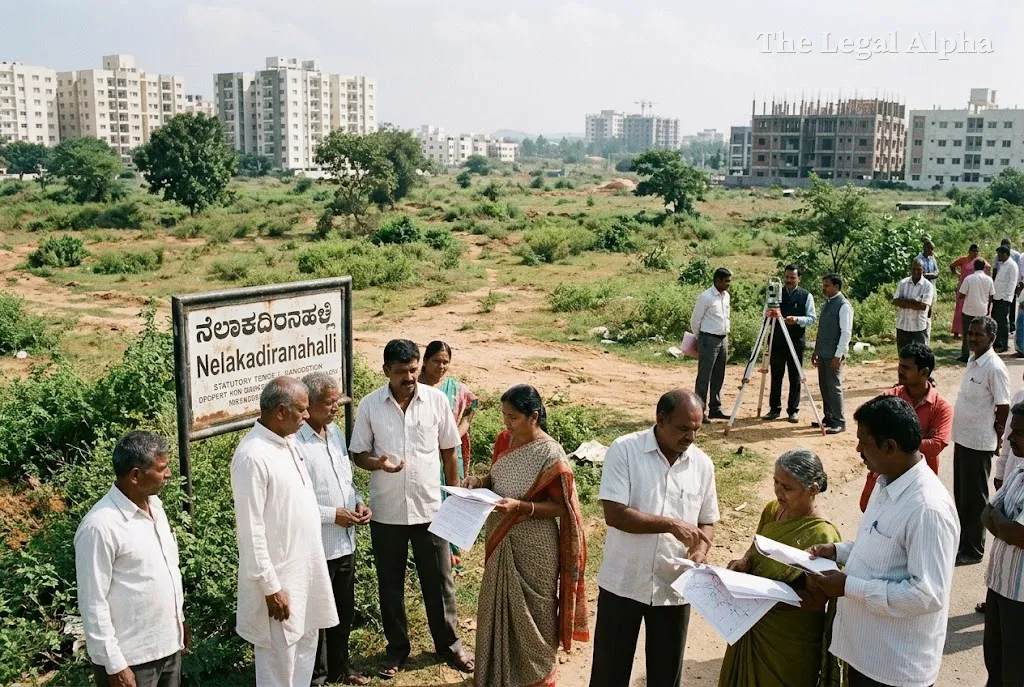
The Supreme Court set aside a decades-old land acquisition undertaken by the Karnataka government for a cooperative housing society. The acquisition, which covered nearly 59 acres in Nelakadiranahalli village in Bengaluru, originally commenced through notifications issued in 1988 and 1989.
A Division Bench of the Karnataka High Court had previously reversed a Single Judge’s decision that voided the acquisition. Hearing a batch of civil appeals brought by the original landholders, a Supreme Court bench comprising Justice J.B. Pardiwala and Justice K. Vinod Chandran set aside the Division Bench ruling and restored the Single Judge’s order, holding that the sovereign power of eminent domain had been weaponized through private middlemen in a process tainted by fraud.
Legal Topic
Area of Law: Property Law / Constitutional Law
Sub-topic: Land Acquisition & Eminent Domain / Doctrine of Colourable Exercise of Power
Core Legal Issue
The controversy centered on whether an exercise of eminent domain under the Land Acquisition Act, 1894 can stand when private agents broker the acquisition for a cooperative society without a verified and pre-approved housing scheme or layout plan.
The Court had to resolve whether procedural bars such as delay, laches, or earlier rounds of litigation could shield an acquisition from judicial review when foundational proceedings were vitiated by fraud and collusion.
What Did the Court Decide?
The Supreme Court allowed the landholders' appeals and held the entire acquisition void. The Bench held:
-
The state's machinery had been deployed as an instrument of private convenience rather than genuine public purpose, violating statutory safeguards.
-
Prior litigation and the passage of several decades could not validate the exercise, as fraud unravels every solemn administrative and judicial act (fraus omnia corrumpit).
-
Physical possession of the land must be restored to the rightful owners.
-
In cases where landowners are unable or unwilling to refund the initial compensation received, the State is directed to auction the land under judicial supervision and allocate the proceeds for victim compensation.
-
The Karnataka government must pay litigation costs of ₹50,000 to each landowner who contested the acquisition.
Key Legal Points
-
Public Purpose as an Absolute Prerequisite: Just compensation alone does not legitimize an acquisition; the presence of an authentic public purpose and lawful authority remains non-negotiable.
-
Middlemen Invalidate Statutory Acquisitions: Utilizing private facilitators or entering into agreements with intermediaries to secure state-assisted land acquisitions renders the statutory process a colourable exercise of power.
-
Pre-Approval of Housing Schemes: Acquiring agricultural or private land on behalf of a housing cooperative requires a formal, pre-approved housing layout scheme prior to issuing acquisition notifications.
-
Fraud Trumps Res Judicata and Delay: The passage of time or intermediate appellate judgments cannot estop aggrieved parties from challenging proceedings when material facts reveal foundational deceit and suppression.
Relevant Law
-
Land Acquisition Act, 1894: Section 4(1) (Preliminary notification), Section 6 (Declaration of public purpose), and provisions governing acquisitions for cooperative housing societies and companies.
-
Constitution of India: Article 300A (Right to property as a constitutional right requiring legal authority and due process).
-
Legal Precedents: Settled jurisprudence on colourable exercise of eminent domain and the doctrine that fraud vitiates all administrative and judicial acts.
Arguments of the Parties
Appellants (Landowners)
The original landowners argued that the acquisition process was irregular from its inception. They submitted that the cooperative housing society never obtained prior approval for an actual housing layout or development scheme, making the public purpose assertion illusory. They also highlighted agreements entered into with private intermediaries, contending that state power was misused to serve commercial brokers rather than legitimate beneficiaries.
Respondents (State and Cooperative Society)
The State and the cooperative society defended the notifications, arguing that the land was acquired for a valid public purpose—providing residential housing to members. They maintained that the challenge was heavily barred by unexplained delay and laches, and that earlier legal proceedings had settled the validity of the acquisition, precluding subsequent interference.
Why Does It Matter?
This ruling provides clarity on the boundaries of eminent domain and real estate transactions involving cooperative societies in India. By penalizing the state with costs and holding the acquisition void despite the passage of over 35 years, the judgment creates a check against the historical practice of cooperative societies relying on land middlemen to orchestrate government acquisitions. It also establishes that long-standing administrative inertia cannot protect acquisitions that lack initial planning approvals or stem from collusive arrangements.
Legal Takeaway
Fair compensation cannot cure an acquisition that lacks genuine public purpose or lawful authority. Where the machinery of eminent domain is manipulated through private brokers and without statutory approvals, the proceedings are void for fraud, and the passage of time will not shield them from judicial nullification.
Sources
Primary Source:
-
Supreme Court of India, Judgment in N. Arasappa v. State of Karnataka & Others (Civil Appeal batch), Bench of Justice J.B. Pardiwala and Justice K. Vinod Chandran.
Additional Sources:
-
High Court of Karnataka records (Single Judge order and Division Bench appellate judgment in Nelakadiranahalli land acquisition matters).
-
Land Acquisition Act, 1894.