Delhi High Court Affirms Direct Benefit Transfers for EWS School Uniforms, Rejecting In-Kind Mandate
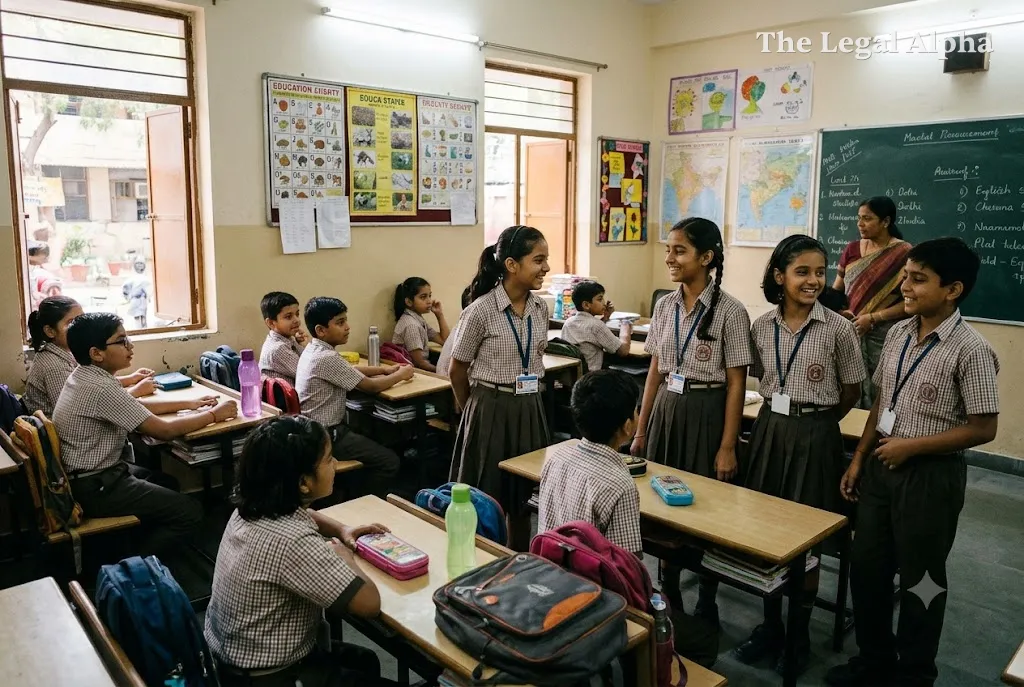
The Delhi High Court has dismissed a review petition seeking to compel the Delhi government to physically procure and distribute school uniforms to students admitted under the Economically Weaker Section (EWS) and Disadvantaged Group (DG) categories in private unaided schools.
Reaffirming its January 2026 judgment, the High Court held that the Government of National Capital Territory of Delhi (GNCTD) is legally justified in transferring funds directly to student bank accounts via Direct Benefit Transfer (DBT) to purchase uniforms. The NGO petitioner, Justice For All, had sought a review of the earlier verdict, arguing that welfare obligations under education laws mandate the physical delivery of uniform kits. However, the court held that executive policy relying on DBT avoids serious logistical delays and falls well within permissible administrative discretion.
Legal Topic
Area of Law: Education Law / Constitutional Law
Sub-topic: Right to Education / Welfare Delivery Mechanisms & Judicial Review of Executive Policy
Core Legal Issue
Does the statutory obligation under the Right of Children to Free and Compulsory Education Act, 2009, read with local education rules, mandate the physical distribution of educational materials in kind, or can a state government discharge this obligation through monetary subsidies delivered via Direct Benefit Transfer?
The issue also examined whether the executive’s operational difficulties in procuring diverse school-specific uniforms justified replacing direct distribution with financial aid without infringing on a child’s statutory right to free education.
What Did the Court / Authority Decide?
The Delhi High Court dismissed the review petition, declining to disturb its previous ruling that permitted the Delhi government to disburse uniform subsidies in cash.
The court ruled that the Delhi government's policy—adopted on June 10, 2025—cannot be characterised as arbitrary, whimsical, or capricious. The bench observed that the petitioner was seeking to re-argue points already settled rather than identifying an apparent error on the face of the judicial record. The court confirmed that transferring money into student accounts is a lawful, pragmatic mode of administration designed to ensure children receive uniforms before the academic term starts, leaving the policy undisturbed.
Key Legal Points
-
No Mandatory "In-Kind" Requirement: The Delhi Right of Children to Free and Compulsory Education Rules, 2011 mandate the provision of uniforms, but do not dictate that the state must supply them exclusively in kind.
-
Administrative Feasibility In Policy Decisions: Courts must recognize genuine executive constraints; measuring thousands of individual pupils across schools with varying dress codes, floating tenders on the Government e-Marketplace (GeM), tailoring, and distributing before classes commence is practically unfeasible.
-
Standard of Judicial Review: Executive determinations regarding public resource disbursement are shielded from judicial interference unless demonstrated to be manifestly arbitrary, ultra vires, or capricious.
-
Limited Scope of Review Jurisdiction: A review plea cannot serve as an appeal in disguise or a platform to re-agitate established arguments without establishing an evident patent error.
Relevant Law
-
Right of Children to Free and Compulsory Education (RTE) Act, 2009: Sections 3, 8, and 12(1)(c) (mandating free and compulsory elementary education and non-discrimination for disadvantaged categories).
-
Delhi Right of Children to Free and Compulsory Education Rules, 2011: Rule provisions governing the supply of free learning materials, textbooks, and uniforms.
-
Constitution of India: Article 21A (Fundamental Right to Education) and Article 226 (Writ Jurisdiction and standard of review for administrative policy).
-
Code of Civil Procedure, 1908 (Principles of Review): Order XLVII, Rule 1 (limitations on the scope of reviewing prior judicial decisions).
Arguments of the Parties
Petitioner (Justice For All):
The petitioner argued that the RTE statutory framework guarantees actual physical uniforms and supplies to EWS and disadvantaged students, shielding underprivileged families from commercial exploitation or price disparities. They submitted that cash transfers dilute the state's welfare responsibility, lead to delayed disbursements, and may fail to cover the full market cost charged by designated school vendors.
Respondent (Government of NCT of Delhi):
The Delhi Government contended that private schools maintain distinct uniform colors, fabrics, and patterns, making centralized procurement via the GeM portal, individual sizing, stitching, and distribution practically impossible prior to the school year. The state submitted that its June 10, 2025 policy provides direct monetary assistance through DBT transparently and efficiently, preventing bureaucratic delays and fully serving the welfare object of the RTE Act without contravening any statutory bar.
Why Does It Matter?
This decision clarifies the scope of executive authority in choosing delivery channels for statutory welfare rights. By endorsing Direct Benefit Transfers over in-kind centralized procurement, the High Court acknowledges the administrative bottlenecks inherent in tailoring government procurement systems to diverse private school environments.
For policymakers, the ruling confirms that statutory phrases directing authorities to "provide" entitlements do not legally preclude cash equivalents when direct logistics would defeat timely delivery. For beneficiaries and private school administrations, the order solidifies financial subsidies as the binding procedure for uniform procurement in Delhi, avoiding recurring seasonal litigation over tendering processes.
Legal Takeaway
The statutory obligation to provide welfare entitlements under education laws does not mandate physical distribution in kind unless expressly compelled by statute. Where direct procurement is administratively unfeasible, courts will defer to executive policy utilizing Direct Benefit Transfers, provided the mechanism is reasonable, timely, and aligned with legislative objectives.
Sources
Primary Source:
-
High Court of Delhi: Order dismissing Review Petition in Justice For All v. Government of NCT of Delhi & Ors. (Order upholding policy dated 10.06.2025).
Additional Sources:
-
Right of Children to Free and Compulsory Education Act, 2009 & Delhi RTE Rules, 2011.
-
Proceedings and judgments of the High Court of Delhi (Judgment dated January 23, 2026, and Review Order dated October 2026).