Kerala High Court Pushes State for Speedy Prosecution Sanction in Sabarimala Gold Theft Case
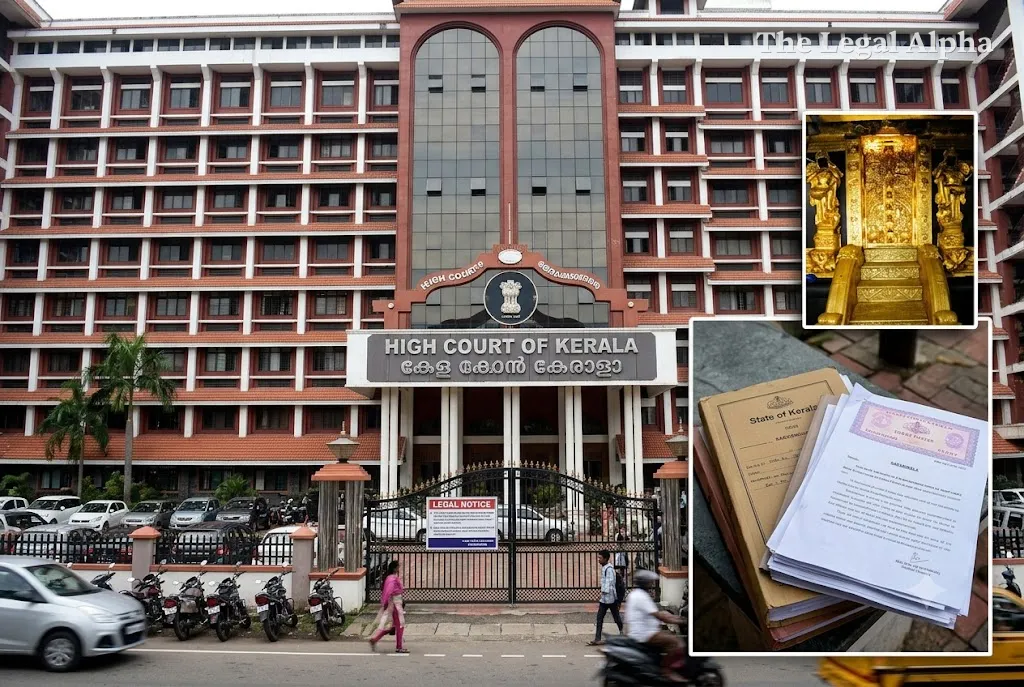
The Kerala High Court intervened to eliminate procedural roadblocks preventing the prosecution of suspects in the Sabarimala temple gold misappropriation case. During proceedings initiated suo motu, a Division Bench comprised of Justice Raja Vijayaraghavan V. and Justice K.V. Jayakumar learned that while the Special Investigation Team (SIT) has concluded its inquiry into the alleged gold theft from temple doorframes and drawn up a draft chargesheet, the case remains halted because the State has not yet obtained the required legal advice to formally sanction prosecution. The delay was primarily attributed to an administrative vacancy in the office of the Assistant Legal Advisor. In response, the High Court instructed the State government to promptly secure the pending advice and expedite the sanctioning process so the final investigation report can reach the jurisdictional trial court.
Legal Topic
Area of Law: Criminal Law / Anti-Corruption Law
Sub-topic: Sanction for Prosecution / Investigation Closure Under Public Accountability Frameworks
Core Legal Issue
The core legal question centers on whether bureaucratic bottlenecks and internal staffing vacancies can justify delaying statutory sanction for prosecution under the Prevention of Corruption Act and criminal procedural law.
Under the statutory framework, a criminal court is barred from taking cognizance of offenses committed by public servants without an explicit sanction order from the competent authority. The High Court was called upon to resolve how administrative delays in procuring legal scrutiny must be addressed to ensure timely submission of police reports (chargesheets) under Section 173 of the Code of Criminal Procedure (or equivalent under current criminal procedure statutes).
What Did the Court / Authority Decide?
The Division Bench issued clear directives aimed at unfreezing the proceedings:
-
The High Court directed the State government to immediately streamline the process of obtaining the necessary legal opinion regarding the grant of prosecution sanction.
-
It noted that the Special Investigation Team had completed its probe and finalized its draft chargesheet, indicating that police investigative work is no longer the cause of delay.
-
The Bench made it clear that administrative vacancies cannot perpetually stall judicial process, requiring competent departments to act with urgency.
-
The court scheduled the next hearing for November 10, when it will review whether the sanction process has moved forward and if the final report can be officially registered before the trial court.
Key Legal Points
-
Cognizance Precondition: Obtaining a formal sanction order is a condition precedent before the competent criminal court can take cognizance of graft offenses against public servants, making administrative clearance critical to avoiding pre-trial gridlock.
-
Separation of Investigation and Authorization: While the police machinery completes the factual probe, the decision to accord sanction requires an independent application of mind by the sanctioning authority based on competent legal advice.
-
Judicial Oversight of Administrative Laches: The High Court demonstrated that writ courts exercising supervisory or suo motu jurisdiction can set strict accountability timelines for executive clearances to prevent criminal probes from languishing indefinitely.
-
Public Trust and Temple Administration: The court treated misappropriation of religious institution assets as a matter of significant public interest requiring transparent, prompt judicial follow-through rather than bureaucratic delays.
Relevant Law
-
Prevention of Corruption Act, 1988 — Section 19: Mandatory requirement of previous sanction for the prosecution of public servants facing corruption and criminal misconduct charges.
-
Code of Criminal Procedure, 1973 (CrPC) — Section 197 / Section 173: Provisions governing prosecution sanctions for public servants and the submission of the police report (chargesheet) upon conclusion of an investigation.
-
Constitution of India — Article 226: Inherent and supervisory writ jurisdiction of High Courts to supervise public authorities, ensure rule of law, and initiate suo motu proceedings in public interest matters.
Arguments of the Parties
-
The State of Kerala:
Appearing through the Director General of Prosecution, the State submitted that the Special Investigation Team had completed its field investigation and formulated a draft chargesheet. However, the State explained that formal forwarding of the file for prosecution sanction required legal clearance from an Assistant Legal Advisor, an office currently experiencing a vacancy, which temporarily impeded the movement of the paperwork.
-
The Court / Pro Bono Context (Suo Motu):
Because the proceedings arose suo motu, the Bench acted as the guardian of procedural fairness and public interest. The Court emphasized that an completed probe must not be paralyzed by avoidable administrative holdups, observing that obtaining legal counsel is an internal governmental process that must be expedited to uphold trial integrity.
Why Does It Matter?
This development is significant beyond the specifics of temple administration. Prosecution sanction is frequently cited as one of the most persistent bottlenecks in India's anti-corruption machinery, often resulting in prolonged delays before chargesheets can be formally presented in court.
By actively monitoring the timeline and directing the executive to bypass internal bureaucratic hurdles, the Kerala High Court reinforced the principle that statutory safeguards intended to protect public servants from frivolous prosecution cannot be converted into an administrative shield against timely accountability. The order serves as practical precedent for managing procedural delays in high-profile public asset investigations.
Legal Takeaway
An investigation report cannot translate into judicial cognizance under anti-corruption statutes without an executive prosecution sanction, but internal staffing gaps cannot serve as a valid ground to shelve that decision. Constitutional courts possess supervisory power to mandate strict administrative timelines to ensure draft chargesheets are promptly moved to trial.
Sources
-
Primary Source: High Court of Kerala, Suo Motu v. State of Kerala [WP(C) No. 40608 of 2025], Order dated October 26, 2026 (Bench comprising Justice Raja Vijayaraghavan V. & Justice K.V. Jayakumar).
-
Additional Sources: High Court Registry Cause Lists and Case Proceedings; Director General of Prosecution Submissions on SIT Progress.