Supreme Court Monitoring Committee Urges Urgent Redevelopment of 1950s C-Type Tenements in Delhi
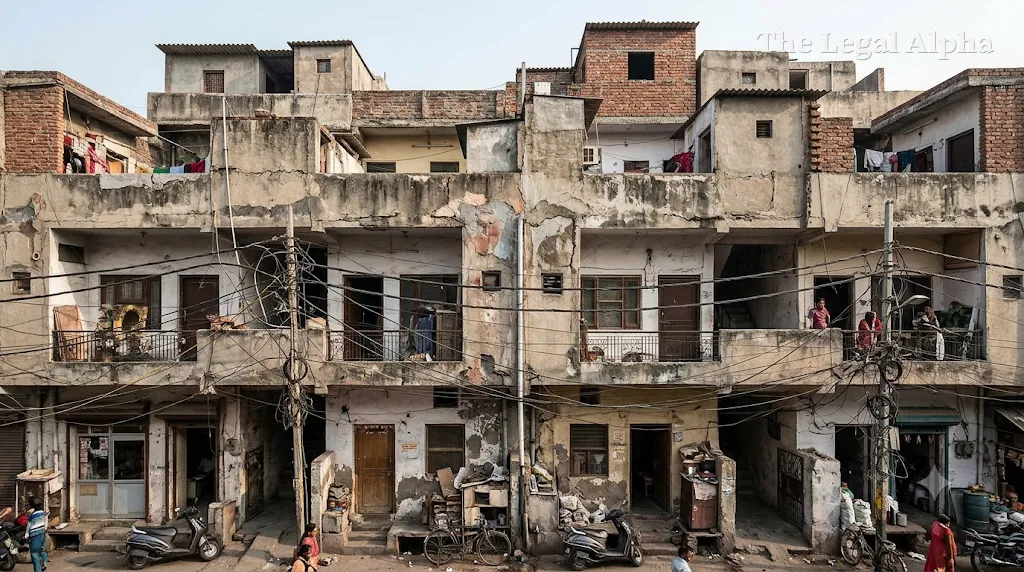
The Supreme Court-appointed monitoring committee on sealing in Delhi has formally urged the Union Ministry of Housing and Urban Affairs to initiate the immediate redevelopment of aging C-Type residential tenements across the capital. In a recent communication addressed to Union Urban Development Minister Manohar Lal, the panel warned that these two-storey structures—originally allotted by the Land and Development Office (L&DO) in the early 1950s—have surpassed their structural lifespan and pose a severe safety hazard to occupants.
The directive affects several prominent residential neighbourhoods, including Amar Colony, Moti Nagar, Malkaganj, Ramesh Nagar, Vijay Nagar, Motia Khan, and Rajendra Nagar. The committee highlighted that widespread unauthorized vertical extensions and encroachments on public land have compromised the structural integrity of these decades-old buildings, calling on civic and central authorities to intervene before a fatal building collapse occurs.
Legal Topic
Area of Law: Urban Planning, Municipal & Land Law
Sub-topic: Structural Safety, Unauthorized Construction & Urban Redevelopment
Core Legal Issue
The central administrative and legal issue concerns the statutory duty of land-owning and municipal agencies to enforce building safety norms, remove encroachments on public land, and execute urban regeneration policies when aging public-allotted housing becomes structurally hazardous. Specifically, the matter tests how authorities reconcile legacy leasehold or rehabilitation allotments from the 1950s with modern municipal building bye-laws and redevelopment frameworks under the Master Plan for Delhi 2047 (MPD-2047).
What Did the Court / Authority Decide?
The Supreme Court-appointed monitoring committee has issued an administrative recommendation and warning rather than a binding judicial decree, urging the central government and civic bodies to act on two fronts:
-
Comprehensive Redevelopment: The panel advised the Ministry of Housing and Urban Affairs to formulate and execute an urgent redevelopment plan for C-Type tenements, pointing to existing provisions under the recently notified Delhi Master Plan 2047 and successful urban renewal models in Mumbai.
-
Enforcement Against Violations: Authorities have been directed to take immediate action against illegal multi-storey additions constructed above the originally allotted first floors, as well as widespread encroachments onto adjoining public land.
-
Pending Action: No formal redevelopment scheme or demolition schedule has yet been notified by the government. The panel noted that despite sending two similar letters to the ministry in 2024 and multiple prior Supreme Court directives on unauthorized construction, executive agencies have shown negligible progress on the ground.
Key Legal Points
-
Obligation to Ensure Structural Safety: Land-owning agencies such as the L&DO bear a continuing administrative responsibility to conduct periodic structural audits of aging housing stock and prevent life-threatening collapses.
-
Illegal Vertical Extensions: Constructing additional floors beyond the sanctioned two-storey limit violates municipal building bye-laws and invalidates the original structural load assumptions of 1950s-era tenements.
-
Protection of Public Land: Encroachments onto common areas and public pathways surrounding allotted tenements remain unlawful regardless of the passage of time, requiring eviction and clearance under public premises and municipal statutes.
-
Regulatory Pathway Under MPD-2047: The notification of the Master Plan for Delhi 2047 provides a formal legal mechanism for the regeneration and redevelopment of aging planned colonies, removing prior policy bottlenecks that stalled renewal projects.
-
Accountability for Administrative Inaction: The committee criticized civic and land-owning bodies for disregarding binding Supreme Court directions on sealing and demolition, emphasizing that prolonged regulatory inaction exacerbates public safety risks.
Relevant Law
-
Delhi Development Act, 1957 (and Master Plan for Delhi 2047): Governs planned urban development, zoning regulations, Floor Area Ratio (FAR) limits, and colony regeneration frameworks in the National Capital Territory.
-
Delhi Municipal Corporation Act, 1957 (Sections 343, 344, and 345A): Empowers municipal authorities to halt unauthorized construction, order demolition of illegal structures, and seal premises violating building regulations.
-
Public Premises (Eviction of Unauthorised Occupants) Act, 1971: Provides the statutory mechanism for central government bodies like the L&DO to reclaim encroached public land and address breaches of allotment conditions.
-
M.C. Mehta v. Union of India (Delhi Sealing Matter): The ongoing Supreme Court public interest litigation under which the monitoring committee was constituted to oversee compliance with urban planning laws and curb unauthorized construction and land misuse in Delhi.
Arguments of the Parties
Supreme Court Monitoring Committee
The panel contended that L&DO has failed to conduct mandatory structural safety inspections through government engineering agencies, leaving residents exposed to potential disaster. Citing past fatal building collapses in Delhi linked to illegal construction, the committee stated that civic agencies appear detached from ground realities and have failed to enforce repeated Supreme Court orders against encroachments and unauthorized floors.
Government and Civic Authorities
While the Ministry of Housing and Urban Affairs and the L&DO have not yet issued a formal response to the latest communication, the committee's letter notes that two previous representations sent in 2024 resulted in virtually no administrative follow-through on drafting a redevelopment framework.
Why Does It Matter?
Thousands of families residing in post-Partition rehabilitation colonies across Delhi live in C-Type tenements that were never engineered to bear the weight of three or four additional floors. If the Ministry of Housing and Urban Affairs acts on the committee's recommendation, residents in colonies like Amar Colony, Rajendra Nagar, and Moti Nagar could face mandatory structural audits, sealing or demolition of illegal upper floors, and eventual participation in a state-supervised redevelopment scheme under MPD-2047. For municipal bodies and the L&DO, the intervention signals heightened judicial scrutiny over administrative negligence in enforcing building safety laws.
Legal Takeaway
Aging government-allotted tenements in Delhi cannot legally be expanded beyond their sanctioned two-storey structure, and prolonged municipal inaction does not legitimize encroachments or unsafe additions. With redevelopment provisions now active under the Master Plan for Delhi 2047, residents and property owners in 1950s colonies should expect stricter structural audits and policy-driven urban renewal rather than continued tolerance of unauthorized construction.
Sources
Primary Source
Communication from the Supreme Court-Appointed Monitoring Committee on Sealing to the Union Minister of Housing and Urban Affairs (November 2026), issued pursuant to ongoing monitoring directions in M.C. Mehta v. Union of India.
Additional Sources
-
Master Plan for Delhi 2047 (MPD-2047), Ministry of Housing and Urban Affairs / Delhi Development Authority.
-
Public reporting on the Monitoring Committee's inspections and correspondence regarding C-Type tenements in Delhi (November 16, 2026).