Supreme Court Issues Notice to Election Commission Over Allegations of Unauthorised Changes to Voter Registration Form in Bihar
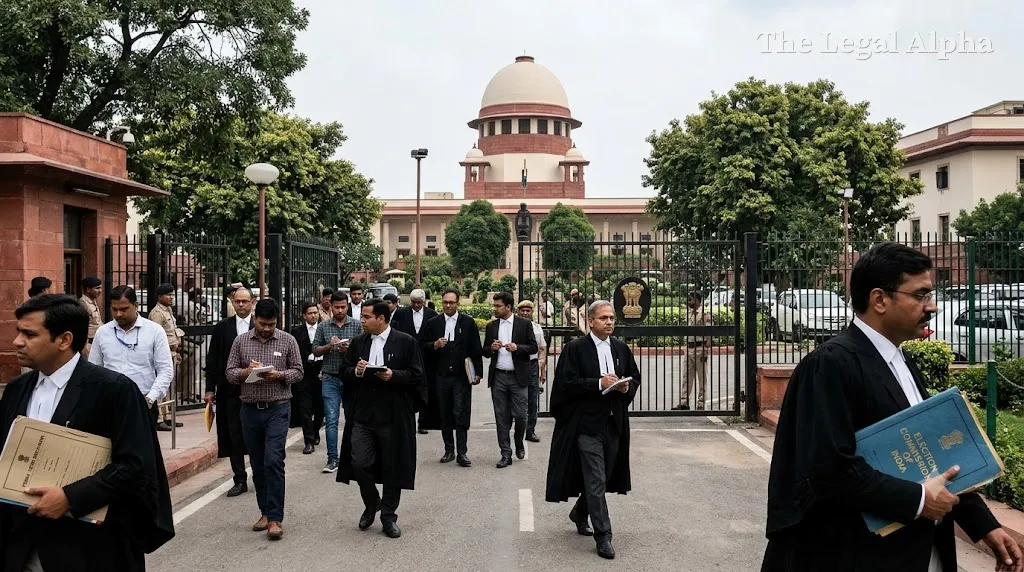
The Supreme Court has issued notice to the Election Commission of India on a fresh application alleging that the poll body altered statutory voter registration procedures during its Special Intensive Revision of electoral rolls in Bihar. The plea, brought by Trinamool Congress Member of Parliament Dola Sen, challenges the Commission’s addition of extra verification declarations to Form 6—the prescribed statutory application form used by eligible citizens to enroll as electors.
The petitioner raised objections to official claims suggesting the apex court had granted prior approval to these modifications, asserting that the poll panel altered voter registration requirements under the guise of administrative instructions. A three-judge bench comprising Chief Justice Surya Kant, Justice Joymalya Bagchi, and Justice V. Mohana directed the Election Commission to respond to the allegations and granted the petitioners ten days to file a rejoinder to the Commission’s comprehensive counter-affidavit.
Legal Topic
-
Area of Law: Constitutional and Election Law
-
Sub-topic: Electoral Roll Revisions / Delegated Legislation and Statutory Forms under the Registration of Electors Rules, 1960
Core Legal Issue
The principal question before the court is whether the Election Commission can introduce supplementary declarations and documentary verification requirements to statutory voter registration forms through executive instructions, or if such modifications require formal legislative amendment under parliamentary rules.
A secondary legal issue concerns the procedural limits of the Commission's plenary authority: whether administrative convenience in merging digital verification workflows breaches the mandatory framework established by the Registration of Electors Rules, 1960.
What Did the Court Decide?
The Supreme Court did not pass a final determination on the legality of the disputed declaration format. Instead, the bench issued notice specifically on the interlocutory application challenging the alterations to Form 6 and recorded that the court had not endorsed any unilateral revisions to the statutory form.
The court granted the petitioners ten days to file their response to the 248-page counter-affidavit submitted by the Commission. All substantive contentions, including claims regarding internal dissent among Election Commissioners and the procedural validity of the revision exercise, remain pending for further examination.
Key Legal Points
-
Prescribed Forms vs. Administrative Additions: Statutory forms prescribed under delegated legislation (the Registration of Electors Rules, 1960) cannot be casually substituted or expanded by administrative circulars without statutory backing.
-
Separation of Digital and Physical Formats: Digital single-window convenience cannot dilute the distinct legal identity of a statutory form; merging separate affidavits or declarations into a single online Form 6 risks creating de facto amendments without legislative authority.
-
Plenary Powers under Article 324: While the Election Commission holds wide constitutional powers to prepare and revise rolls, such power operates to supplement the law rather than supersede occupied statutory fields governed by parliamentary enactments.
-
Collegial Decision-Making: Under Section 18 of the Chief Election Commissioner and other Election Commissioners Act, 2023, the Commission is required to conduct business unanimously as far as possible, with internal objections and deliberations distinguished from final institutional decisions.
Relevant Law
-
The Constitution of India: Article 324 (superintendence, direction, and control of elections) and Article 327 (power of Parliament to make provision with respect to elections).
-
The Representation of the People Act, 1950: Section 21 (preparation and revision of electoral rolls) and Section 28 (power to make rules).
-
The Registration of Electors Rules, 1960: Rule 13 (form for claims) and Rule 26, read alongside Form 6 (application for inclusion of name in electoral roll).
-
The Chief Election Commissioner and other Election Commissioners (Appointment, Conditions of Service and Term of Office) Act, 2023: Section 18 (transaction of business of the Election Commission).
-
Judicial Precedent: Mohinder Singh Gill v. Chief Election Commissioner (1978) 1 SCC 405 (settling that Article 324 operates only in areas left unoccupied by statute).
Arguments of the Parties
The Petitioners
-
Argued that the Election Commission modified the statutory Form 6 by attaching mandatory additional declarations during the Special Intensive Revision in Bihar without statutory sanction.
-
Contended that the Commission inaccurately claimed the Supreme Court had approved the modified form, creating confusion among prospective electors and field officers.
-
Submitted that introducing onerous verification hurdles creates arbitrary barriers to voter registration that disproportionately burden marginalized electors.
The Election Commission of India
-
Maintained that the statutory Form 6 was never altered or amended and that the declaration is a separate document designed specifically for the Special Intensive Revision to allow legacy verification with the 2002–2003 rolls.
-
Acknowledged that the integration of the declaration onto its online voter portal was executed for administrative convenience—enabling single-OTP verification—which may have created the mistaken impression that Form 6 had been modified, prompting a corrective measure to separate the screens.
-
Contended that the revision orders were issued under Article 324 with unanimous institutional approval in compliance with Section 18 of the 2023 Act, and that internal deliberation files do not invalidate formal commission orders.
Why Does It Matter?
Voter registration forms are the entry portal to adult franchise. If an election management body can unilaterally attach complex declarations or conditional burdens to statutory enrollment forms, it risks disenfranchising eligible citizens without the parliamentary scrutiny mandated by the Representation of the People framework.
This proceeding also brings critical judicial focus to digital governance in electoral administration. As government bodies increasingly digitize paper forms, collapsing separate legal documents into unified online workflows cannot bypass statutory mandates. The eventual ruling will clarify how far the Commission's regulatory powers can extend before they encroach on legislative rules governing citizen enrollment.
Legal Takeaway
Statutory application forms prescribed under parliamentary rules cannot be modified or expanded through executive notices or digital redesigns. While the Election Commission holds wide constitutional powers under Article 324 to ensure accurate rolls, administrative changes to voter registration procedures must remain strictly within the boundaries of delegated legislation.
Sources
-
Primary Source: Record of Proceedings, Supreme Court of India, Bench of Chief Justice Surya Kant, Justice Joymalya Bagchi, and Justice V. Mohana (Hearing dated October 27, 2026); Affidavit filed by Deputy Election Commissioner Bhanu Prakash Yeturu on behalf of the Election Commission of India.
-
Additional Sources: The Registration of Electors Rules, 1960; The Chief Election Commissioner and other Election Commissioners (Appointment, Conditions of Service and Term of Office) Act, 2023; Press Trust of India (PTI) court reports.