Supreme Court Halts Criminal Defamation Trial Against Rahul Gandhi Over Remarks Targeting Prime Minister
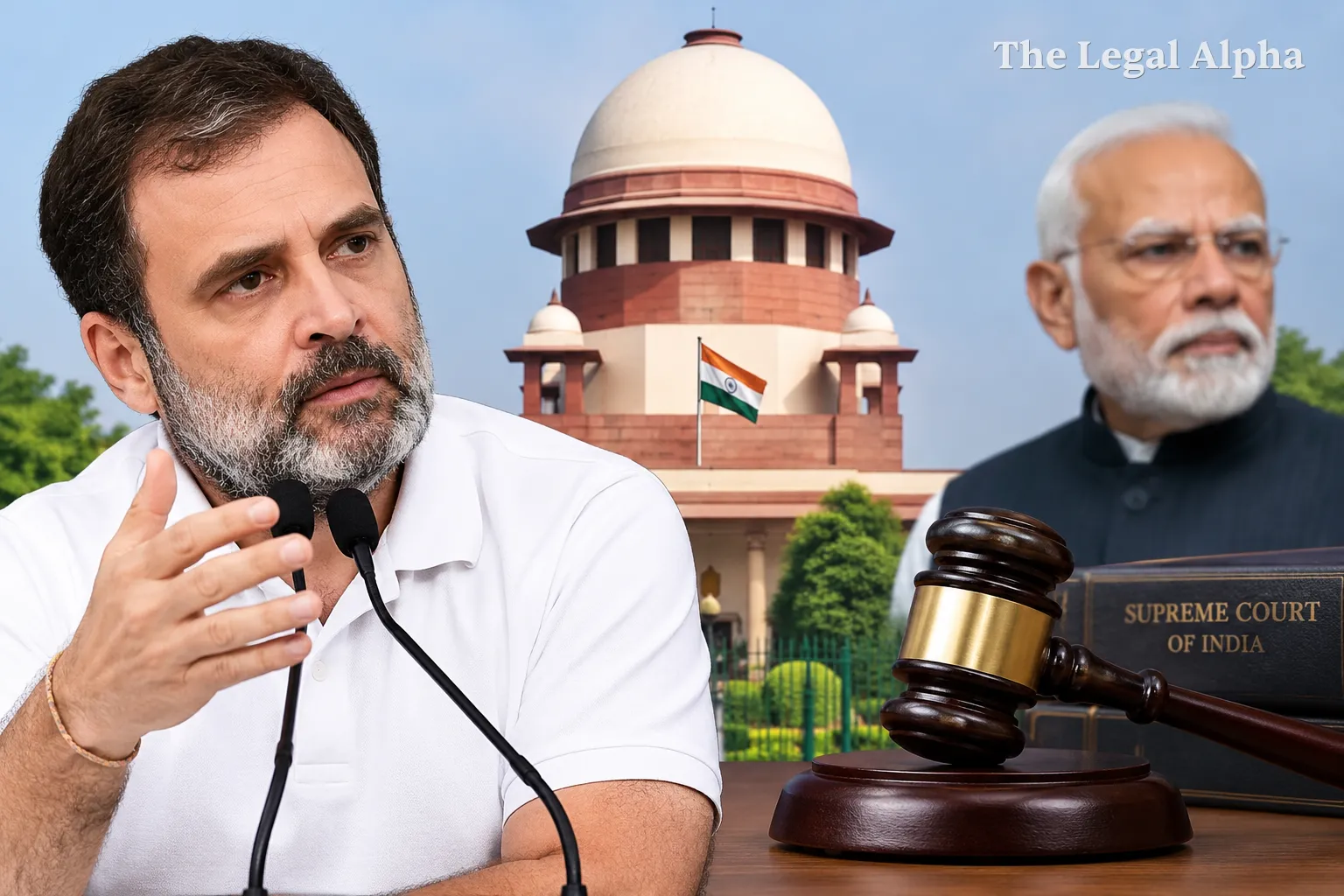
The Supreme Court of India has stayed trial court proceedings in a criminal defamation case pending against Congress leader and Leader of Opposition in the Lok Sabha, Rahul Gandhi. The prosecution stems from a private criminal complaint initiated by a Bharatiya Janata Party (BJP) worker over political remarks made during a 2018 rally targeting Prime Minister Narendra Modi.
The interim stay halts an active summons issued by a magistrate court in Girgaon, Mumbai. The order comes after Gandhi approached the apex court challenging a recent decision of the Bombay High Court, which had declined to quash the complaint and summoned process. The matter is significant because it once again places before the Supreme Court the contentious question of whether individual political party workers possess the legal locus standi to prosecute criminal defamation over allegations directed at their top leadership.
Legal Topic
Area of Law: Criminal Law / Constitutional Law
Sub-topic: Criminal Defamation / Locus Standi of an "Aggrieved Person" under Section 199 CrPC
Core Legal Issue
The fundamental legal issue before the Court centers on the threshold requirement of who qualifies as an "aggrieved person" competent to initiate criminal defamation under Section 199(1) of the Code of Criminal Procedure, 1973 (CrPC).
Specifically, the Court is examining whether broad political criticism directed at a named individual—here, the Prime Minister—can be treated as collective defamation of an entire political organisation, enabling any individual party worker or member to file a private criminal prosecution.
What Did the Court Decide?
A Supreme Court bench comprising Justices Vikram Nath and Aparesh Kumar Singh issued formal notice to the complainant and the State of Maharashtra, making it returnable in four weeks.
In the interim, the bench stayed all further proceedings before the Girgaon metropolitan magistrate court. The order does not dispose of the underlying dispute or dismiss the complaint outright; it merely pauses the operational trial machinery while the top court considers the legality of the Bombay High Court's refusal to quash the summons.
Key Legal Points
-
Interim Stay Granted: The Supreme Court froze trial-level proceedings to prevent coercive steps and trial participation until the threshold questions of maintainability are scrutinized.
-
Threshold of "Person Aggrieved": The proceedings put scrutiny on whether generalized political remarks create a specific, individual cause of action for unaffiliated party functionaries under criminal law.
-
High Court Deferral Under Section 482: The challenge directly contests the High Court's approach of leaving questions of class defamation and locus standi to a full trial rather than filtering them out at the threshold stage under inherent powers.
-
Parallels to Existing Precedents: Counsel highlighted that similar proceedings involving opposition leaders facing third-party defamation claims for party-level criticism are currently being examined across parallel benches of the Supreme Court.
Relevant Law
-
Section 499 & Section 500, Indian Penal Code, 1860: Defining criminal defamation and prescribing punishment for the offense.
-
Section 199(1), Code of Criminal Procedure, 1973: Mandating that no court shall take cognizance of an offense punishable under Chapter XXI of the IPC except upon a complaint made by some person aggrieved by the offense.
-
Section 482, Code of Criminal Procedure, 1973: Inherent powers of the High Court to prevent abuse of the process of any court and secure the ends of justice.
Arguments of the Parties
Petitioner (Rahul Gandhi)
Senior Advocate Abhishek Manu Singhvi, representing Gandhi, submitted that the complaint is legally unsustainable at the threshold because the complainant is not the person targeted by the remarks. He argued that settled legal precedents make it clear that third-party workers cannot claim personal injury from remarks aimed at leaders, and that identical questions are already being heard by the Supreme Court in related matters.
Respondent / Complainant
The original complainant, BJP worker Mahesh Shrishrimal, contended before the lower courts that as an active and registered member of the party, remarks characterizing the party leader in defamatory terms caused direct reputational harm to the party apparatus and all members associated with it. Before the High Court, it had been maintained that determining the extent of the imputation was an evidentiary question suitable only for a complete trial.
Why Does It Matter?
This case directly tests the procedural boundaries of Section 199(1) of the CrPC in political contexts. If individual party workers are routinely permitted to file private criminal complaints on behalf of their leadership, political figures could face multiple concurrent criminal trials across distant jurisdictions for a single speech.
By stepping in to stay the trial, the Supreme Court signals continued caution regarding criminal defamation mechanisms being deployed as instruments of satellite litigation. The final resolution will help demarcate the boundary between genuine defamation of an identifiable, determinate body of persons and political speech that should not expose speakers to criminal prosecution by proxy litigants.
Legal Takeaway
Criminal defamation cannot be prosecuted by proxy unless the complainant personally establishes that they fall within the strict definition of an "aggrieved person" under Section 199 of the CrPC. The Supreme Court's intervention underscores that trial courts must carefully evaluate locus standi before subjecting political speech to protracted criminal trials.
Sources
Primary Source:
Supreme Court of India, Rahul Gandhi v. State of Maharashtra & Anr., Record of Proceedings (Coram: Vikram Nath and Aparesh Kumar Singh, JJ., October 13, 2026).
Additional Sources:
-
High Court of Judicature at Bombay, Criminal Application challenging Girgaum Metropolitan Magistrate Order (September 2026).
-
Code of Criminal Procedure, 1973 (Sections 199, 482).