Calcutta High Court Quashes Criminal Case Against SSC Candidates, Affirms Peaceful Dissent Cannot Be Penalised Merely for Irking the State
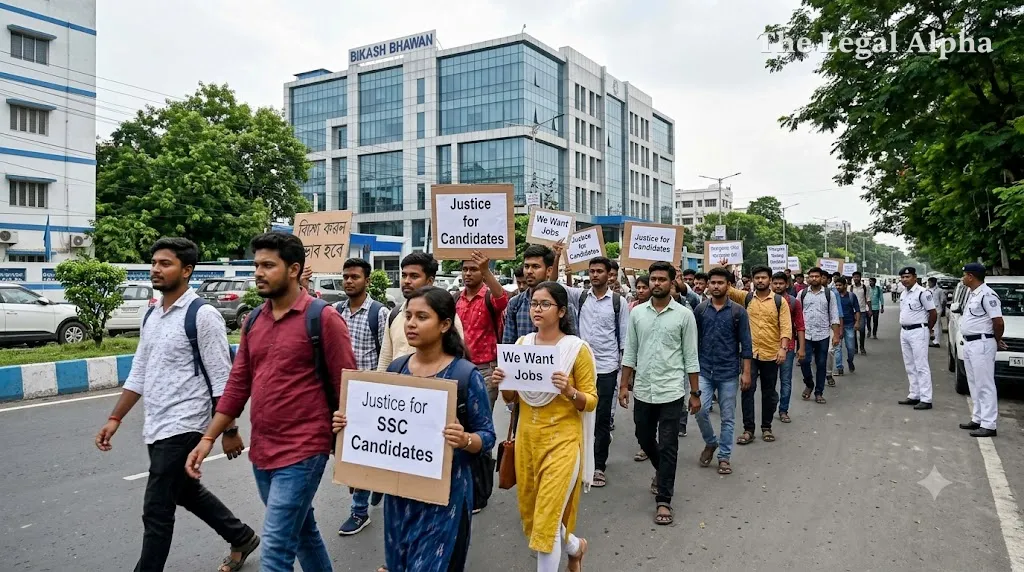
The Calcutta High Court quashed a criminal First Information Report (FIR) and subsequent proceedings against six School Service Commission (SSC) job aspirants who staged a demonstration in Salt Lake, Kolkata, back in August 2021.
The candidates had gathered near Mayukh Bhawan and marched toward Bikash Bhawan, raising slogans over alleged irregularities in teacher recruitment. Police at Bidhannagar North Police Station registered an FIR alleging illegal assembly, wrongful restraint, and violations of pandemic-era public health norms. Ruling on a petition filed by the job seekers, the High Court held that the allegations failed to satisfy the legal components of any cognisable offence and represented an improper attempt to penalise citizens merely for holding an uncomfortable demonstration.
Legal Topic
Area of Law: Criminal Law & Constitutional Law
Sub-topic: Quashing of FIR / Right to Peaceful Assembly / Unlawful Assembly
Core Legal Issue
The principal legal issue before the High Court was whether a non-violent gathering organised to express grievances against official policies constitutes an "unlawful assembly" or an actionable criminal offence under the Indian Penal Code and public safety statutes.
Specifically, the court examined whether invocation of criminal machinery is legally sustainable when an FIR alleges assembly, slogan-shouting, and pandemic guideline breaches without demonstrating an unlawful common object, physical obstruction, or actionable danger.
What Did the Court Decide?
Justice Anuj Singh allowed the writ petition filed by Trina Halder and five other candidates, entirely quashing the FIR and the pending criminal case.
The bench ruled that the allegations disclosed no prima facie offence. The court noted that merely voicing demands and marching does not fit the legal definition of an unlawful assembly, nor does a general protest amount to wrongful restraint in the absence of tangible obstruction. Addressing the pandemic-related charges, the court found zero evidence that the protesters were carrying contagious diseases or knowingly acting to spread an infection. Describing the proceedings as frivolous and vexatious, the court concluded that the prosecution was pursued simply to penalise the candidates for exercising dissent.
Key Legal Points
-
Right to Peaceful Dissent: Democratic protest and sloganeering do not become criminal simply because they are unwelcome, inconvenient, or displeasing to authorities.
-
Threshold for Unlawful Assembly: Gathering to register a demand lacks an unlawful common object under Section 141 of the Indian Penal Code; consequently, Section 143 cannot be automatically invoked against peaceful demonstrators.
-
Substantiation of Public Health Offences: Penal provisions concerning negligent acts likely to spread infection require concrete grounds or evidence of risk, rather than generic recitals in an FIR.
-
Prevention of Process Abuse: Where the contents of an FIR fail to disclose the foundational elements of the offences cited, continuation of the case constitutes harassment, warranting interference under high court review.
Relevant Law
-
Indian Penal Code, 1860 (IPC):
-
Section 141 & Section 143: Unlawful assembly and punishment for being a member of an unlawful assembly.
-
Section 341: Punishment for wrongful restraint.
-
Section 269 / 270: Negligent and malignant acts likely to spread infection of disease dangerous to life.
-
-
Constitution of India:
-
Article 19(1)(a) & Article 19(1)(b): Fundamental freedoms of speech and expression, and peaceful assembly without arms.
-
Arguments of the Parties
Petitioner / Applicants The candidates argued that they were job aspirants conducting a peaceful demonstration against administrative irregularities in recruitment. They submitted that exercising their constitutional right to assemble and raise slogans did not breach the law, and that the police registered a frivolous case to suppress legitimate democratic grievance redressal.
Respondent / State Counsel representing the State opposed the petition, maintaining that the petition was not maintainable and ought to be dismissed. The State contended that the demonstrators gathered without proper permissions, obstructed administrative movement during pandemic restrictions, and warranted prosecution under the relevant provisions of the IPC and public order regulations.
Why Does It Matter?
This ruling reinforces the constitutional distinction between public disturbance and democratic assembly. Law enforcement authorities frequently resort to routine penal sections—such as unlawful assembly and public health non-compliance—to break up protests and drag participants through protracted court proceedings.
By scrutinising the factual ingredients of the FIR rather than accepting broad administrative assertions, the High Court established that holding an assembly and shouting slogans cannot be equated with an unlawful design. The decision provides important protection for civic activists, students, and job seekers by establishing that administrative discomfort is not a ground for criminalisation.
Legal Takeaway
A peaceful demonstration does not mutate into an unlawful assembly simply because government authorities find it inconvenient or objectionable. Unless an FIR demonstrates a clear unlawful object or identifiable criminal conduct, courts will intervene to quash vexatious prosecutions targeting public dissent.
Sources
Primary Source:
-
Judgment of the High Court at Calcutta, Trina Halder & Ors. v. State of West Bengal & Ors. (Bench of Justice Anuj Singh).
Additional Sources:
-
High Court reporting and analysis via The Indian Express and LiveLaw.