Police Crackdown on Protesting Lawyers Reaches Supreme Court in Plea Demanding Accountability and Crowd-Control Norms
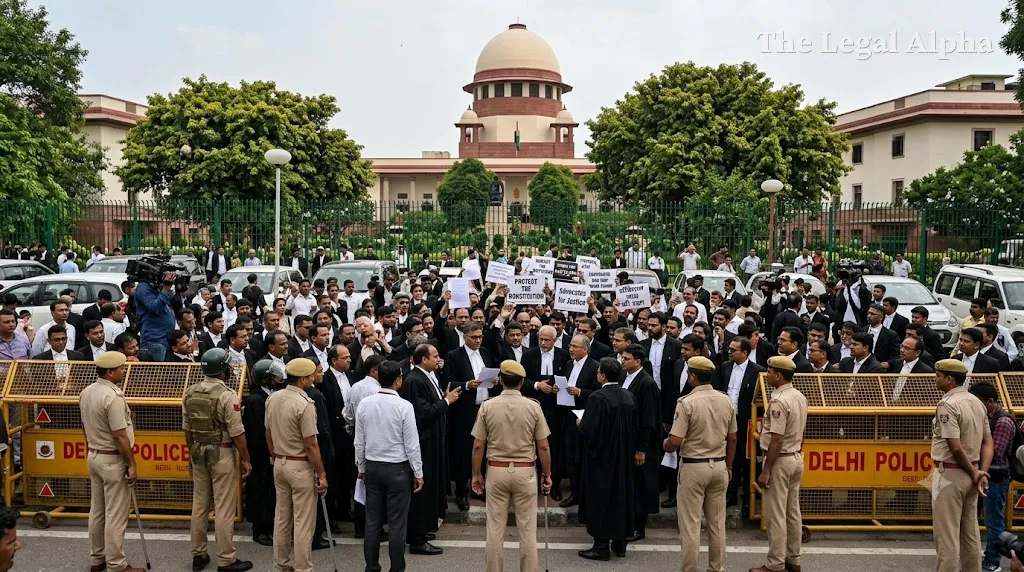
A group of legal professionals organised under the Lawyers’ Association for Constitution (LAFC) has approached the Supreme Court under Article 32 of the Constitution following the alleged heavy-handed policing of peaceful demonstrations in New Delhi. Represented by Senior Advocate Anjana Prakash alongside several practicing advocates, the petitioners alleged that law enforcement personnel used unlawful force, subjected advocates and women demonstrators to assault and verbal abuse, and carried out arbitrary detentions near the apex court precincts.
The incident unfolded during demonstrations on October 10 and 11, where lawyers and civil society members gathered peacefully. The plea brings executive policing methods under judicial scrutiny, asserting that basic arrest safeguards, access to legal counsel, medical assistance, and statutory communication norms were disregarded by personnel on the ground.
Legal Topic
-
Area of Law: Constitutional Law & Criminal Procedure
-
Sub-topic: Fundamental Freedoms / Police Accountability & Assembly Regulation
Core Legal Issue
The petition raises fundamental questions concerning the limits of state coercive power against citizens exercising expressive freedoms: whether executive and police authorities can deploy blanket detentions, force, and communications blackouts against peaceful public assemblies without adhering to mandatory statutory and constitutional arrest protocols.
At its core, the proceeding asks the Court to examine how fundamental protections under Articles 19 and 21 survive during public order enforcement, specifically whether law enforcement agencies must remain bound by strict crowd-policing standards and transparent identification measures during civil protests.
What Did the Court / Authority Decide?
The matter has been formally instituted before the Supreme Court as a writ petition under Article 32.
No final adjudication or interim order on the merits has been delivered yet; the matter remains pending preliminary hearing and listing before a bench. The petitioners have requested several interim and final reliefs, including a court-monitored independent inquiry into the conduct of the police, preservation of CCTV footage from protest locations and police stations, compensation for rights violations, and the formulation of binding guidelines governing assembly policing.
Key Legal Points
-
Enforceability of Arrest Safeguards in Assemblies: Detentions conducted during protests must comply strictly with procedural mandates, including informing grounds of arrest and providing immediate access to legal counsel.
-
Proportionality in Crowd Control: The state's maintenance of public order cannot breach constitutional limits or resort to disproportionate physical restraint against peaceful demonstrators.
-
Transparency of Law Enforcement Personnel: The failure of police officers to display identification tags during crowd dispersal violates established detention guidelines.
-
Legality of Communication Blackouts: The routine resort to local internet shutdowns to manage assemblies faces constitutional scrutiny regarding proportionality and procedural compliance.
Relevant Law
-
Constitution of India:
-
Article 14 (Equality before the law)
-
Article 19(1)(a) & 19(1)(b) (Freedoms of speech, expression, and peaceful assembly)
-
Article 21 (Protection of life and personal liberty)
-
Article 22 (Protection against arbitrary arrest and detention)
-
Article 32 (Right to constitutional remedies)
-
-
Judicial Precedents:
-
D.K. Basu v. State of West Bengal (mandating strict arrest, identification, and memo protocols)
-
Anuradha Bhasin v. Union of India (governing conditions and proportionality tests for telecom/internet suspensions)
-
Arguments of the Parties
Petitioners (Lawyers’ Association for Constitution & Advocates): The petitioners contended that members of the bar and peaceful citizens were subjected to unprovoked police brutality, physical assaults, and unlawful detention merely for participating in democratic assembly. They submitted that arresting personnel failed to wear name badges, refused detainees access to legal representatives and emergency medical aid, and neglected mandatory arrest memos under the D.K. Basu guidelines. The association further argued that arbitrary mobile internet blackouts were deployed unlawfully to suppress information and speech. Consequently, they urged the Court to establish binding national policing norms and protect lawyers and journalists from executive retaliation.
Respondents (Delhi Police / State): While formal counter-affidavits are awaited upon judicial listing, law enforcement agencies maintain that measures taken during the events were strictly preventive and necessary to maintain public peace, manage traffic flow, and secure high-security central administrative zones where gatherings were neither sanctioned nor permissible.
Why Does It Matter?
This petition brings the friction between state crowd-policing practices and the exercise of democratic freedoms back to the apex judicial forum. When legal practitioners themselves are subjected to custodial excesses and denied procedural guarantees, it underscores broader risks faced by regular citizens who lack institutional standing or legal literacy.
Should the Supreme Court admit the plea and formulate binding assembly directives, it could delineate enforceable rules of engagement for police forces dealing with peaceful civil dissent, curtail hasty internet shutdowns, and ensure institutional accountability when fundamental guarantees are trampled under the guise of public order.
Legal Takeaway
The petition affirms that participation in public assembly does not strip individuals of constitutional safeguards against arbitrary state action. Whether dealing with lawyers or ordinary citizens, law enforcement agencies remain strictly bound by procedural arrest protocols, proportionality, and the rule of law.
Sources
-
Primary Source: Writ Petition filed under Article 32 before the Supreme Court of India by the Lawyers’ Association for Constitution (LAFC & Ors. v. Union of India & Ors.).
-
Additional Sources: Supreme Court Bar Association (SCBA) Executive Resolution (October 2026); D.K. Basu v. State of West Bengal (1997) 1 SCC 416.