Supreme Court Examines Mandate on Six-Stanza Vande Mataram, Seeks Central Government Response
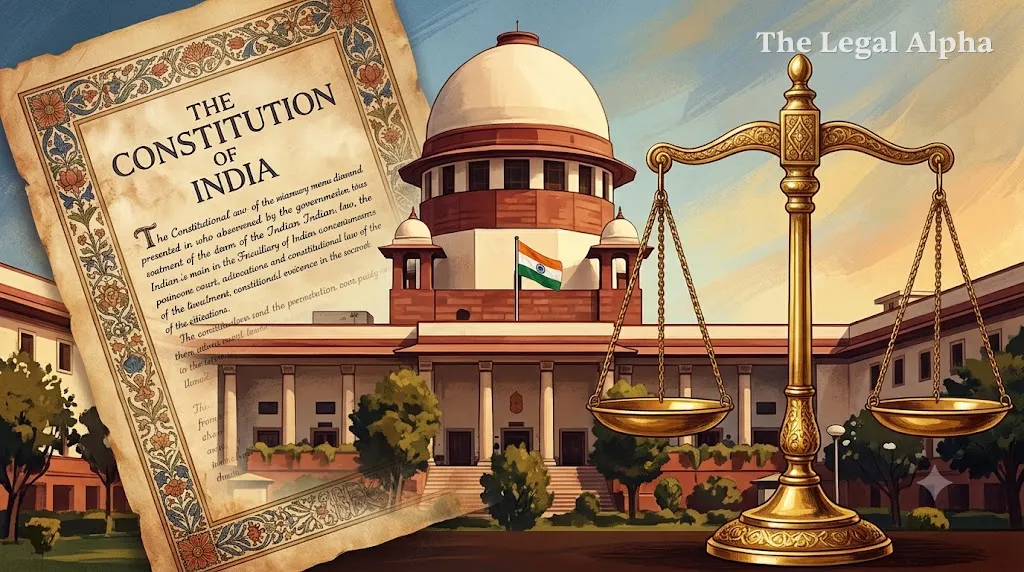
The Supreme Court of India has agreed to hear fresh constitutional challenges to two executive orders issued by the Union Ministry of Home Affairs requiring all six stanzas of Vande Mataram to be played and sung during specified official and ceremonial events.
A three-judge bench headed by Chief Justice Surya Kant, sitting alongside Justices Joymalya Bagchi and V. Mohana, issued notice to the Union government on petitions filed by Buddhist and civil rights activist Bhimrao Duryodhan Borkar and retired administrative officer Balakrishnan Sathyabhama Mavoji. The court tagged the matters with a related pending petition filed by musician T.M. Krishna and scheduled the consolidated proceedings for hearing on November 30, 2026.
Legal Topic
Area of Law: Constitutional Law
Sub-topic: Fundamental Rights / Freedom of Conscience / Secularism and State Ceremonial Mandates
Core Legal Issue
The controversy centres on whether the executive branch can mandate citizens or attendees at state functions to recite the complete, six-stanza version of Vande Mataram, or whether compulsory recitation of stanzas containing sectarian religious imagery breaches the constitutional guarantees of secularism, freedom of conscience, and freedom of speech.
The court must determine whether enforcing verses beyond the historically adopted two-stanza version amounts to state-sanctioned religious expression in violation of the basic structure of the Constitution and the rights of conscientious objectors.
What Did the Court Decide?
The Supreme Court did not stay the administrative orders or deliver a final ruling on the merits.
Instead, the bench issued formal notice directing the Central Government to file its counter-affidavit responding to the constitutional challenges. The petitions have been clubbed together and listed for comprehensive hearing on November 30, 2026. The bench had previously observed in companion proceedings that constitutional protections for conscientious objectors—as laid down in established precedent—must remain a guiding consideration when applying ceremonial mandates.
Key Legal Points
-
Examination of Executive Competence: The court is scrutinising whether the Ministry of Home Affairs possesses the statutory or constitutional authority to expand ceremonial recitations beyond established historical conventions without specific legislative sanction.
-
Historical versus Full-Text Adoption: The petitions question the deviation from the Constituent Assembly's historic acceptance of the initial two stanzas of the national song, arguing that the later stanzas alter its secular and inclusive civic standing.
-
Protection of Conscientious Objection: The bench reiterated the relevance of jurisprudence safeguarding individuals who decline to sing anthems or state verses on bona fide grounds of religious faith or conscience, provided no disrespect is shown.
-
Secular Character of the Republic: The legal challenges invoke the secular framework of the Indian Constitution, arguing that the state cannot endorse or require recitation of overtly theological invocations at official functions.
Relevant Law
-
Article 25 of the Constitution of India: Freedom of conscience and free profession, practice, and propagation of religion.
-
Article 19(1)(a) of the Constitution of India: Freedom of speech and expression, which encompasses the negative right not to speak or sing under state compulsion.
-
Article 28 of the Constitution of India: Freedom regarding attendance at religious instruction or religious worship in educational institutions or state-funded events.
-
Bijoe Emmanuel & Ors v. State of Kerala (1986): Landmark Supreme Court ruling establishing that forcing individuals to sing the National Anthem against genuine religious or conscientious convictions violates fundamental freedoms, provided they stand respectfully and do not disrupt proceedings.
-
Prevention of Insults to National Honour Act, 1971: Statutory framework governing disrespect toward national symbols, emblems, and anthems.
Arguments of the Parties
The Petitioners
The petitioners contended that the Home Ministry’s orders unlawfully replace the widely accepted two-stanza national song with the full text from Bankim Chandra Chattopadhyay’s novel Anandamath. They argued that the final four stanzas depict specific sectarian deities and religious imagery, thereby transforming an inclusive patriotic song into an exclusive theological invocation.
They further submitted that compelling individuals—particularly minorities, Buddhists, and non-theistic citizens—to sing these verses violates Articles 14, 19(1)(a), 25, and 28 of the Constitution, undermining the secular character of the Indian Republic.
The Union of India
While the Centre’s formal counter-affidavit has been sought by the court, the underlying administrative policy treats Vande Mataram as holding an equal status with the National Anthem in terms of national honour and historic significance. The executive directions aim to formalise protocols for ceremonial occasions, asserting that paying respect to national symbols and heritage reflects fundamental civic duties.
Why Does It Matter?
This litigation brings back to the forefront the delicate balance between state-mandated expressions of national pride and fundamental civil liberties.
If the Supreme Court limits the mandate, it will reinforce the long-settled doctrine that patriotism cannot be coerced at the expense of individual conscience and secular norms. Conversely, any ruling upholding executive power over ceremonial protocols will define how far the state can go in prescribing compulsory civic rituals across government departments, state functions, and publicly funded institutions.
Legal Takeaway
The Supreme Court's intervention signals renewed scrutiny over compulsory civic and ceremonial mandates. At its core, the issue reaffirms that government orders prescribing patriotic rituals must respect constitutional secularism and the fundamental right to freedom of conscience.
Sources
Primary Source:
-
Supreme Court of India, Bhimrao Duryodhan Borkar v. Union of India & Anr. (Diary No. 61620/2026) and Balakrishnan Sathyabhama Mavoji v. Union of India & Anr. (Diary No. 62724/2026), Order dated October 27, 2026.
-
Union Ministry of Home Affairs, Administrative Orders dated January 28, 2026, and July 9, 2026.
Additional Sources:
-
Bijoe Emmanuel & Ors v. State of Kerala, (1986) 3 SCC 615.
-
Proceedings in T.M. Krishna v. Union of India, Supreme Court of India.