Supreme Court Encroachment Rebuke Triggers Top Legal Department Shake-Up at BMC
The Brihanmumbai Municipal Corporation (BMC) has sent its Chief Law Officer, Komal Punjabi, on compulsory leave and handed interim charge of its legal division to Joint Law Officer Sukhshri Modle. The administrative restructuring follows severe censure from the Supreme Court over chronic non-compliance with judicial eviction orders.
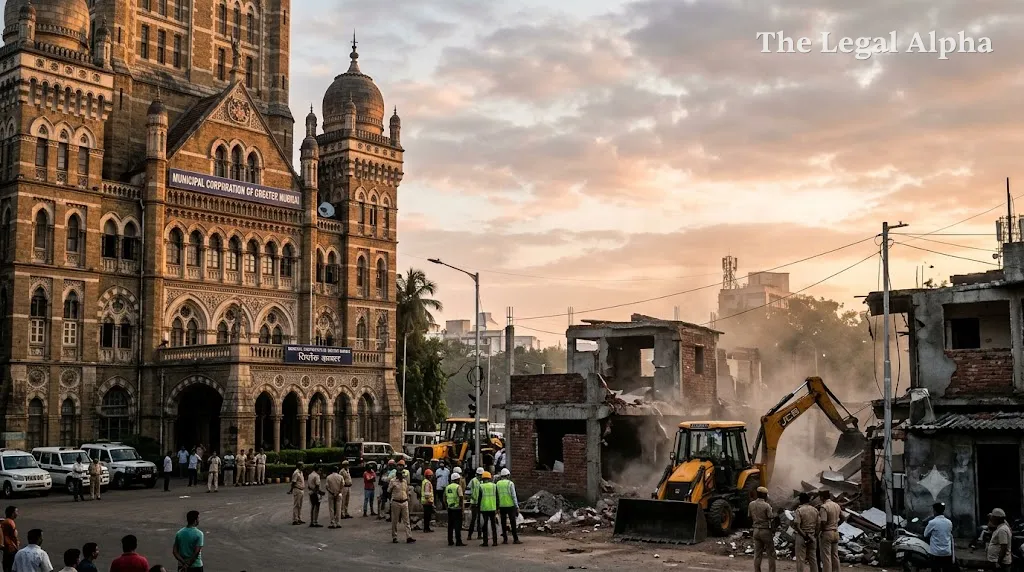
The apex court had previously initiated contempt proceedings and ordered the withholding of the civic commissioner's salary after municipal authorities stalled the clearance of illegal commercial encroachments from a 3,400-square-metre plot in Borivali East reserved for a Brihanmumbai Electric Supply and Transport (BEST) bus depot. Facing imminent judicial penalties, the municipal body executed an emergency pre-dawn demolition drive to clear the site and subsequently moved to hold its internal legal machinery accountable for systemic communication and litigation lapses.
Legal Topic
-
Area of Law: Administrative Law / Municipal Law
-
Sub-topic: Contempt of Court / Civil Enforcement and Public Land Governance
Core Legal Issue
The underlying legal issue concerns the constitutional duty of municipal bodies to obey binding apex court mandates under Article 142 and Article 144, rather than using lower court civil suits or procedural inaction as an excuse to avoid evicting encroachers from designated public utility lands.
It also highlights the administrative liability of in-house government law officers when internal legal handling shields chronic departmental non-compliance and exposes the executive leadership to civil contempt sanctions.
What Did the Court / Authority Decide?
The Supreme Court took severe exception to the BMC's failure to clear the reserved public plot despite explicit deadlines, imposing a fine of ₹5 lakh on the civic corporation and serving a contempt notice that temporarily halted the salary disbursement of the Municipal Commissioner. The bench sharply noted that civic officers appeared eager to entertain lower civil court delays while flouting apex court decrees.
Following the immediate razing of the commercial structures on the BEST land, the Supreme Court stayed the salary freeze and deferred punitive contempt measures, directing the Municipal Commissioner to submit a detailed personal compliance affidavit. In direct response to the court's reprimand, the BMC General Administration Department issued an order transferring the headship of the law department until further notice.
Key Legal Points
-
Subordinate civil court filings or status quo arguments cannot override or suspend final executable directions issued by the Supreme Court.
-
The doctrine of civil contempt under Article 129 of the Constitution enables constitutional courts to attach executive salaries and summon top administrative leadership to enforce public trust obligations.
-
In-house legal departments bear institutional liability when poor representation or failure to apprise executive heads leads to willful disobedience of judicial commands.
-
Demolition of encroaching commercial establishments on reserved master-plan infrastructure takes precedence over unverified historical possession claims pending formal eligibility review.
Relevant Law
-
Constitution of India: Article 129 (Power of the Supreme Court to punish for contempt); Article 141 and 144 (Binding nature of Supreme Court orders and civil authorities acting in aid of the Supreme Court).
-
Contempt of Courts Act, 1971: Section 2(b) (Willful disobedience of court orders) and Section 12 (Punishment for contempt of court).
-
Mumbai Municipal Corporation Act, 1888: Statutory obligations concerning public infrastructure reservations and clearance of street and public amenity encroachments.
Arguments of the Parties
-
The Supreme Court Bench / Petitioners: Maintained that public utility reservations (such as municipal transport depots) cannot be permanently paralyzed by unauthorized commercial occupation. The court noted that civic bodies cannot hide behind lower civil litigation to avoid executing long-standing eviction directives.
-
Brihanmumbai Municipal Corporation: Submitted that the delay stemmed from complicated lower-court claims and protracted status assessments. The administration contended that once the legal position was clarified, immediate enforcement action was mobilized, deploying municipal squads to restore vacant possession of the reserved site.
Why Does It Matter?
This development marks a significant shift in bureaucratic accountability for municipal governance across major metropolitan areas. For decades, municipal corporations have routinely allowed commercial encroachments to persist by pointing to pending city civil court suits or vague internal legal consultations.
By holding the civic chief personally liable through salary attachment and forcing the administrative removal of the legal head, the judiciary has sent a clear message: in-house municipal lawyers cannot act as buffers for bureaucratic inertia. Civic administrations across the country are now under immediate compliance pressure to audit internal legal advice, enforce public land clearances, and prioritize apex court mandates over protracted lower-court maneuvering.
Legal Takeaway
Statutory bodies cannot treat judicial demolition orders as discretionary or subordinate to lower civil court delays. Failure to execute clear judicial mandates leaves administrative heads personally exposed to coercive contempt proceedings and directly imperils the positions of civic legal officers responsible for non-compliance.
Sources
-
Primary Source: Supreme Court of India Contempt Proceedings & Compliance Directives concerning Borivali BEST Depot Plot Encroachments (November 2026); Municipal Corporation of Greater Mumbai (MCGM / BMC) General Administration Department Office Order (November 6, 2026).
-
Additional Sources: Municipal Law Department Records, The Times of India, ETV Bharat Legal Desk, Free Press Journal.