Supreme Court Declares Marital Discord Cannot Serve as Standalone Ground to Terminate Pregnancy
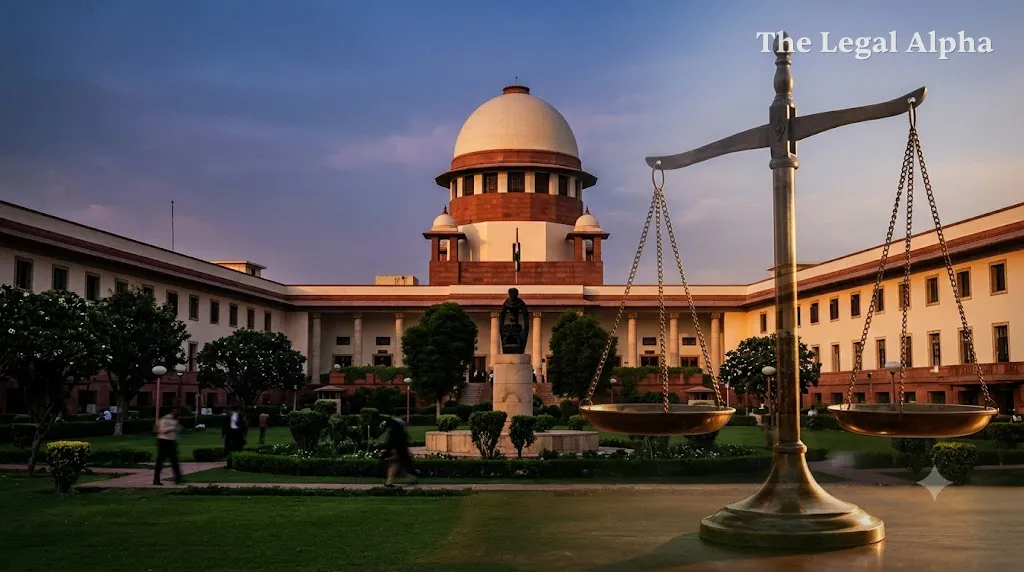
The Supreme Court of India declined to allow a married woman to terminate her first pregnancy on the sole ground of a bitter domestic quarrel with her husband.
A Bench comprising Justice B.V. Nagarathna and Justice R. Mahadevan observed that differences between spouses had escalated unnecessarily, pushing the woman to seek medical termination of pregnancy without any underlying clinical necessity. While refusing to permit the termination on the basis of a dispute between spouses whose legal marital status remains intact, the Bench directed the husband to tender an unconditional apology and submit an affidavit formally retracting all allegations made against his wife. The matter was posted for compliance.
Legal Topic
Area of Law: Family and Reproductive Rights Law
Sub-topic: Medical Termination of Pregnancy / Spousal Disputes
Core Legal Issue
The fundamental legal question before the Bench was whether interpersonal matrimonial discord and verbal disputes between spouses, in the absence of medical complications, foetal abnormalities, or formal dissolution of the marital tie, constitute a valid ground under the law to authorise the termination of a pregnancy.
The Court was required to weigh the bounds of statutory grounds under the Medical Termination of Pregnancy framework against personal domestic conflicts that have not severed legal marital relations.
What Did the Court Decide?
The Supreme Court took a clear stand against permitting termination solely arising out of matrimonial friction:
-
The Court firmly declined to allow the medical termination of the pregnancy based merely on a bitter exchange of words or interpersonal marital conflict.
-
It directed the husband to file an affidavit explicitly withdrawing all allegations levelled against his wife across all forums—whether made orally, in writing, or via digital communications.
-
The Bench observed that the husband must express genuine regret and apologise to repair the fallout of his conduct.
-
The matter was scheduled for follow-up proceedings to review the filing of the husband's affidavit.
Key Legal Points
-
Marital Status Remains Operative: The Court underscored that ordinary domestic friction between continuing spouses cannot be equated with circumstances warranting termination, specifically observing that the legal status of the marriage had undergone no change.
-
Distinction from Severe Offences: The Bench explicitly distinguished interpersonal marital disputes from cases involving sexual assault, rape, or non-consensual cohabitation where reproductive autonomy operates under distinct statutory exceptions.
-
Absence of Clinical Grounds: The Bench noted that the pregnancy carried no verified foetal abnormality or direct medical danger to the woman's life, meaning statutory medical thresholds were not met.
-
Judicial Discretion Against Escalation: The Court exercised its authority to de-escalate private disputes by directing corrective conduct—such as retractions and apologies—rather than permitting irreversible medical steps stemming from situational anger.
Relevant Law
-
Medical Termination of Pregnancy (MTP) Act, 1971 (as amended in 2021): Governs statutory limits, prescribed medical board criteria, and specific conditions under which pregnancies may be legally terminated.
-
MTP Rules, 2003 (Rule 3B): Defines special categories of women eligible for termination between 20 and 24 weeks (e.g., survivors of sexual assault, minors, or women undergoing change of marital status during ongoing pregnancy through widowhood or divorce).
-
Article 21 of the Constitution of India: Pertains to bodily autonomy, personal liberty, and reproductive choices within the boundaries of statutory parameters.
Arguments of the Parties
Petitioner (Wife)
Counsel for the woman submitted that relations had deteriorated to the point where continuing the pregnancy would cause immense mental trauma and potentially harm the unborn child. It was further contended that during personal discussions, the husband had threatened to end the marriage if she pursued the termination, alongside subjecting her character to question. Consequently, she remained steadfast in her plea to terminate the pregnancy.
Respondent (Husband)
Counsel for the husband denied broadcasting disparaging messages or defamatory statements regarding her character. It was submitted on his behalf that he retained materials which he had consciously refrained from placing on record because his primary intention was to preserve the matrimonial union rather than dismantle it.
Why Does It Matter?
This development clarifies the judicial application of India's abortion laws when invoked amidst private matrimonial quarrels. While Indian jurisprudence has progressively broadened reproductive autonomy under the amended MTP Act, the Supreme Court has demonstrated that statutory termination remedies cannot be repurposed as leverage or an immediate reaction to marital strife where the legal relationship persists and medical grounds are absent.
For family law practitioners and lower courts, this approach underscores that courts will scrutinise whether a termination petition stems from genuine statutory exceptions or an unravelling domestic dispute that warrants reconciliation and dispute resolution rather than irreversible medical intervention.
Legal Takeaway
A bitter interpersonal dispute between legally married spouses does not qualify as a valid ground to seek an abortion under the Medical Termination of Pregnancy framework. In the absence of statutory exceptions or clinical emergencies, courts will refuse to treat temporary matrimonial friction as a legal basis for terminating a pregnancy.
Sources
Primary Source:
Supreme Court of India, Proceedings before the Bench of Justice B.V. Nagarathna and Justice R. Mahadevan (Order/Hearings of November 2026).
Additional Sources:
-
The Medical Termination of Pregnancy Act, 1971 (and Amendment Act, 2021).
-
The Medical Termination of Pregnancy Rules, 2003 (Rule 3B).
-
Judicial proceedings reported via Hindustan Times (Utkarsh Anand, November 2026).